

BMW has always been more than just a car brand. For many, it represents the perfect blend of luxury, engineering, and driving pleasure. Founded in 1916, BMW started as an aircraft engine manufacturer before evolving into one of the most iconic automobile makers in the world. Today, the brand is recognized globally for its premium cars, motorcycles, and innovations in mobility.
In this article, we’ll dive deep into the SWOT Analysis of BMW — exploring its strengths, weaknesses, opportunities, and threats. This analysis will help you understand why BMW continues to lead in the luxury automotive industry and where it faces challenges in 2025.
Overview of BMW
- Company type: Public
- Industry: Automotive
- Founded: 7 March 1916 (108 years ago)
- Founder: Karl Rapp
- Headquarters: Munich, Germany
- Area served: Worldwide
- Key people: Oliver Zipse (Chairman of the Board of Management), Norbert Reithofer (Chairman of Supervisory Board)
- Products: Cars, motorcycles
- Total deliveries (2023): 2,253,835 units
- Website: bmw.com
BMW’s long history, backed by German precision engineering and premium branding, makes it a leader in the luxury automobile segment. But like every company, it faces both opportunities and challenges. Let’s break them down in this BMW SWOT Analysis 2025.
BMW SWOT Analysis
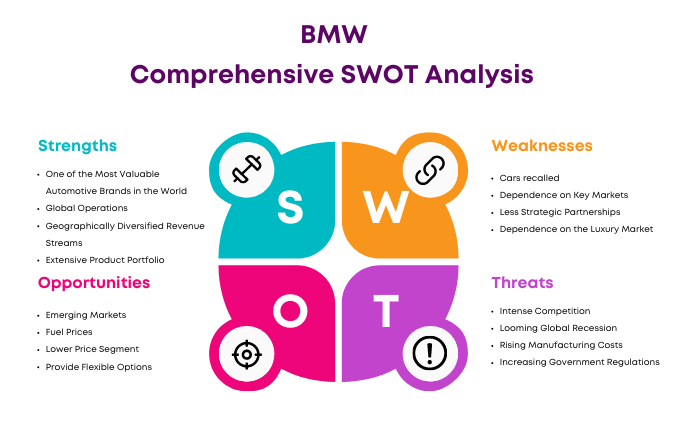
Strengths of BMW
- One of the Most Valuable Automotive Brands in the World
BMW consistently ranks among the most valuable automotive brands worldwide. In 2023, Interbrand estimated its brand value at $51.16 billion. This recognition highlights its unmatched reputation for luxury and performance. Unlike other carmakers, BMW has built an identity that blends engineering excellence with an aspirational lifestyle. Owning a BMW isn’t just about transportation — it’s about status, prestige, and a promise of driving pleasure. - Global Operations
BMW has expanded beyond Germany into nearly every corner of the world. With over 30 manufacturing and assembly plants in 140 countries, the company ensures that its products are available to diverse customer bases. This global footprint also helps BMW reduce dependence on a single region and strengthens its resilience during regional disruptions. - Geographically Diversified Revenue Streams
Unlike competitors who depend heavily on one or two markets, BMW enjoys strong geographic diversification. While China is its largest market, it contributes only 17.2% of total revenue. Other key markets such as the US and Europe provide balance, which helps BMW manage risks from regional slowdowns. - Extensive Product Portfolio
BMW’s product lineup is one of its biggest strengths. From luxury sedans (3 Series, 5 Series, 7 Series) and SUVs (X1 to X7) to high-performance sports cars (M Series) and electric models (iX, i4), BMW appeals to a wide range of customers. This variety ensures that the brand remains relevant to different market segments. - Successful Partnership in China
Through its joint venture, BMW Brilliance Automotive Ltd., the company has solidified its presence in the world’s largest automobile market. China is a growth engine for luxury carmakers, and this partnership allows BMW to tap into local expertise, distribution, and consumer preferences. - Unparalleled Engineering and Driving Experience
BMW has long marketed itself with the tagline “The Ultimate Driving Machine.” Its cars deliver a combination of performance, luxury, and cutting-edge technology unmatched by most competitors. From precise handling to advanced infotainment systems, BMW vehicles provide an experience beyond commuting — they make driving enjoyable. - Well-Trained Workforce
With more than 150,000 employees worldwide, BMW benefits from a highly skilled workforce. Their dedication and craftsmanship help maintain the brand’s reputation for quality. Skilled employees also drive continuous innovation in design, safety, and technology. - Pioneering in Hybrid and Electric Vehicles
BMW was one of the early movers in electric mobility with the launch of the i3 in 2013 and the plug-in hybrid i8. In 2023, it sold 330,596 fully electric vehicles — a significant step toward its sustainability goals. The company continues to expand its EV portfolio, competing against Tesla, Mercedes, and Audi in the green mobility space. - Future-Ready Strategy
BMW’s “Strategy Number One” outlines its focus on:
- E-mobility (electric and hybrid vehicles),
- Autonomous driving, and
- Digital mobility services.
This forward-thinking approach ensures that BMW adapts to shifting trends in consumer behavior and technology. It positions the brand for long-term success.
Weaknesses of BMW
Even premium brands face challenges. The BMW weaknesses highlight areas where the company must improve.
- Car Recalls
In recent years, BMW has recalled thousands of vehicles due to safety issues like brake malfunctions. A recall of 79,670 cars not only costs money but also damages the company’s reputation for reliability. - Dependence on Key Markets
Although BMW has global operations, nearly 59% of its revenue comes from China, the US, and Germany. This dependency makes it vulnerable to regional downturns, trade wars, or regulatory changes. - Less Strategic Partnerships
Compared to rivals like Volkswagen or Toyota, BMW has fewer global partnerships. This reduces opportunities for technology-sharing, cost-sharing, and market expansion. - Dependence on the Luxury Market
BMW primarily targets high-income consumers. In times of recession or economic downturn, luxury spending drops, which directly affects BMW’s sales. - High Debt Levels
BMW’s debt exceeded €79.1 billion, mainly due to investments in EVs and autonomous driving research. High debt reduces financial flexibility and creates risks if global sales slow down. - Reducing Market Share
Sales of MINI and Rolls-Royce — both BMW-owned brands — have declined, leaving the company more dependent on its core BMW models. This over-reliance poses risks if consumer tastes shift. - Electric Car Transition Challenges
Although BMW has EV models, it lags behind Tesla in terms of innovation speed and market perception. If it fails to catch up, it risks losing relevance in the future mobility market. - High Production Costs
Premium engineering and luxury features mean BMW cars are expensive to produce. While this maintains its premium status, it puts pressure on profit margins compared to more cost-efficient competitors. - Negative Publicity
During the COVID-19 pandemic, BMW requested subsidies from the German government while simultaneously paying $1.7 billion in dividends. This drew criticism and hurt public perception. - Limited Portfolio of Brands
Unlike Volkswagen, which owns Audi, Porsche, Skoda, and more, BMW only manages BMW, MINI, and Rolls-Royce. This lack of brand diversification restricts its reach beyond the luxury segment.
Opportunities for BMW
- Emerging Markets
Countries like India, Brazil, and regions in Southeast Asia have growing middle classes with rising disposable incomes. By expanding its operations here, BMW can capture new demand for luxury cars. - Impact of Fuel Prices
As fuel prices rise, consumers look for smaller, fuel-efficient, or hybrid vehicles. BMW already has smaller models like the 1 Series and X1, positioning it well to benefit from this trend. - Entry into Lower Price Segment
BMW can attract middle-class buyers by offering more affordable models without diluting its premium image. A lower-cost luxury line can significantly increase market share. - Flexible Mobility Options
Millennials and Gen Z prefer access over ownership. BMW can leverage this by expanding into car-sharing and subscription-based models, using its existing fleet to provide new mobility services. - Autonomous Vehicles
The global autonomous car market is expected to be worth $300–$400 billion by 2035. If BMW invests more aggressively, it can become a key player alongside Tesla and Google. - Weakening Euro
A weaker euro makes BMW exports cheaper in markets like the US. This currency advantage can boost sales and profitability outside Europe. - Faster Model Launches
Releasing updated models more frequently can keep consumers excited and maintain competitiveness in the luxury auto segment.
Threats Facing BMW
- Intense Competition
Mercedes-Benz, Audi, Lexus, and Tesla continue to compete directly with BMW in luxury, technology, and electric mobility. Staying ahead requires constant innovation. - Global Recession Risk
Luxury cars are discretionary purchases. Economic downturns directly reduce BMW sales, as seen during past recessions. - Rising Manufacturing Costs
Material shortages and labor costs have already affected profitability. In 2024, BMW’s Q1 profits fell by 18.9% due to cost pressures. - Strict Government Regulations
New emission and fuel efficiency standards increase production costs. BMW must invest heavily to meet sustainability goals while keeping cars affordable. - Possibility of Tariffs
Trade tensions between the US and EU could result in tariffs on BMW exports, reducing competitiveness in one of its biggest markets. - Pandemic Aftereffects
COVID-19 disrupted supply chains, delayed production, and created long-term uncertainties in the auto industry. BMW, like other manufacturers, still faces lingering impacts. - Demographic Changes
Younger generations are less interested in owning luxury cars. Instead, they prefer shared mobility or eco-friendly alternatives. BMW must adapt its model to remain relevant.
Conclusion
The SWOT analysis of BMW shows a company with a strong legacy of luxury, engineering excellence, and global presence. Its strengths — brand reputation, global reach, and EV initiatives — position it well for the future. However, BMW weaknesses such as dependence on luxury markets, high debt, and limited brand diversification are real challenges.
By tapping into emerging markets, expanding EV offerings, and adapting to flexible mobility trends, BMW can strengthen its position. But it must also overcome threats like rising competition, global recessions, and regulatory pressures.
In 2025, BMW stands at a crossroads: with the right strategy, it can continue to be “The Ultimate Driving Machine” for generations to come.
FAQs
What is the main strength of BMW?
BMW’s biggest strength is its global brand reputation as a luxury carmaker combined with its engineering excellence and premium driving experience.
What are the weaknesses of BMW?
The key BMW weaknesses include high production costs, dependence on luxury markets, increasing debt, and limited brand diversification compared to rivals.
What opportunities does BMW have in 2025?
BMW can expand in emerging markets, grow its EV lineup, enter flexible mobility solutions like car-sharing, and benefit from favorable exchange rates.
What are the biggest threats to BMW?
Intense competition, economic downturns, rising manufacturing costs, government regulations, and changing consumer demographics are the top threats.
Why is SWOT Analysis of BMW important?
The BMW SWOT analysis helps understand the company’s internal strengths and weaknesses, along with external opportunities and threats. It provides insights into BMW’s current challenges and future growth potential.

A digital marketer with a strong focus on SEO, content creation, and AI tools. Creates helpful, easy-to-understand content that connects with readers and ranks well on search engines. Loves using smart tools to save time, improve content quality, and grow online reach.