

Chevrolet, one of the most recognized names in the global automobile industry, has a legacy that spans over a century. Founded in 1911 by Louis Chevrolet and William C. Durant, the company has grown into a symbol of affordability, innovation, and dependable performance. With a strong foothold in the American market and expanding operations globally, Chevrolet continues to maintain its reputation as a customer-focused brand.
This Chevrolet SWOT analysis explores the company’s strengths, weaknesses, opportunities, and threats in 2025. We will also look at the role of its parent organization, General Motors, and how global automotive trends affect Chevrolet’s position in the market.
Overview of Chevrolet
- Industry: Automotive
- Founded: November 3, 1911 (112 years ago)
- Founders: Arthur Chevrolet, Louis Chevrolet, William C. Durant
- Fate: Acquired by General Motors in 1918
- Headquarters: Detroit, Michigan, U.S.
- Key people: Alan Batey (SVP)
- Parent company: General Motors
- Website: chevrolet.com
As one of GM’s flagship brands, Chevrolet plays a central role in the company’s global strategy. To fully understand its standing, let’s dive deep into the SWOT analysis of Chevrolet.
Chevrolet SWOT Analysis
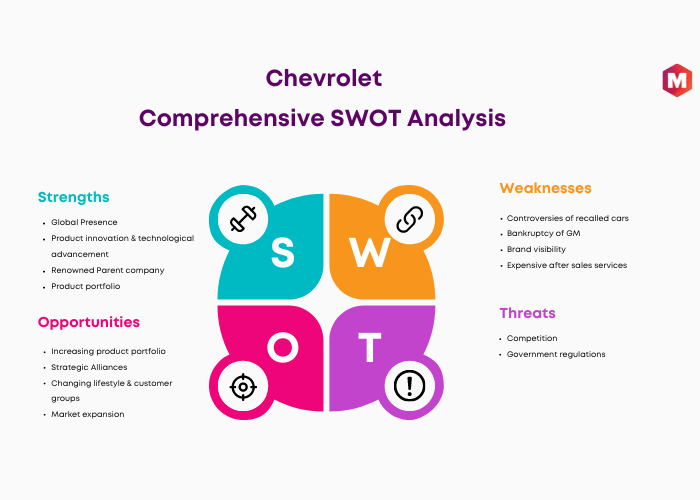
The Chevrolet SWOT analysis examines its internal strengths and weaknesses, as well as external opportunities and threats that influence the company’s future.
Strengths of Chevrolet
- Global Presence
Chevrolet operates in over 200 countries, making it one of the most widely distributed automobile brands in the world. Its strongest market remains the United States, but Chevrolet is aggressively expanding into emerging economies like China and India. Manufacturing across 37 countries under 13 brands gives Chevrolet resilience and adaptability in diverse markets. - Product Innovation & Technological Advancement
Chevrolet’s history of innovation is deeply tied to motorsports. Its participation in NASCAR, INDYCAR, and FIA Touring Championships demonstrates its engineering excellence and brand strength. This connection also supports a NASCAR SWOT analysis, where Chevrolet consistently emerges as one of the most dominant racing brands. Beyond sports cars, Chevrolet has invested heavily in hybrid and plug-in vehicles like the Malibu and Tahoe, aligning with the industry’s shift toward sustainability. - Strong Parent Organization – General Motors
Being under General Motors’ umbrella is a major strength. GM owns 13 brands, including GMC, Cadillac, and Buick, and is one of the world’s largest automakers. The General Motors SWOT analysis shows that GM’s global scale, resources, and R&D capabilities provide Chevrolet with financial backing and technological support. As a result, Chevrolet benefits from shared innovation, economies of scale, and global distribution networks. - Diverse Product Portfolio
Chevrolet caters to nearly every vehicle category: hatchbacks, sedans, SUVs, and commercial vehicles like buses and trucks. This wide product mix ensures the company remains competitive across multiple customer segments. Customers seeking affordable cars, family vehicles, or heavy-duty trucks can all find a Chevrolet option, making the brand versatile and accessible. - Large Workforce
Chevrolet draws strength from General Motors’ global workforce of 300,000+ employees across more than 100 countries. This pool of highly skilled professionals drives product development, production, and innovation. Skilled employees are critical to maintaining quality standards and meeting the demands of diverse markets. - US Market Leadership
Despite GM’s bankruptcy struggles in the late 2000s, Chevrolet remains one of the strongest brands in the U.S. With a loyal customer base and high recognition, the company continues to dominate key segments like trucks and SUVs. This strong domestic foundation supports global expansion.
Weaknesses of Chevrolet
- Recurring Car Recalls
One of the biggest Chevrolet weaknesses has been product recalls. A notable case was the faulty ignition switch controversy, linked to at least 13 deaths and costing $1.3 billion in losses. Recalls undermine consumer trust and raise doubts about the company’s quality control systems. - GM Bankruptcy Legacy
Chevrolet’s parent organization, General Motors, filed for bankruptcy during the 2008–09 financial crisis. Although GM has since recovered, the episode damaged the reputation of all its brands. The SWOT analysis of General Motors highlights this as one of its most significant challenges, and Chevrolet continues to face skepticism from some consumers. - Low Brand Visibility
Compared to competitors like Toyota, Ford, or Hyundai, Chevrolet struggles with advertising effectiveness. Its brand campaigns often lack global impact, reducing visibility in key international markets. Weak marketing reduces the ability to attract younger buyers and expand outside the U.S. - High After-Sales Costs
Chevrolet’s after-sales services and spare parts are often considered more expensive than competitors. In highly price-sensitive markets, this creates a barrier for consumers. For a brand positioned as affordable and reliable, expensive servicing is a strategic weakness.
Opportunities for Chevrolet
- Expanding Product Portfolio
By introducing more models in electric and hybrid categories, Chevrolet can appeal to eco-conscious customers and strengthen its global presence. Expanding into new niches, like compact EVs, will diversify its product offering. - Strategic Alliances
Currently, Chevrolet has limited partnerships with other companies. Strategic collaborations with tech firms, battery manufacturers, or even other automakers can enhance innovation, reduce costs, and improve market competitiveness. - Changing Lifestyles & Consumer Groups
With nuclear families growing in developing countries, demand for affordable, safe, and fuel-efficient vehicles is rising. Chevrolet’s mid-segment cars can capitalize on this demographic shift. - Emerging Market Expansion
Penetrating markets like India, Southeast Asia, and Latin America offers significant growth potential. These regions are witnessing rising middle-class incomes and demand for affordable cars — areas where Chevrolet has traditionally performed well. - Commercial Vehicle Growth
The global commercial vehicle market is projected to expand steadily due to infrastructure growth and public transport demand. Chevrolet’s trucks and buses position it well to capture this segment, even if passenger vehicle sales slow down.
Threats to Chevrolet
- Intense Industry Competition
The automotive sector is one of the most competitive industries in the world. Chevrolet faces competition from giants like Toyota, Ford, Volkswagen, Hyundai, and even sibling brands under GM. High competition pressures pricing, margins, and innovation cycles. - Government Regulations
Tighter environmental laws and transportation policies around the world pose challenges. From emission restrictions to fuel economy standards, governments are pushing automakers to invest heavily in compliance. Policies that discourage private car ownership (to reduce congestion or emissions) could further impact Chevrolet sales. - Shifts in Consumer Preferences
Ride-sharing, car subscription models, and increased use of public transportation threaten traditional car ownership models. If Chevrolet does not adapt quickly, it risks losing relevance among younger generations. - Economic Volatility
The global economy remains uncertain. Economic downturns, inflation, and fluctuating fuel prices directly affect car demand. Since Chevrolet caters to a broad middle-class audience, its sales are highly sensitive to these external shocks.
Conclusion
The SWOT analysis of Chevrolet demonstrates that the brand continues to be a strong player in the global automotive market. Its strengths lie in global presence, innovation, a diverse product portfolio, and backing from its powerful parent organization, General Motors. However, Chevrolet weaknesses like recurring recalls, costly after-sales services, and weak visibility remain challenges.
Opportunities exist in emerging markets, EV development, and commercial vehicle expansion. Yet threats such as intense competition, strict regulations, and changing consumer habits create constant pressure.
When placed within the broader General Motors SWOT analysis, Chevrolet remains one of GM’s most important brands, supporting global reach and affordability. By addressing weaknesses and adapting to new market trends, Chevrolet can continue to build on its century-long legacy.
FAQs
What is Chevrolet best known for?
Chevrolet is best known for its wide range of affordable cars, trucks, and SUVs, along with its strong motorsports heritage, particularly in NASCAR.
Who is the Chevrolet parent organization?
Chevrolet’s parent organization is General Motors (GM), one of the largest automakers in the world.
What are the main Chevrolet weaknesses?
The main Chevrolet weaknesses include recurring recalls, expensive after-sales service, weak brand visibility, and the legacy impact of GM’s bankruptcy.
How does NASCAR relate to Chevrolet’s strengths?
Chevrolet’s dominance in NASCAR highlights its engineering excellence, racing pedigree, and brand strength in performance cars. This supports the brand’s credibility and connects to a broader NASCAR SWOT analysis.
How is Chevrolet linked to the SWOT analysis of General Motors?
Since Chevrolet is part of GM, the SWOT analysis of General Motors directly influences Chevrolet’s strategy. GM’s resources, R&D, and global network support Chevrolet’s growth and innovation.
What opportunities can Chevrolet leverage in 2025?
Chevrolet can grow by expanding its EV portfolio, entering new emerging markets, forming alliances with tech companies, and strengthening its commercial vehicle segment.

A digital marketer with a strong focus on SEO, content creation, and AI tools. Creates helpful, easy-to-understand content that connects with readers and ranks well on search engines. Loves using smart tools to save time, improve content quality, and grow online reach.