


Summary
- Why this matters: The SWOT analysis of Axis Bank shows a strong digital-first bank with steady profits, a wide network, and a trusted brand—competing in a crowded, highly regulated market.
- What’s working: Hybrid cloud leadership, strong FY24 performance, diversified products, and a deep physical + virtual footprint.
- What to fix: Margin pressure, per-unit revenue decline, HR depth, and liquidity/operational risks.
- Where to bet next: Premium customer segments, embedded insurance via Max Life, partnerships to lower launch costs, and relentless digital innovation.
- Watch-outs: Aggressive Axis Bank competitors (HDFC Bank, ICICI Bank, SBI, Kotak, etc.), rate swings, cyber risk, fintech disruption, and evolving regulation.
Axis Bank is one of India’s leading private sector banks. Founded in 1993 (as UTI Bank), it has evolved from a traditional branch-led lender to a digital-forward universal bank. This SWOT analysis of Axis Bank explores where the bank wins, where it struggles, and where it can grow—so leaders, investors, and customers can understand its strategic position in 2025.
Company Snapshot

- Industry: Financial services
- Headquarters: Axis House, Mumbai, Maharashtra, India
- Founded: 1993 (as UTI Bank)
- Network (Mar 2024): 5,377 branches & extension counters across 2,963 centers; 16,026 ATMs & cash recyclers; 1,590+ Virtual Relationship Managers
- Leadership: Amitabh Chaudhry (MD & CEO), Shri Rakesh Makhija (Chairperson)
- FY24 Highlights:
- Net Interest Income up 16% YoY to ₹49,894 crore
- Operating profit up 16% to ₹37,123 crore; core operating profit up 10% to ₹35,393 crore
- Net profit up 160% to ₹24,861 crore (from ₹9,580 crore in FY23)
- Scale: ~1.04 lakh employees (Mar 2024)
- Brand strength: Among India’s top private banks; strong recognition with sizable market capitalization (May 2024 data)
SWOT Analysis of Axis Bank
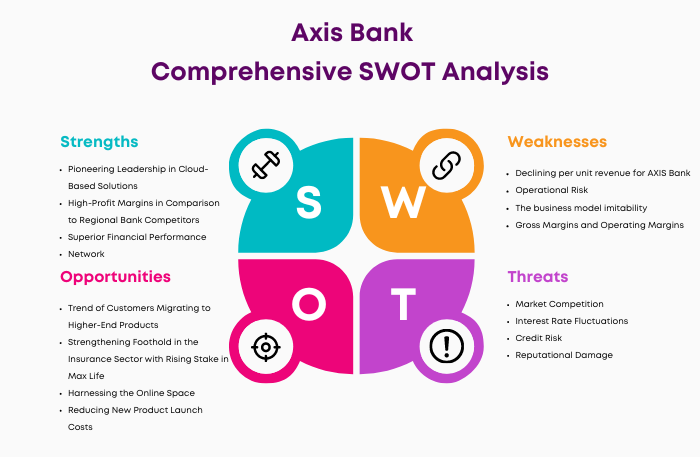
Strengths
1) Hybrid Cloud & Cyber Maturity
Axis Bank blends private cloud (to secure sensitive customer data) with public cloud (for scale and agility). This hybrid approach:
- Absorbs traffic spikes during campaigns or seasonal peaks.
- Enabled 20,000+ employees to work remotely in crisis periods.
- Reduces downtime and improves deployment speed.
- Builds layered cybersecurity, lowering breach probability and boosting trust.
Why it matters: In a market where digital journeys decide loyalty, cloud-first reliability is a competitive moat.
2) Consistent Financial Outperformance
Despite an industry notorious for margin compression, Axis Bank posted solid FY24 growth—NII +16%, operating profit +16%, core operating profit +10%, and net profit +160% (on a low FY23 base).
Why it matters: Strong earnings give Axis Bank room to invest in technology, people, and risk controls while maintaining capital buffers.
3) Deep Distribution + Virtual Scale
- 5,377 domestic branches and extension counters.
- 16,026 ATMs and cash recyclers.
- 1,590+ Virtual Relationship Managers (VRCs) driving remote sales and service.
Why it matters: A “phygital” footprint lets Axis serve high-touch segments (SMEs, affluent, rural) while scaling advisory and cross-sell through virtual centers.
4) Diversified Product Mix
Axis serves retail, SME, corporate, and international customers with deposits, loans, cards, payments, forex, wealth, and transaction banking.
Why it matters: Multiple engines mean diversified income streams, lower volatility, and more cross-sell opportunities per customer.
5) Brand Equity & Trust
A strong brand allows premium pricing in select pockets, higher card/fee penetration, and better partner confidence.
Why it matters: In banking, trust reduces acquisition friction and improves lifetime value.
6) Scale in a Leadership Pack
Axis Bank is India’s 3rd largest private sector bank by several scale indicators.
Why it matters: Scale compounds advantages—distribution, data, vendor leverage, and talent magnetism.
Weaknesses
1) Per-Unit Revenue Slowdown
Competitive intensity pushes fees and spreads lower. The result: per-unit revenue erosion in some lines.
What to do: Sharpen value-based pricing, bundle high-value services, and prioritize profitable micro-segments.
2) Operational Risk Exposure
Banks face manual errors, process breaks, fraud, and system issues.
What to do: Automate controls, invest in fraud analytics, strengthen maker-checker workflows, and track leading risk indicators.
3) Easy Imitability of Products
Products are replicable. Competitors can match features fast.
What to do: Compete on experiences—journey design, speed, personalization, and ecosystem integrations that are harder to clone.
4) Margin Sensitivity
Gross and operating margins face pressure from funding costs, competition, and compliance overheads.
What to do: Improve granular ALM, push low-cost deposits, optimize cost-to-income through automation.
5) Liquidity Risk Management
Liquidity gaps can stress payouts and profitability in volatile cycles.
What to do: Diversify funding, build contingency buffers, and strengthen stress testing.
6) Market Share vs. Revenue Growth
Revenue up, but share gains may lag top Axis Bank competitors in certain regions or products.
What to do: Prioritize underpenetrated regions, deepen ecosystem partnerships, and double down on high-growth niches (affluent, SME, new-to-credit).
7) Talent Depth & Replacement Cost
Specialist bankers are expensive and scarce. Attrition hurts continuity.
What to do: Build internal academies, succession pipelines, and differentiated EVP (learning, rotations, impact).
8) Shrinking Local Monopolies
Digital platforms erode local “moats.” Customers can switch with a tap.
What to do: Win on convenience, rewards, and proactive service.
9) HR & Culture Execution Gaps
Large workforces are hard to align to rapid change.
What to do: Use OKRs, real-time dashboards, and frontline empowerment; reward innovation and risk discipline equally.
Opportunities
1) Premiumization
Affluent and mass-affluent customers want curated experiences—priority banking, wealth advisory, and lifestyle benefits.
Play: Personalize portfolios, private-bank style RM support, and premium card ecosystems to lift ARPU.
2) Insurance Synergies (Max Life Stake)
Axis Bank’s stake in Max Life strengthens bancassurance economics and design influence.
Play: Embed insurance in lending and wealth journeys; use risk profiling to match protection gaps.
3) Digital & Ecosystem Banking
More customers bank online due to convenience.
Play: Own end-to-end digital journeys—account opening, credit, investments, and service via app-first flows and API partnerships (e-commerce, travel, gig).
4) Low-Cost Product Launch via Partnerships
Test new propositions inside partner networks before scaling.
Play: Co-create with fintechs, NBFCs, and marketplaces to reduce CAC and iterate fast.
5) Macro Tailwinds & Diversification
India’s growth offers retail and SME demand; select global markets open FX/transaction/investment flows.
Play: Build export-oriented SME corridors, NRI propositions, and cross-border payments.
6) Technology Acceleration (AI/ML)
AI enables underwriting improvements, early delinquency flags, and hyper-personalization.
Play: Use AI for risk models, collections prioritization, RM augmentations, and next-best-offer engines.
Threats
1) Intense Competition
Axis Bank competitors include HDFC Bank, ICICI Bank, State Bank of India (public sector but influential), Kotak Mahindra Bank, IndusInd Bank, IDFC FIRST Bank, Federal Bank, and new-age fintechs.
Impact: Pricing wars, fee compression, and constant innovation cycles.
2) Interest Rate Volatility
Rate cycles move Net Interest Margin (NIM) and loan demand.
Impact: Profit swings; refinancing risk in sensitive segments.
3) Credit Risk & NPA Cycles
Macroeconomic shocks can stress retail and MSME portfolios.
Impact: Higher provisions, capital drag, and rating sensitivity.
4) Reputation Risk in a Social Era
Service lapses or disputes can trend instantly.
Impact: Trust damage; churn; regulatory scrutiny.
5) FX Volatility
Cross-border business faces currency swings.
Impact: Translation losses and hedging costs.
6) Cybersecurity Threats
Phishing, malware, and account takeovers are rising.
Impact: Financial loss and erosion of digital trust.
7) Disruption by Fintech & Big Tech
Speedy, UX-rich apps set customer expectations.
Impact: Young users may prefer non-bank apps unless banks match convenience.
8) Regulatory Change
Rapid updates in KYC, data privacy, consumer protection, and digital lending.
Impact: Compliance cost, product redesigns, and slower time-to-market.
9) Economic Instability
Inflation and income shocks dent savings and credit health.
Impact: Demand slows; risk costs rise.
10) Global Macro & Geopolitics
Supply chain shifts, conflicts, and trade rules affect flows.
Impact: FX volatility and cross-border uncertainty.
11) Climate & ESG
Portfolio emissions scrutiny is increasing.
Impact: Sectoral limits, higher disclosures, and rebalanced lending.
12) Changing Customer Preferences
Mobile-first, instant service, and sustainable finance.
Impact: Legacy journeys lose patience; the best app wins.
Axis Bank Competitors
When readers search “axis bank competitors,” they usually want the peer set to benchmark performance and strategy. Key competitors include:
- HDFC Bank – Scale, low-cost deposits, strong retail/SME engine.
- ICICI Bank – Robust digital stack, diversified portfolio, corporate depth.
- State Bank of India (SBI) – Massive public sector scale; deposit franchise.
- Kotak Mahindra Bank – Affluent franchise, wealth, and disciplined risk.
- IndusInd Bank – Consumer finance niches and transactional banking.
- IDFC FIRST Bank – Customer-friendly features; retail build-out.
- Federal Bank, Yes Bank, AU Small Finance Bank – Regional strengths and niches.
Takeaway: Axis competes in a high-skill field. Differentiation must come from experience quality, speed, and ecosystem reach—not just product parity.
Strategic Recommendation
- Own Premium Experience: Expand priority/wealth tiers with concierge benefits, family banking, and curated rewards.
- Embed Insurance & Protection: Use Max Life synergy to make protection default in loans and wealth journeys.
- Hyper-personalize with AI: Drive next-best-offers, proactive service alerts, and intelligent collections.
- Deepen Low-Cost Deposits: Sharpen salary, youth, and senior propositions; gamify savings in-app.
- Phygital SME Dominance: RM-led acquisition with digital onboarding, invoice financing, and FX toolkits.
- Fintech-as-a-Channel: White-label and co-create; test in partner ecosystems before nationwide launches.
- Resilience by Design: Strengthen ALM, liquidity buffers, and cyber drills; measure time-to-recover as a core KPI.
- ESG-Aligned Credit: Green lending frameworks, transition finance for MSMEs, and transparent ESG reporting.
FAQs
1) What is the purpose of a SWOT analysis of Axis Bank?
It reveals Axis Bank’s internal strengths/weaknesses and external opportunities/threats, so leadership can prioritize investments, fix gaps, and allocate capital more effectively.
2) Who are Axis Bank competitors?
Major Axis Bank competitors include HDFC Bank, ICICI Bank, SBI, Kotak Mahindra Bank, IndusInd Bank, IDFC FIRST Bank, and regional/niche players—plus fintechs in payments, lending, and wealth.
3) How is Axis Bank performing financially?
FY24 showed strong momentum: NII up 16%, operating profit up 16%, core operating profit up 10%, and net profit up 160% (vs. FY23). This supports continued tech and growth investments.
4) What makes Axis Bank strong in digital?
A hybrid cloud strategy, advanced cybersecurity, and virtual relationship centers support reliable, scalable digital journeys across acquisition, service, and cross-sell.
5) Where does Axis Bank need to improve?
Margin resilience, per-unit revenue, operational risk controls, liquidity management, and talent depth. These areas will decide long-term competitiveness.
6) What are the biggest external risks?
Rate cycles, credit risk, cyber threats, regulatory change, and disruption by fintechs and big tech—alongside macro and FX volatility.
7) What opportunities can lift growth in 2025?
Premiumization, bancassurance with Max Life, ecosystem partnerships to lower launch costs, SME corridors, and AI-driven personalization.
8) How should customers interpret this SWOT?
For customers, it signals a stable, innovative bank with expanding digital services. For businesses, it suggests a partner capable of complex cash, trade, and FX needs—provided risk and margin improvements stay on track.
Conclusion
Axis Bank enters 2025 with strong digital muscle, a broad product engine, a powerful “phygital” network, and rising profitability. The SWOT analysis of Axis Bank highlights a clear path: protect margins, systematize risk, elevate premium experiences, and scale embedded finance. Competition will stay fierce, regulations will evolve, and customer expectations will rise. The winners will be banks that deliver instant, secure, and personalized experiences—continuously. Axis has the foundations to remain in that leadership pack—if it keeps executing with focus and speed.

A digital marketer with a strong focus on SEO, content creation, and AI tools. Creates helpful, easy-to-understand content that connects with readers and ranks well on search engines. Loves using smart tools to save time, improve content quality, and grow online reach.