

Summary
This SWOT analysis of IDBI Bank shows a legacy-rich, government-backed institution that is rebuilding performance while modernizing its digital stack.
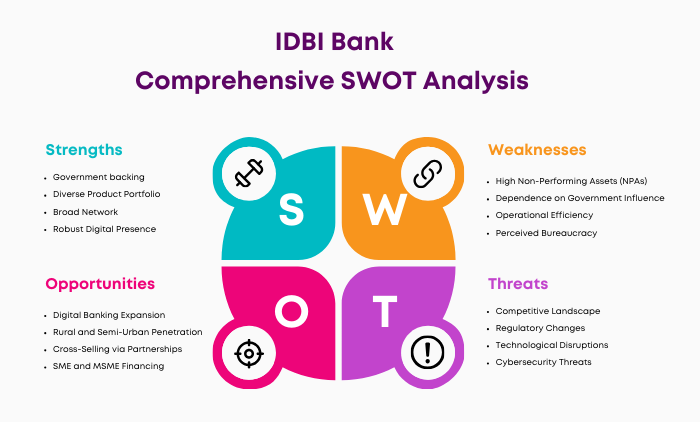
Strengths: policy support, a wide product suite, a national network, and proven inclusion programs.
Weaknesses: historical NPA overhang, slower execution vs. private peers, legacy systems, and capital/efficiency pressures.
Opportunities: digital banking at scale, MSME lending, rural penetration, fintech/API partnerships, green finance, and NRI services.
Threats: intense competition from private banks/NBFCs/fintechs, regulation and cyber risks, macro volatility, and shifting customer expectations.
Bottom line: With disciplined risk management, faster tech upgrades, and experience-led products, IDBI Bank can turn its strong foundation into sustainable growth in 2025 and beyond.
IDBI Bank started life in 1964 as the Industrial Development Bank of India—an apex development financial institution. Over decades, it evolved into a full-service universal bank that serves retail, MSME, corporate, and international customers. Its mission blends financial inclusion, development finance, and digital modernization.
In 2025, the bank faces a different battlefield. Customers expect mobile-first journeys. Risk cycles turn faster. Competition is everywhere—public banks, private banks, NBFCs, and nimble fintechs. This SWOT analysis of IDBI Bank helps you see where IDBI is strong, where it must improve, and where the next growth curve can come from.
IDBI Bank Overview
- Industry: Financial services
- Predecessor: Industrial Development Bank of India (DFI)
- Founded: 1964
- Headquarters: IDBI Tower, WTC Complex, Cuffe Parade, Mumbai
- Ownership: Life Insurance Corporation of India (~49.24%); Government of India (~45.5%)
- Key People: M. R. Kumar (Chairman), Rakesh Sharma (MD & CEO)
- Employees: ~18,283 (Sept 2023)
- Capital Ratio: ~13.31%
- Network: 1,890+ branches; 3,300+ ATMs
- Selected FY2024 figures: Revenue ~₹30,370 crore; Operating income ~₹9,774 crore; Net income ~₹5,763 crore
- Website: idbibank.in
What Is a SWOT and Why Use It?
SWOT = Strengths, Weaknesses, Opportunities, Threats.
- Strengths/Weaknesses are internal.
- Opportunities/Threats are external.
Use this tool to prioritize investments, reduce risk, and find distinct ways to win against rivals. For IDBI Bank, it spotlights how to leverage legacy strengths while accelerating digital growth.
SWOT Analysis of IDBI Bank
Strengths
1) Government Backing
Government and LIC ownership gives IDBI Bank stability and confidence. In stressed cycles, that comfort matters to depositors, bond investors, and corporate clients. It lowers perceived risk and supports long-term planning.
2) Diverse Product Portfolio
IDBI offers deposits, loans, cards, payments, trade/FX, wealth, and transaction banking. It serves retail, MSME, and corporate clients. A broad catalogue lets the bank cross-sell and smooth revenue across cycles.
3) Broad National Network
With 1,890+ branches and 3,300+ ATMs across metros, towns, and rural locations, IDBI can serve customers where they live and work. This reach is a durable moat for onboarding new-to-bank users and implementing inclusion programs.
4) Robust Digital Presence
Internet and mobile banking keep getting better. Digital reduces cost-to-serve, enables 24×7 access, and improves speed. As more journeys go paperless, the bank can scale without proportionate branch costs.
5) Legacy and Brand Value
The DFI heritage builds trust with customers who value continuity. The brand stands for stability and nation-building. That reputation still opens doors in government-linked projects, infrastructure finance, and development-oriented lending.
6) Experienced Workforce
IDBI’s bankers bring deep domain knowledge. That matters in complex lending (project finance, structured solutions), risk assessment, and recovery. Strong know-how improves underwriting quality and client advice.
7) Financial Inclusion Credentials
The bank has won recognition for Aadhaar/DBT enablement and inclusion efforts. These programs create goodwill, widen the funnel, and can become fee-earning relationships over time.
8) Specialized Subsidiaries
IDBI Capital, IDBI Intech, and IDBI Asset Management expand capability beyond plain-vanilla banking. The group can serve investment, technology, and asset-management needs under one umbrella.
9) NPA Reduction Efforts
A dedicated NPA Management Group (NMG) focuses on resolution and recovery. Practical restructuring and early-warning analytics can keep future slippages in check and free up capital.
10) Strategic Alliances
Partnerships—especially in insurance and investments—help IDBI expand offerings, share economics, and improve customer stickiness without carrying the full build cost.
11) Capacity Building
Consistent training keeps teams current on regulation, risk, tech, and product. A learning culture is essential when customer expectations and compliance rules change fast.
12) Recent Capital Infusion
Equity support improves buffers, credit growth capacity, and market confidence. Stronger capital also improves ratings outcomes and liability costs over time.
13) Adoption of Newer Tech
Core-banking upgrades, straight-through processing, and API layers reduce turn-around times. Better data and workflow tooling raise productivity and service quality.
14) Risk Management Systems
IDBI has frameworks for credit, market, operational, and liquidity risk. Standardized scorecards and stress testing enable consistent decisions and faster escalations.
15) Sustainable Banking Focus
Green lending, paperless processes, and energy-efficient operations align with ESG expectations. Over time, ESG-linked products can become a differentiator in retail and MSME segments.
Weaknesses
1) High NPAs (Historical Overhang)
Legacy stress raised gross NPAs in the past. Even with improvement, the overhang shapes investor perception and capital costs. Continued, visible progress is necessary.
2) Dependence on Government Influence
Policy alignment is a strength, but overdependence can slow commercial decisions. The bank must balance public objectives with market agility.
3) Operational Efficiency Gaps
Cost-to-income metrics have trailed top private peers. Process simplification, automation, and scale digital journeys are vital to close the gap.
4) Perceived Bureaucracy
Complex approvals can delay product rollouts or partnerships. In fast digital markets, time-to-market is everything.
5) Legacy Systems
Integrating older platforms with modern apps and analytics is hard. Frictions hit UX, adoption, and developer velocity.
6) HR Challenges and Morale
Change is hard in large organizations. Past union episodes show the need for strong communication, reskilling, and shared incentives.
7) Brand Perception vs. Modern Peers
Some customers see IDBI as “traditional.” Younger, digital-native users may default to slick private banks or fintech apps unless IDBI’s app experience shines.
8) Limited Global Presence
A smaller overseas footprint reduces diversification and access to higher-margin corridors (NRI hubs, trade finance flows).
9) Cybersecurity Exposure
Like all banks, IDBI faces rising attack volumes. Any breach would hurt trust and growth plans.
10) Regulatory Complexity
State-backed banks navigate layered oversight. Compliance change can slow execution and add cost.
11) Capital Constraints (History)
The PCA episode is past, but memory lingers. Management must keep buffers strong and growth prudent.
12) Tech Adoption Lag vs. Leaders
Digital leaders iterate weekly. IDBI must match that pace to keep parity in onboarding, lending, and service.
13) Marketing & Experience Gaps
Product parity is common. Experience parity is not. IDBI needs sharp storytelling and habit-forming UX to win daily usage.
Opportunities
1) Digital Banking Expansion
Own the mobile-first customer with instant onboarding, seamless payments, in-app credit, and human-style chat support. Put every frequent task three taps away.
2) Rural and Semi-Urban Growth
Deepen presence with micro-ATMs, assisted banking, and agent networks. Bundle savings + micro-credit + insurance for families and small traders.
3) Cross-Sell Through Partnerships
Use insurance, mutual funds, and wealth tie-ups to build lifetime value. Embed these into app journeys and RM playbooks.
4) SME/MSME Financing
MSMEs need working capital, invoice discounting, and FX tools. A phygital RM model can win share with sector-specific scorecards and quick decisions.
5) Financial Literacy Programs
Workshops in schools, colleges, and market towns build trust and brand salience. They also lower onboarding friction for new users.
6) Sustainable/Green Banking
Offer green home loans, EV loans, rooftop-solar financing, and ESG-linked MSME credit. Tie pricing to verified outcomes.
7) NRI Services
Enable easy remittances, compliant investments, and property-linked solutions. Serve diaspora hubs with curated RM support and digital self-serve.
8) Fintech Collaborations
Co-create journeys with fintechs (collections, KYC, alternate data). Use APIs to plug products into marketplaces where customers already are.
9) Asset Reconstruction Expertise
Leverage NMG learnings to accelerate resolution. Grow fee income from advisory and improve recoveries with analytics.
10) Value-Added Services
Tax filing, retirement planning, cash-flow tools, and goal-based investing increase daily relevance and reduce churn.
11) Portfolio Diversification
Balance sector exposure and tenor to steady earnings through cycles. Use data to find under-banked niches.
12) Selective Foreign Expansion
Target corridors with high India linkages—Gulf, SE Asia, UK. NRI + trade finance can be profitable with controlled risk.
13) Modernize Branch Experience
Turn branches into advice studios. Fewer counters, more pods and video-rooms. Book appointments from the app.
14) E-Banking for Businesses
Upgrade cash management, bulk payouts, e-collections, and trade platforms. Business users are sticky if you save them time.
15) AI/ML & Blockchain
AI for underwriting, fraud, and collections. Personalized “next best action” for every customer. Blockchain for secure records and trade doc flows.
Threats
1) Intense Competition
Public banks, agile private banks, NBFCs, and fintechs crowd every product. Price wars compress fees and spreads.
2) Regulatory Changes
Frequent updates in KYC, data privacy, and digital lending can force product redesigns and add cost.
3) Technological Disruption
If apps are slow or clunky, customers switch. Challenger apps set the bar for design, speed, and transparency.
4) Cybersecurity Risks
Phishing, ATOs, and ransomware are rising. One incident can trigger large costs and reputational loss.
5) Economic Fluctuations
Inflation, rate spikes, and growth shocks increase credit costs and reduce loan demand.
6) NPA Cycles
A sudden macro dip can raise delinquencies. Provisioning then hits profit and capital.
7) Reputation Risk
Social media amplifies every misstep. Customer experience must be consistent across channels.
8) Global Uncertainties
Geopolitics and trade can shake FX flows and cross-border portfolios.
9) Shifting Preferences
Customers expect instant, personalized, and sustainable finance. Anything less drives churn.
10) Capital Adequacy Pressures
Growth needs capital. Buffers must stay ahead of risk.
11) High Physical Infrastructure Costs
Branches are valuable but expensive. The mix must evolve toward digital.
12) HR and Change-Management
Transformation needs new skills and mindsets. Poor change execution slows the journey.
13) Black-Swan Events
Pandemics or disasters test operations and liquidity. Contingency planning is essential.
14) Market Share Erosion
Aggressive private players grow faster in urban affluent and salaried segments.
15) Fraud/Malpractice
Internal control failures can be costly. Culture and systems must deter and detect.
IDBI Bank Competitors: Who Are They?
When readers search “IDBI Bank competitors,” they usually compare capability and experience. Key peers:
- Public Sector Banks: State Bank of India (SBI), Bank of Baroda, Canara Bank, Punjab National Bank.
- Private Sector Banks: HDFC Bank, ICICI Bank, Kotak Mahindra Bank, Axis Bank, IndusInd Bank, IDFC FIRST Bank, Federal Bank.
- NBFCs/Fintechs: Bajaj Finance (retail/SME), fintech players in payments, lending, and wealth.
Takeaway: IDBI can win by combining policy-grade trust with fintech-grade UX and RM-grade advice.
Strategic Priorities
- Accelerate digital journeys: 3-tap tasks, instant onboarding, and proactive in-app support.
- Strengthen risk early-warning: AI models, bureau + alternate data, and faster collections workflows.
- MSME growth engine: Sector scorecards, invoice financing, and FX corridors with advisory RMs.
- Low-cost deposits: Salary, youth, senior-citizen programs; rewards that build habits.
- Fintech/API partnerships: Pilot in partner ecosystems before national rollouts.
- Modernize core + cybersecurity: Reduce tech debt; run breach-response drills; track time-to-recover.
- ESG products: Green retail and MSME credit; transparent impact metrics.
- Phygital branches: Advice-led formats; video RMs; app-booked appointments.
- People and culture: Upskill for data/AI; align incentives to risk-adjusted growth.
- Sharper brand and CX: Simple language, clean UX, and clear promises across channels.
FAQs
1) What makes IDBI Bank different from private peers?
A strong legacy and government/LIC backing give IDBI stability. Its nationwide network and inclusion credentials add reach. The gap to close is speed, UX, and efficiency.
2) How is IDBI addressing NPAs now?
Through a dedicated NPA Management Group, early-warning analytics, and pragmatic resolution. The aim is to improve asset quality and release capital for growth.
3) Where is the biggest growth opportunity in 2025?
Digital retail, MSME financing, and partnerships. Rural/semi-urban expansion and NRI services are strong secondary bets.
4) How competitive is IDBI against private banks and NBFCs?
Private peers lead on speed and UX; NBFCs/fintechs are nimble in niches. IDBI can compete by blending trust, phygital reach, and better app-led experiences.
5) What is IDBI doing on cybersecurity?
Upgrading defenses, monitoring, and drills. Focus areas include phishing prevention, authentication, anomaly detection, and fast incident response.
6) How does government/LIC ownership affect strategy?
It supports stability and stakeholder confidence. The trade-off is ensuring market agility and efficiency remain high.
7) What will customers notice first as IDBI improves?
Faster, simpler app journeys; clearer communication; better turnaround times for loans and service requests.
8) What risks should investors track?
Asset quality, capital buffers, cost-to-income, and execution on digital/partnership roadmaps.
Conclusion
IDBI Bank has solid foundations: government/LIC support, a wide network, and a mission rooted in development and inclusion. The SWOT analysis of IDBI Bank shows clear priorities: keep reducing NPAs, modernize core tech, deliver fintech-level digital journeys, and scale MSME and NRI propositions.
Competition will stay fierce. Regulation and cyber risks will evolve. Customers will expect instant, transparent, sustainable banking. If IDBI executes with discipline—on risk, on UX, and on partnerships—it can translate its legacy into durable, profitable growth in 2025 and the years ahead.

A digital marketer with a strong focus on SEO, content creation, and AI tools. Creates helpful, easy-to-understand content that connects with readers and ranks well on search engines. Loves using smart tools to save time, improve content quality, and grow online reach.