

Summary
Procter & Gamble (P&G) is one of the world’s largest consumer goods companies, with over 180 years of history and an unmatched brand portfolio. From Tide and Pampers to Gillette and Olay, P&G dominates the global market with innovation, brand strength, and a strong presence across 180+ countries. However, like every major corporation, it faces challenges such as intense competition, brand dilution, and reliance on mature markets. This SWOT Analysis of Procter & Gamble (P&G) in 2025 highlights the company’s strengths, weaknesses, opportunities, and threats, offering insights into how the brand can sustain its leadership in the ever-changing consumer goods industry.
Procter & Gamble (P&G) is a global leader in consumer goods. Founded in 1837 by William Procter and James Gamble as a modest soap and candle company, it has grown into a multinational giant with world-famous brands such as Tide, Pampers, Gillette, Olay, Pantene, Oral-B, and Vicks.
With more than 65 brands under its umbrella and operations in 180+ countries, P&G is known for its innovative marketing, customer-focused products, and commitment to sustainability. In FY 2023, P&G reported revenue of US$82 billion and employed over 107,000 people worldwide, proving its scale and dominance.
This comprehensive SWOT analysis of P&G (Updated 2025) dives deep into its strengths, weaknesses, opportunities, and threats, offering a clear picture of where the company stands in today’s competitive landscape.
Company Overview of Procter & Gamble (P&G)
- Industry: Consumer Goods
- Founded: October 31, 1837
- Headquarters: Cincinnati, Ohio, United States
- Founders: William Procter & James Gamble
- Global Presence: 180+ countries, 65+ brands
- Key Executives: David S. Taylor (Executive Chairman), Jon R. Moeller (President & CEO)
- Revenue (2023): $82.01 billion
- Net Income (2023): $14.65 billion
- Employees (2023): 107,000
- Website: www.pg.com
Also Read: SWOT Analysis of Jeep
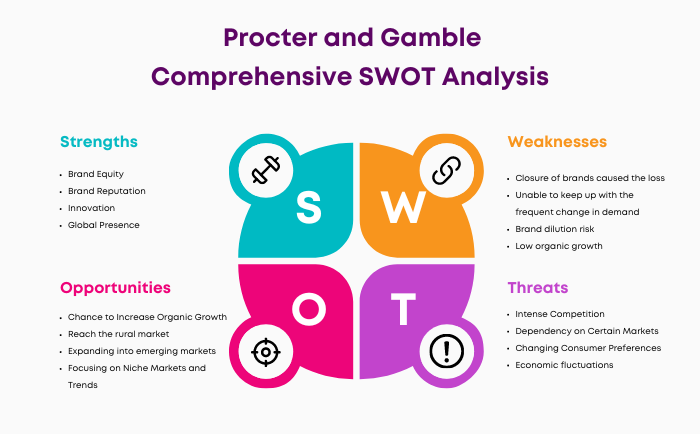
SWOT Analysis of Procter & Gamble (P&G)
Strengths of P&G
- Brand Equity
P&G has one of the strongest brand portfolios in the world. With leading names like Tide, Ariel, Pampers, Whisper, Gillette, Head & Shoulders, Pantene, Oral-B, and Olay, it dominates nearly every consumer goods category. In 2023, P&G generated over $82 billion in global net sales, reflecting its brand power. Strong brand equity allows P&G to charge premium prices and maintain consumer trust. - Brand Reputation
For decades, P&G has been seen as a symbol of quality and reliability. Its reputation for ethical practices and customer satisfaction makes it a preferred choice among consumers. This strong brand image ensures loyalty even when competitors launch alternatives. - Innovation
Innovation is at the core of P&G’s growth. From the creation of Tide detergent to the launch of Pampers diapers, the company has consistently innovated to meet evolving customer needs. Its “P&G Good Everyday” initiative also combines consumer engagement with corporate responsibility, showcasing innovative marketing. - Global Presence
P&G operates in 180+ countries with around 65 brands in different product categories. Its wide international presence reduces reliance on any single market and gives it access to billions of consumers worldwide. - Automation and Technology
P&G invests heavily in automation and advanced manufacturing technologies. This reduces production costs, improves efficiency, and ensures consistent product quality. It also enables the company to adapt quickly to market demands. - Trained Workforce
With over 107,000 employees worldwide, P&G invests significantly in training and development. This highly skilled workforce drives innovation, efficiency, and customer engagement. - Marketing and Advertising Leadership
P&G is famous for its powerful marketing campaigns. It consistently invests billions in advertising and was among the top global advertisers in 2023. Its emotional, innovative campaigns set industry benchmarks and build consumer connections. - Cost Management
Through economies of scale and efficiency measures, P&G effectively manages costs, allowing it to compete in price-sensitive markets while maintaining profitability. - High Brand Awareness
Celebrity endorsements and strategic advertising have made P&G brands household names. From sports icons endorsing Gillette to beauty influencers promoting Olay, P&G leverages star power to expand reach. - Dealer and Distribution Network
P&G has a strong relationship with retailers, distributors, and dealers worldwide. This network helps ensure wide product availability and active promotion at every consumer touchpoint.
Weaknesses of P&G
- Closure of Subsidiary Brands
P&G has discontinued or sold several brands over the years, such as Pringles (sold to Kellogg’s), which reduced its product diversification. Losing such brands also meant losing corresponding market share. - Slow Adaptation to Market Changes
The fast-moving consumer goods (FMCG) industry demands quick responses. P&G sometimes struggles to adapt to changing consumer trends, which can weaken its competitiveness. - Risk of Brand Dilution
Managing a vast portfolio of 65+ brands increases the risk of brand dilution. If not carefully managed, individual brands may lose distinctiveness, weakening their market positioning. - Low Organic Growth
P&G’s growth in recent years has relied more on acquisitions and less on organic expansion. This indicates saturation in mature markets and slower innovation-driven growth. - Slow Decision-Making
Due to its large and complex structure, decision-making at P&G is often slow. In today’s fast-paced market, this can result in missed opportunities. - Dependence on Mature Markets
Over 50% of P&G’s sales come from North America and Western Europe. Heavy reliance on mature markets exposes it to risks when these economies slow down. - Cost-Cutting Risks
P&G’s focus on cost reduction can sometimes backfire. Reducing R&D or marketing budgets could undermine innovation and long-term brand strength. - Dependence on External Vendors
P&G heavily relies on third-party vendors for raw materials and packaging. This makes it vulnerable to supply chain disruptions. - Overreliance on Traditional Advertising
While P&G has embraced digital marketing, it still invests significantly in traditional TV ads. Overdependence on traditional platforms may limit reach in the digital-first era.
Opportunities for P&G
- Boost Organic Growth
P&G can focus on innovative product development and targeted marketing campaigns to boost organic growth. Introducing products tailored to unmet needs will strengthen brand loyalty. - Rural Market Expansion
Rural markets, especially in Asia and Africa, offer untapped opportunities. P&G can grow revenue by customizing products and pricing strategies for these segments. - Expansion in Emerging Markets
Emerging economies like India, Brazil, and Indonesia have growing middle-class populations. These markets provide significant growth opportunities for P&G’s brands. - Eco-Friendly and Sustainable Products
Sustainability is becoming a priority for consumers. By introducing more organic, eco-friendly, and biodegradable products, P&G can capture environmentally conscious buyers. - Digital and E-Commerce Growth
E-commerce and online retail are booming. By investing in digital platforms and direct-to-consumer strategies, P&G can increase sales and gather valuable consumer insights. - Strengthening Innovation
Investing in R&D ensures P&G remains ahead of consumer trends. Innovative products will allow the company to maintain its leadership in key categories. - Strategic Partnerships
Collaborating with startups, IT firms, and research institutions will help P&G innovate faster and access new technologies. - Corporate Social Responsibility and Sustainability
By committing to sustainability goals, P&G can enhance brand image and attract eco-conscious customers. - Personalization and Customization
Offering personalized products, such as skincare solutions or oral care kits, can improve customer engagement and satisfaction. - AI and Data Analytics
By leveraging AI and data analytics, P&G can optimize supply chains, forecast demand, and create highly targeted marketing campaigns. - Employee Development
Focusing on employee development and talent retention ensures that P&G maintains a skilled and motivated workforce. - Mergers and Acquisitions
Strategic acquisitions can expand P&G’s product portfolio and allow it to enter new markets quickly.
Threats to P&G
- Intense Competition
P&G competes with giants like Unilever, Colgate-Palmolive, and Johnson & Johnson, as well as private-label brands. This constant rivalry pressures market share and pricing. - Dependence on Key Markets
Heavy reliance on North America and Europe makes P&G vulnerable to regional downturns or regulatory shifts. - Shifting Consumer Preferences
Consumers are increasingly moving toward natural, organic, and local products. Failure to adapt may weaken P&G’s relevance. - Economic Fluctuations
During recessions, consumers often cut back on premium products, affecting P&G’s profitability. - Rise of Private Labels
Retailers are launching their own private brands, which are often cheaper. This trend threatens P&G’s premium offerings. - Raw Material Price Volatility
Price fluctuations in raw materials like chemicals and packaging materials affect profit margins. - Consumer Switching and Buyer Power
With many alternatives available, brand loyalty is difficult to sustain. Discounts and peer influence often drive customers to switch. - Retailer In-House Brands
Retail giants like Walmart and Target are aggressively promoting their own in-house brands, challenging P&G’s dominance. - Supply Chain Disruptions
Global conflicts, pandemics, or natural disasters can disrupt P&G’s vast supply chain, delaying production and increasing costs. - Regulatory Challenges
Government regulations promoting local brands or restricting international players may limit P&G’s growth in certain countries.
Conclusion
Procter & Gamble has been a market leader in consumer goods for over 180 years, driven by innovation, strong branding, and global reach. Its vast product portfolio and high brand equity are unmatched in the industry. However, challenges like slow adaptation, reliance on mature markets, and rising competition cannot be ignored.
Looking ahead, P&G has opportunities to expand in emerging markets, digital commerce, and sustainability-focused products, all while strengthening innovation. At the same time, it must address threats such as private labels, economic uncertainty, and regulatory hurdles.
With the right strategy, P&G is well-positioned to continue its leadership in the consumer goods industry in 2025 and beyond.
FAQs
What is P&G best known for?
P&G is best known for its strong portfolio of consumer brands like Tide, Pampers, Gillette, Olay, Oral-B, and Head & Shoulders.
What are the key strengths of P&G?
Brand equity, global presence, innovation, strong marketing, and a skilled workforce are P&G’s top strengths.
What are the weaknesses of P&G?
Weaknesses include reliance on mature markets, slow decision-making, brand dilution risks, and heavy dependence on external vendors.
What opportunities lie ahead for P&G?
P&G can grow by expanding into emerging and rural markets, strengthening its digital presence, and focusing on sustainability.
What are the major threats P&G faces in 2025?
Intense competition, private labels, raw material price volatility, and supply chain disruptions are key threats.
How does P&G maintain brand equity?
Through continuous innovation, powerful advertising campaigns, and strong distribution networks.
What role does sustainability play in P&G’s strategy?
Sustainability is central to P&G’s future strategy, with eco-friendly products and CSR initiatives shaping its brand image.
Who are P&G’s top competitors?
Unilever, Colgate-Palmolive, Johnson & Johnson, Nestlé, and retailer-owned brands are its biggest competitors.

A digital marketer with a strong focus on SEO, content creation, and AI tools. Creates helpful, easy-to-understand content that connects with readers and ranks well on search engines. Loves using smart tools to save time, improve content quality, and grow online reach.