

App stores are more crowded than ever, with millions of apps competing for user attention across Google Play and the Apple App Store. In this environment, App Store Optimization (ASO) is one of the most efficient ways to increase visibility, lower acquisition costs, and turn store impressions into high-quality installs. This guide walks through ASO end‑to‑end for 2026, using practices backed by current store documentation and industry data so every recommendation can be implemented with confidence.
What is App Store Optimization?
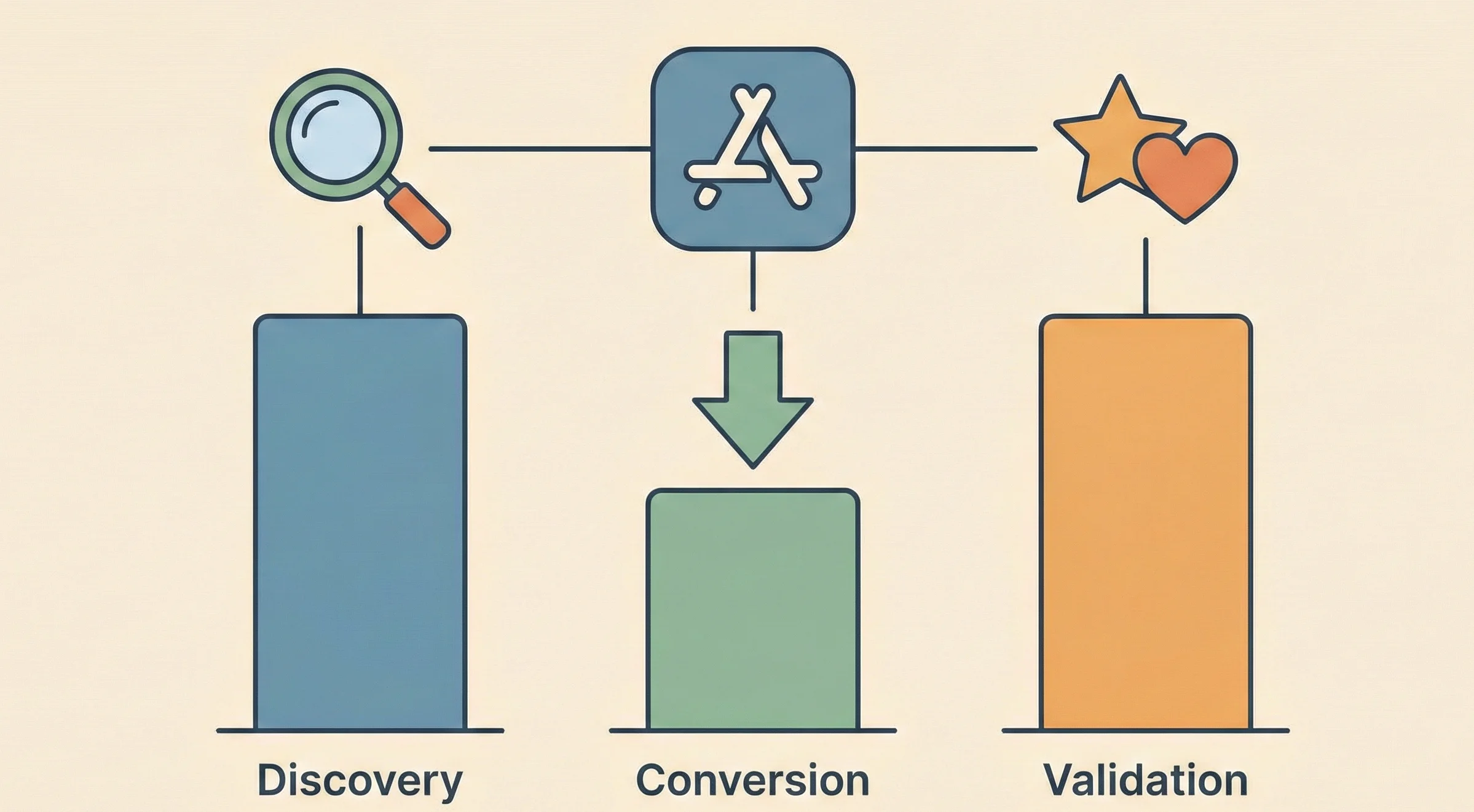
App Store Optimization is the process of improving how your app appears and performs in app stores so it ranks for relevant searches, gets more page views, and converts more of those views into installs. It is often described as “SEO for apps” because it uses structured metadata (titles, descriptions, keywords) and behavioral signals (click‑through rate, installs, engagement) to influence ranking and conversion.
ASO typically focuses on three types of signals: discovery, conversion, and validation. Discovery signals help the store understand what your app is about; conversion signals measure how effectively your listing turns visitors into installers; and validation signals measure post‑install quality and engagement, which influence ongoing visibility.
- Discovery signals include your app name/title, subtitle or short description, long description, keywords, and category selection.
- Conversion signals include listing click‑through rate (CTR), install rate from product page views, and the persuasive power of your visuals (icon, screenshots, videos).
- Validation signals include ratings, reviews, crash and ANR (App Not Responding) rates, uninstall rate, and engagement metrics like repeat opens and active users.
ASO Ranking Factors
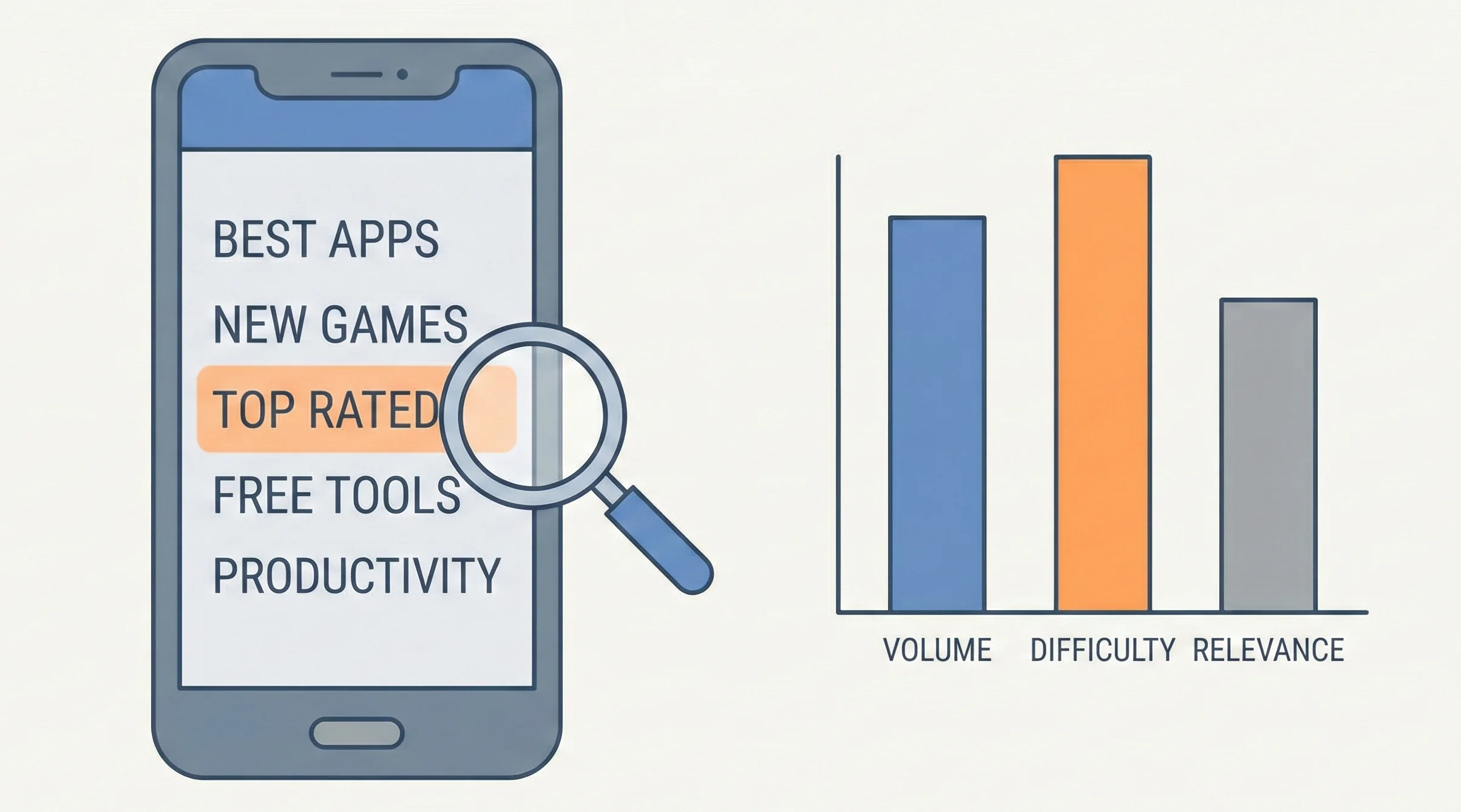
ASO rankings are driven by a mix of on‑page metadata, behavioral metrics, and technical quality indicators. While algorithms differ between Google Play and the App Store, public sources and developer documentation agree that text fields, visuals, user feedback, and app health are consistent pillars.
Key ranking signals across major stores include app title/name, descriptions and keywords, installs and their velocity, engagement, in‑app events or promotions, user ratings and reviews, and update frequency. These can be grouped into discovery, conversion, and validation, which gives a practical structure for optimization work.
iOS vs. Android emphasis (high level)
| Factor | Apple App Store emphasis | Google Play emphasis |
| App name / title | Strong discovery & brand indexing. | Strong discovery; title is one of the most weighted text fields. |
| Subtitle / short description | Important for both relevance and conversion. | Key discovery and CTR signal; indexed for keywords. |
| Long description | Used more for conversion and context. | Fully indexed for keywords; density and relevance matter. |
| Keywords field | Dedicated 100‑character field; core discovery input. | No dedicated field; relies on visible text fields. |
| Ratings & reviews | Strong trust and conversion factor; indirect ranking weight. | Direct ranking input; reviews are indexed and impact visibility. |
| App performance / vitals | Important for user experience and retention. | Explicit ranking factor via Android Vitals thresholds. |
| Installs & uninstall rate | Volume and retention affect ranking. | Download volume, velocity, and uninstall rate influence rank. |
Keyword Research for ASO
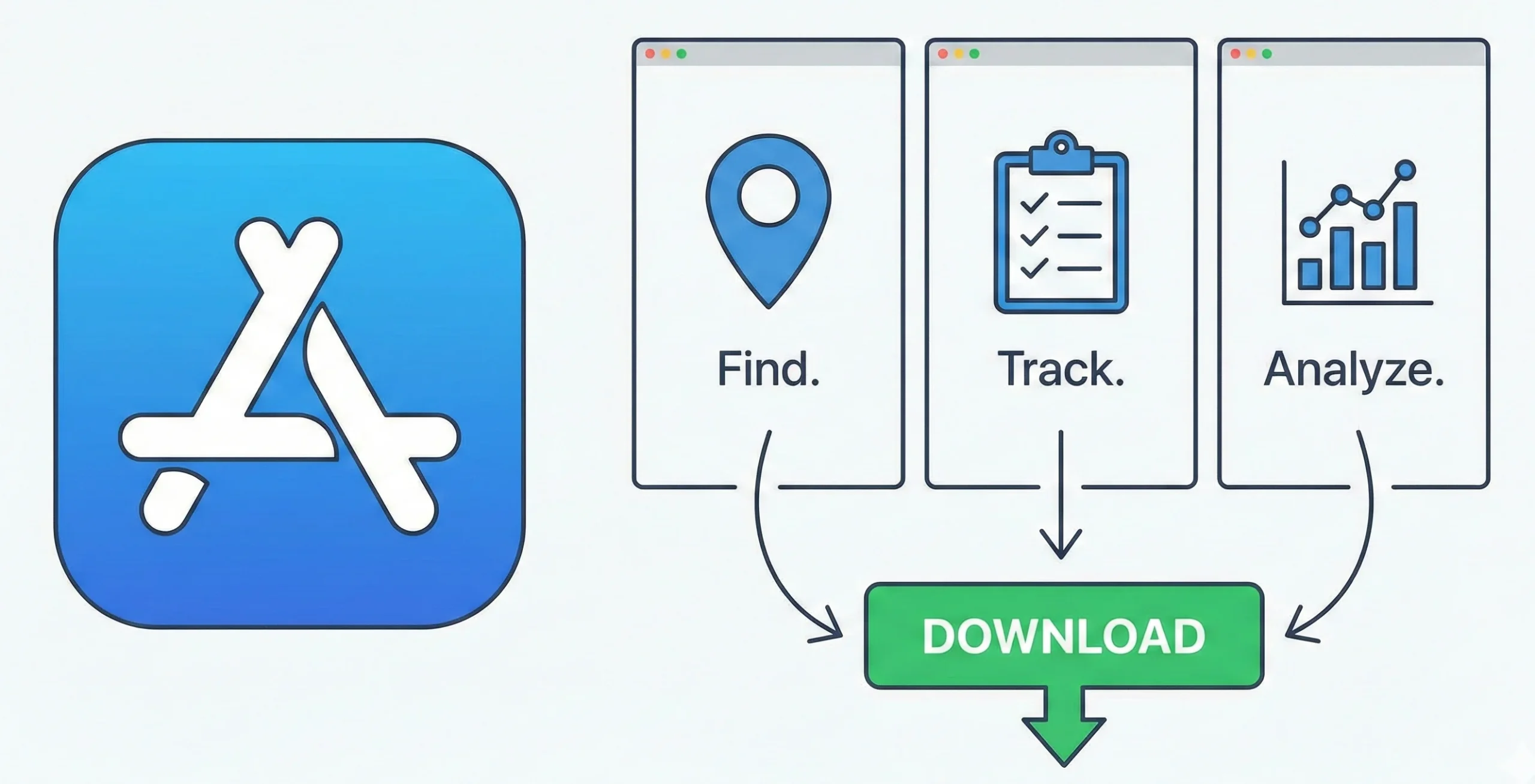
Keyword research for ASO identifies the queries users type into app store search to find apps like yours, then maps those queries into your titles, subtitles, descriptions, and (on iOS) keyword fields. This process is crucial because a large share of organic app installs in many categories comes from store search.
Effective ASO keyword research usually combines store autocomplete suggestions, competitor analysis, and third‑party tools that estimate volume and difficulty. For 2026, ASO tools and analytics platforms emphasize starting with a broad term set, grouping terms by theme and intent, and then prioritizing based on relevancy, difficulty, and potential traffic.
Key steps:
- Collect seed terms from your app’s core features, user problems, and competitors’ titles and descriptions.
- Expand with store suggestions, related searches, and keyword tools to surface long‑tail and niche queries.
- Score and prioritize keywords on relevance first, then on traffic and competition, ensuring you avoid irrelevant high‑volume terms that can hurt conversion.
Optimizing for Google Play
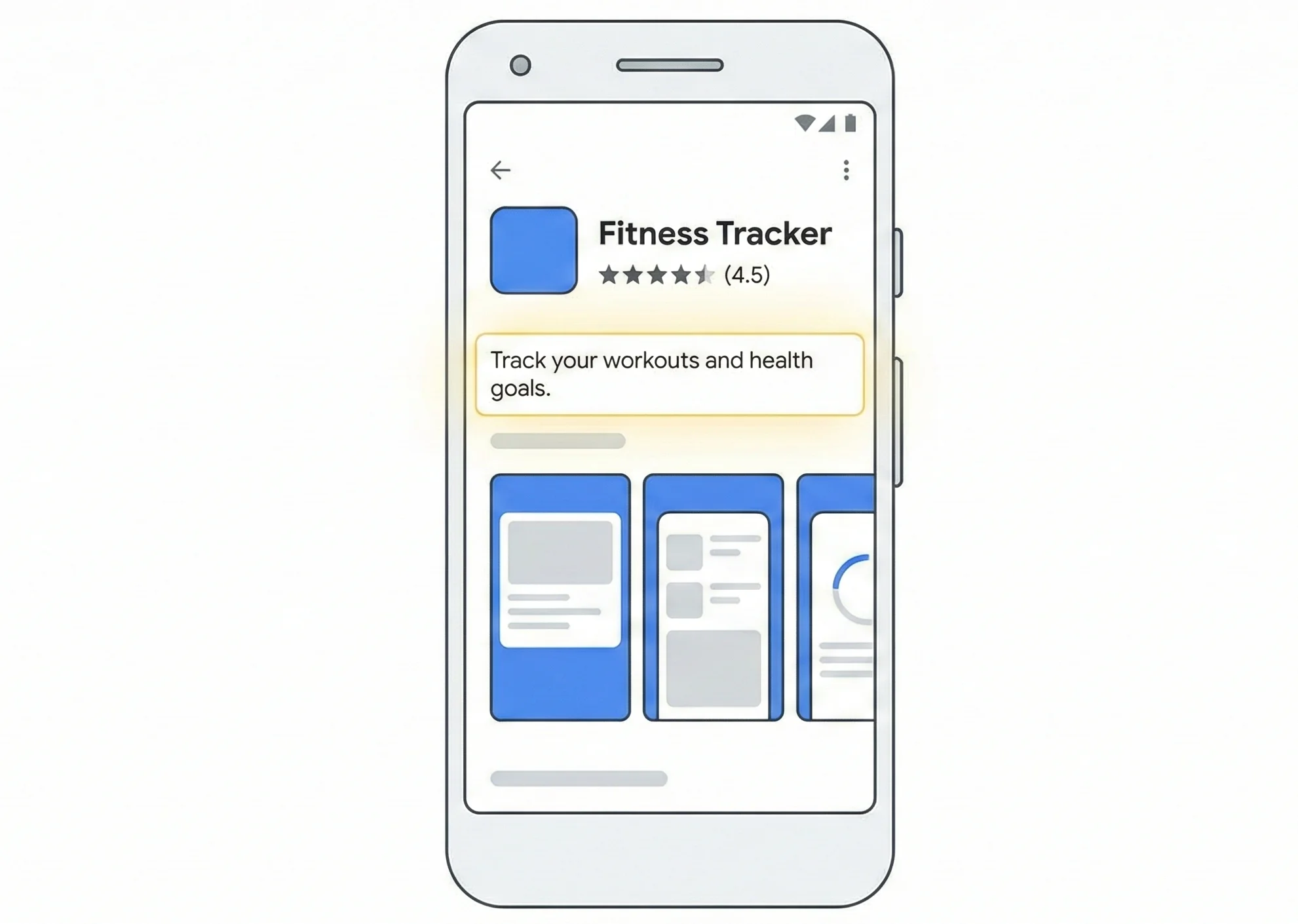
Google Play optimization relies heavily on visible text fields, user behavior, and technical quality signals collected through Android Vitals. Google indexes keywords across the app title, short description, and long description, and combines this with engagement, ratings, and stability metrics to determine ranking and visibility.
Core Google Play elements
- App title (up to 30 characters)
The title is a strong ranking factor and should combine a clear brand name with one or two core keywords without stuffing. Google’s guidelines recommend concise, brand‑safe titles and prohibit misleading or performative text such as “#1 app” or “best ever.” - App category
Choosing the right category helps your app appear in relevant browse sections and supports contextual discovery for generic searches like “health & fitness apps.” Developer help recommends choosing the category that best matches the app’s primary function and user expectations. - Short & long descriptions
The short description (up to 80 characters) appears above the fold and is a key driver of CTR and installs, so it should highlight the main benefit in simple language and include a priority keyword. The long description (up to 4,000 characters) provides detail on features and use cases; Google indexes it for search, so structured, natural keyword use is important, but over‑optimization and repetition can be counter‑productive. - App icon, feature graphic, screenshots, promo video
Visuals are central to conversion, and Google’s policies restrict promotional claims (“best”, “#1”, discounts) in metadata and creatives. Feature graphics and videos can appear in recommendations and search results, so they should showcase the core value proposition and in‑app experience. - App ratings & reviews
Ratings and reviews impact both ranking and conversion by acting as social proof before users open the listing. Apps with higher average ratings and a healthy volume of recent reviews typically convert better, and review text can surface additional keyword combinations. - Google Play Android Vitals
Android Vitals track metrics like user‑perceived crash rate, ANR rate, wake locks, startup time, and rendering performance. Poor vitals can reduce discoverability, and official thresholds label “bad behavior” when user‑perceived crash rate or ANR rate exceeds defined limits, which can negatively affect rankings.
Recommended practices:
- Keep crash and ANR rates below Android Vitals thresholds by monitoring Play Console and fixing high‑impact clusters quickly.
- Regularly test variations of descriptions, icons, and screenshots using Google Play experiments to improve CTR and conversion rate.
Also Check: Are Internal Links in Header and Footer Treated Differently by Google?
Optimizing for Apple App Store
Apple’s App Store relies on a mix of visible metadata, a hidden 100‑character keyword field, and user behavior to rank apps in search and browse placements. While the algorithm is less transparent than Google’s, Apple’s documentation and ASO studies consistently point to the importance of app name, subtitle, keywords field, ratings, and product page performance.
Core App Store elements
- App name (up to 30 characters)
Apple recommends a simple, memorable name that hints at the app’s function, avoiding generic or misleading terms. The app name is indexed for search and strongly affects brand recognition, so it should focus on clarity and brand identity rather than keyword stuffing. - Subtitle (up to 30 characters)
The subtitle appears directly under the app name and is indexed for keywords, making it one of the most valuable fields for ASO. This space should communicate key value or use case and also influences conversion from search results. - Categories (primary and secondary)
Apple allows one primary and one secondary category, and guidelines instruct developers to choose based on the app’s main purpose, where users will look for similar apps, and how competitors are categorized. Selecting misleading categories can violate App Store Review Guidelines and damage relevance. - Keywords field (100 characters)
The hidden keyword field can contain up to 100 characters, with terms separated by commas and no spaces after commas. Best practice is to use single words, avoid duplicates and trademarked names, and focus on relevant, specific terms to maximize combinations the algorithm can generate. - Description & promotional text
The description (up to 4,000 characters) is used more for user understanding than direct ranking, but the first two or three lines significantly influence conversion from the product page. Apple also provides a 170‑character promotional text field at the top that can be updated without a new version, which is useful for time‑bound offers, announcements, or feature highlights. - App icon, previews, screenshots
Apple enforces detailed design specifications and review rules for icons and videos, so compliance and clarity are essential. You can upload up to 10 screenshots, and if no video is present, the first 1–3 screenshots appear in search results, making them critical for communicating core functionality quickly. - App ratings & reviews
Ratings and reviews carry strong weight as social proof, and apps with higher average ratings and a steady volume of recent reviews tend to perform better in rankings and conversions. Native prompts for requesting ratings should be triggered contextually, after positive experiences, to avoid user irritation.
Visuals and Conversion Optimization
Visual assets—icons, screenshots, and videos—are often the deciding factor between a view and an install, especially on mobile where users scan quickly. Stores treat these assets as part of the product experience, so they must follow policies while clearly presenting the app’s value and main use cases.
Effective ASO visuals share a few common traits across high‑performing apps:
- The app icon is simple, distinctive, and legible at small sizes, using strong color contrast and minimal detail so it stands out in grids and search results.
- Screenshots focus on one key benefit or feature per frame, with concise overlay text that explains the value in the user’s language instead of using banned promotional phrases like “#1” or “best app.”
- App previews or promo videos demonstrate real in‑app flows rather than abstract animations, keeping within 30 seconds on iOS and following store‑specific content rules.
Conversion optimization in 2026 heavily relies on structured A/B testing of visual elements such as icons, screenshot sequences, and messaging variants. Both Apple and Google, as well as third‑party platforms, allow controlled experiments that measure impact on CTR and install rate, enabling iterative design improvements.
Reviews, Engagement, and Retention
User ratings, reviews, and post‑install engagement are now central to ASO because they indicate whether the store is sending users to an app that delivers sustained value. Algorithms increasingly factor in app quality and user behavior—such as repeat opens, session length, and feature usage—to decide how prominently to display an app in search and recommendations.
Managing this layer of ASO involves both generating more (and better) feedback and acting on it:
- Encourage satisfied users to rate the app using native prompts timed after successful or “delight” moments, which tends to produce higher average ratings.
- Monitor and respond to reviews, especially negative ones, with specific, solution‑oriented replies, as visible developer engagement can influence user perception and sometimes prompt users to revise ratings upward.
- Improve retention and engagement with UX enhancements, relevant notifications, and feature updates, since higher daily active users and lower churn correlate with better rankings.
Poor performance—frequent crashes, ANRs, or high uninstall rates—can directly reduce visibility, particularly on Google Play where Android Vitals feed into ranking logic. As a result, optimizing in‑app experience is now inseparable from ASO work rather than a separate concern.
Advanced ASO Strategies for 2026
In 2026, successful ASO programs combine foundational tactics with more advanced strategies that leverage experimentation, segmentation, and new store features. These approaches aim to capture more qualified traffic, improve regional performance, and align ASO with other growth channels.
Important advanced angles include:
- Localization
Localizing metadata (titles, subtitles, descriptions, keywords) and creatives (screenshots, videos) for target languages and markets can significantly increase conversion and relevance in those regions. Both major stores support localized product pages, and results are generally better when copy and visuals are adapted rather than simply translated. - A/B testing and iterative optimization
Continuous testing of titles, subtitles, descriptions, icons, screenshots, and ordering allows teams to refine pages based on real performance rather than assumptions. Data‑driven ASO frameworks recommend running one major test at a time per locale, defining clear success metrics (e.g., CTR or install rate), and documenting learnings for future cycles. - In‑app events and promotional placements
Apple’s in‑app events and Google Play’s promotional tools provide additional surfaces for discovery beyond the main listing. Highlighting limited‑time events, feature launches, or seasonal campaigns through these tools can bring incremental impressions and re‑engage lapsed users when integrated into broader marketing plans. - Integration with paid and external channels
Modern ASO strategies pair organic optimization with app campaigns on Apple Search Ads, Google Ads, and social platforms, using paid traffic both for growth and for testing messaging and creatives that later inform organic assets. External review sites, owned web pages, and social content can also drive qualified users directly to store pages, which complements store‑native discovery.
Tools and Measurement
ASO is an ongoing optimization loop that depends on reliable data for visibility, traffic, conversion, retention, and sentiment. Both major stores provide their own analytics, and a mature ASO stack typically combines these with specialized third‑party tools.
Key elements of measurement:
- Core KPIs
Common ASO metrics include indexed keyword count and rankings (visibility), impressions and product page views (traffic), install conversion rate (page performance), and post‑install metrics like retention and average rating. Monitoring these over time makes it easier to understand which changes improve actual business outcomes rather than just rankings. - Store analytics
Google Play Console and App Store Connect provide dashboards for search performance, conversion, retention, and technical quality, including Android Vitals and crash reports. Learning how to segment data by country, device, traffic source, and experiment variant is critical for diagnosing issues and validating tests. - Third‑party ASO tools
Dedicated ASO platforms offer keyword discovery, competitor tracking, creative benchmarking, and experiment analysis that go beyond native analytics. These tools help identify gaps in keyword coverage, monitor ranking shifts, and uncover competitor changes that might explain market movements.
Conclusion
ASO in 2026 is no longer just about inserting keywords into a title; it blends metadata optimization, creative testing, user satisfaction, and technical quality into one continuous process. By systematically addressing discovery, conversion, and validation signals—across both Google Play and the App Store—you can improve visibility, reduce acquisition costs, and build a more durable growth engine for your app. The most effective next step is to audit your current listings against the elements in this guide, prioritize the highest‑impact changes, and establish a simple testing and measurement cadence that turns ASO into an ongoing habit rather than a one‑time project.

Passionate about blogging and focused on elevating brand visibility through strategic SEO and digital marketing. Always tuned in to the latest trends, I’m dedicated to maximizing engagement and delivering measurable ROI in the dynamic world of digital marketing. Let’s connect and unlock new opportunities together!