

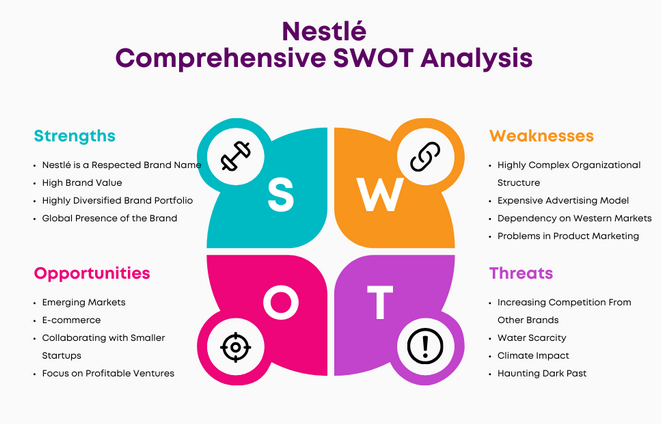
A detailed Nestlé SWOT analysis reveals how the company leverages its strengths, struggles with internal weaknesses, and adapts to opportunities and external threats.
Strengths of Nestlé
Nestlé’s global success is driven by multiple factors that make it resilient and profitable.
1. High Brand Value
In 2023, Nestlé retained its position as the world’s most valuable food brand, worth $20.8 billion. A strong brand name increases trust, attracts investors, and ensures customer loyalty. Nestlé’s brand reputation has been built over decades of delivering consistent quality.
2. Strong Financial Performance
With CHF 68.8 billion in revenue in Q3 2023, Nestlé has the financial muscle to invest in research, acquisitions, and expansion. Strong profits mean the company can withstand recessions and still maintain growth.
3. Efficient R&D System
Nestlé runs 23 global R&D centers with over 4,100 employees, making it the largest food and nutrition research company in the world. In 2022, it invested $1.77 billion in R&D, which helps develop healthier food, sustainable packaging, and new product lines.
4. Global Presence
Nestlé operates in 188 countries with 340 factories in 77 nations. From Europe to Asia and Africa, its global reach ensures brand visibility and reduces dependence on one market.
5. Respected Brand Image
Nestlé is associated with family, nutrition, and trust. The tagline “Good Food, Good Life” resonates globally. Its consistent focus on health, wellness, and sustainability adds credibility to its brand identity.
6. Diversified Portfolio
The company owns over 2000 sub-brands, including Maggi, Nescafé, KitKat, Nespresso, Milo, Purina Petcare, Perrier, and Gerber. Such diversity reduces risks and ensures steady revenue from multiple product categories.
7. Environmental Sustainability Efforts
Through its Creating Shared Value (CSV) program, Nestlé actively promotes sustainable sourcing, reduced emissions, and responsible packaging. This aligns the company with modern consumer expectations.
8. Focus on Healthier Food Options
Nestlé has shifted toward offering low-sugar, high-nutrition, plant-based, and organic foods, responding to health-conscious consumer demand.
9. Strategic Partnerships and Acquisitions
By acquiring brands like Blue Bottle Coffee, Freshly, and Sweet Earth Foods, Nestlé has diversified into premium and plant-based markets. Strategic alliances keep it ahead of competitors.
10. Efficient Distribution System
With one of the world’s largest supply and distribution networks, Nestlé products reach every corner of the globe efficiently, ensuring brand dominance.
Weaknesses of Nestlé
Despite its strengths, this swot analysis of Nestlé company highlights critical weaknesses.
1. Expensive Advertising Model
Nestlé spends billions on marketing. In 2022 alone, it spent CHF 6.47 billion. While effective, such heavy spending reduces profit margins.
2. Complex Organizational Structure
Managing operations across 188 countries requires a highly complex structure. This slows decision-making and often leads to inefficiency.
3. Overdependence on Western Markets
Even with global presence, Nestlé heavily relies on Europe and North America for revenue. Any downturn in these regions can impact profits.
4. Marketing Controversies
The company faced criticism for misleading baby formula marketing in developing countries, leading to consumer mistrust.
5. Contaminated Food Recalls
In 2014, Nestlé recalled 37,000 tons of Maggi noodles in India due to contamination. Such recalls damage brand trust and sales.
6. Cultural Insensitivity Issues
Products with racially insensitive names (like “Red Skins” in Australia) harmed Nestlé’s reputation until they were changed.
7. Unhealthy Product Backlash
Cases like the China Milk Scandal and cookie dough poisoning damaged consumer trust in Nestlé’s product safety.
8. Acquisition Challenges
Integrating acquisitions like Freshly and Blue Bottle Coffee comes with risks of cultural mismatch, inefficiency, or financial loss.
Opportunities for Nestlé
This Nestlé SWOT shows multiple growth opportunities in 2025 and beyond.
1. Expanding in Emerging Markets
Countries like India, China, and Latin America present huge growth opportunities due to rising middle-class populations and increasing disposable incomes.
2. Growth in E-commerce
With the rise of online grocery shopping, Nestlé can boost digital sales by partnering with e-commerce platforms like Amazon, Flipkart, and JD.com.
3. Collaborating with Startups
Through the Nestlé Innovation Accelerator, the company supports and invests in startups. Successful investments include Blue Bottle Coffee and Terrafertil.
4. Focus on Profitable Ventures
Nestlé can restructure unprofitable operations and strengthen fast-growing categories like coffee, dairy, and pet food.
5. Expanding into Trending Sectors
Nestlé is already active in vegan food, pet care, bottled water, and premium coffee—all high-growth sectors.
6. Increased Transparency
By openly sharing sourcing, labeling, and nutrition details, Nestlé can win back consumer trust after past controversies.
7. Sustainability & Cost Efficiency
Adopting green practices, local sourcing, and zero-water factories can reduce costs and enhance brand image.
8. Ready-to-Drink (RTD) Coffee & Tea Market
RTD beverages are booming, especially in the U.S. Nestlé can expand its RTD coffee products under Nescafé and Blue Bottle Coffee.
9. Authentic Labeling
Improved nutritional transparency can strengthen customer loyalty and help overcome past criticisms.
Threats to Nestlé
The Nestlé SWOT analysis also highlights key threats in 2025.
1. Intense Competition
Nestlé competes with Coca-Cola, PepsiCo, Kellogg’s, Unilever, and General Mills. The battle for market share puts pressure on innovation and pricing.
2. Water Scarcity
Being the largest bottled water supplier, Nestlé faces backlash for water extraction. Water scarcity could severely impact its bottled water division.
3. Climate Change
Rising temperatures and unpredictable weather threaten raw material supply chains (coffee, wheat, dairy).
4. Dark Past Issues
Allegations of child labor in cocoa farms in Ivory Coast continue to haunt the company, affecting brand trust.
5. Market Saturation
In mature markets like Europe and the U.S., growth is limited, forcing Nestlé to rely on emerging markets.
6. Cultural & Religious Controversies
Nestlé India faced backlash for printing Hindu gods on wrappers. Such missteps risk consumer boycotts.
7. Poor Investment Choices
With such a wide portfolio, misaligned acquisitions or product investments could lead to financial losses.
8. Changing Consumer Preferences
The shift toward organic, low-sugar, and plant-based foods threatens Nestlé’s traditional product lines.
9. Data Security & Cyber Threats
Increased digital reliance makes Nestlé vulnerable to data breaches and cyberattacks.
10. Government Regulations
Strict food safety, labeling, and environmental laws may increase operational costs.
11. Economic Uncertainty
Global recessions or inflation can affect consumer spending on packaged foods, impacting sales.
Conclusion
The SWOT analysis of Nestlé company shows why it continues to dominate the global FMCG market. Its brand value, product diversity, and R&D capabilities give it unmatched strength. However, issues like health controversies, cultural missteps, and rising competition remain pressing challenges.
To thrive in the future, Nestlé must focus on innovation, transparency, sustainability, and emerging markets while managing risks effectively.
FAQs
What is the SWOT analysis of Nestlé?
The SWOT analysis of Nestlé examines its strengths, weaknesses, opportunities, and threats, helping understand how the company stays competitive globally.
What are Nestlé’s main strengths?
Nestlé’s biggest strengths include strong brand value, global presence, diversified product portfolio, R&D innovation, and financial stability.
What are the weaknesses of Nestlé?
Weaknesses include overreliance on Western markets, product recalls, high advertising costs, and past controversies.
What opportunities does Nestlé have?
Nestlé can grow by expanding in emerging markets, investing in e-commerce, focusing on plant-based and RTD beverages, and increasing transparency.
What threats does Nestlé face?
Nestlé faces threats like competition, climate change, cultural controversies, stricter regulations, and changing consumer preferences.

A digital marketer with a strong focus on SEO, content creation, and AI tools. Creates helpful, easy-to-understand content that connects with readers and ranks well on search engines. Loves using smart tools to save time, improve content quality, and grow online reach.