

Tata Motors, a flagship company of the Tata Group, has been a pioneer in India’s automobile industry since its inception in 1945. From manufacturing locomotives to becoming a global name in passenger vehicles, commercial vehicles, and electric mobility, Tata Motors has redefined innovation and resilience in the automotive sector.
The company’s acquisition of Jaguar Land Rover (JLR) in 2008 transformed it into a global powerhouse and signaled its intent to compete with international giants. Today, Tata Motors operates in over 125 countries, offering a wide portfolio that spans affordable passenger cars, luxury SUVs, electric vehicles, buses, trucks, and even defense vehicles.
In this article, we’ll conduct a detailed SWOT analysis of Tata Motors in 2025, examining its strengths, weaknesses, opportunities, and threats to understand its current position and future trajectory.
Company Overview of Tata Motors
- Company Type: Public
- Industry: Automotive
- Founded: 1945 (79 years ago)
- Founder: Jehangir Ratanji Dadabhoy (J.R.D.) Tata
- Headquarters: Mumbai, Maharashtra, India
- Key People: Natarajan Chandrasekaran (Chairman), Martin Uhlarik (CDO)
- Revenue (2024): ₹4,43,877 crore (US$53 billion)
- Net Income (2024): ₹31,806 crore (US$3.8 billion)
- Total Assets: ₹3,70,663 crore (US$44 billion)
- Employees: ~91,811
- Website: www.tatamotors.com
SWOT Analysis of Tata Motors
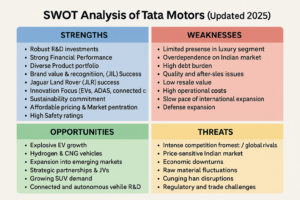
Strengths of Tata Motors
- Robust R&D Investments
Tata Motors increased its R&D spending by 45% in FY24, reaching ₹29,398 crore. With R&D centers across India, UK, Spain, and South Korea, the company is innovating in electric mobility, safety technologies, and advanced design. This investment secures long-term leadership in the evolving automotive landscape. - Strong Financial Performance
Despite the cyclical nature of the auto industry, Tata Motors recorded revenues of ₹4.37 lakh crore in FY24 — a testimony to its operational efficiency, resilience, and market demand for its vehicles. - Diverse Product Portfolio
Tata Motors offers more than 140 products with 700+ variants, ranging from compact cars (Tiago, Tigor), SUVs (Nexon, Harrier, Safari), to heavy trucks and buses. This wide portfolio cushions the company against demand fluctuations in any one segment. - Brand Value & Recognition
The Tata brand is one of India’s most trusted. In 2023, Tata retained the No. 1 spot in Brand Finance’s India 100 list with a value of $26.4 billion. This reputation boosts consumer trust and investor confidence. - Jaguar Land Rover (JLR) Success
The acquisition of JLR has been a turning point. JLR recorded revenues of £7.9 billion in Q4 FY24, with strong growth in China. It adds global scale, prestige, and profitability to Tata Motors’ balance sheet. - Global Distribution & Presence
With operations in 125+ countries, Tata Motors leverages a robust global distribution system, ensuring wide customer reach and faster product rollouts. - Innovation Focus
Tata Motors is investing in ADAS, connected cars, EVs, and hydrogen fuel technologies. This proactive approach aligns with future mobility trends. - Sustainability Commitment
The company follows eco-friendly manufacturing practices and produces BS6-compliant and electric vehicles, ensuring compliance with global emission standards and enhancing its green image. - Affordable Pricing & Market Penetration
Models like Tiago and Tigor cater to India’s price-sensitive market, offering safety and quality at competitive rates. This affordability has boosted Tata’s market share significantly. - High Safety Ratings
Cars like Tata Nexon and Altroz received 5-star Global NCAP crash ratings, building consumer trust and positioning Tata Motors as a safety-first manufacturer. - Defense & Specialized Vehicles
Tata Motors also manufactures armored and defense vehicles, diversifying its business and establishing itself as a key player in India’s defense modernization program.
Weaknesses of Tata Motors
- Limited Presence in Luxury Segment
Despite owning JLR, Tata lacks strong brand positioning in luxury cars under its own name. Competing with BMW, Mercedes, and Audi remains a challenge. - Overdependence on Indian Market
A large share of revenue comes from India. This makes Tata Motors vulnerable to economic fluctuations, policy changes, and domestic competition. - High Debt Burden
Tata Motors has accumulated significant debt, leading to high interest costs and reduced flexibility in allocating funds for innovation and global expansion. - Quality & After-Sales Issues
Though improving, Tata has struggled with past perceptions of poor service quality and recalls. Weak after-sales service compared to competitors like Maruti Suzuki affects customer loyalty. - Low Resale Value
Tata vehicles typically fetch lower resale prices, reducing appeal among cost-conscious customers who consider resale value as a purchase factor. - High Operational Costs
Running JLR operations, managing global plants, and investing heavily in R&D increases operational costs, which in turn affects margins. - Slow Pace of International Expansion
While present globally, Tata’s pace of entering new high-growth markets has been slower compared to competitors like Hyundai or Toyota.
Opportunities for Tata Motors
- Explosive EV Growth
Tata Motors is already India’s EV leader, with nearly 80% market share. Its EV division grew 353% in FY24. With government subsidies and rising demand, Tata has a massive first-mover advantage. - Hydrogen & CNG Vehicles
Rising fuel costs and government incentives make CNG and hydrogen-powered vehicles attractive. Tata’s ongoing investments position it to capture this market. - Expansion into Emerging Markets
Growing middle classes in Africa, Southeast Asia, and Latin America offer untapped opportunities for passenger and commercial vehicles. - Strategic Partnerships & JVs
Collaborating with global technology firms and local players can accelerate product innovation, market entry, and digital transformation. - SUV Demand Surge
SUVs are among the fastest-growing segments globally. Tata’s SUVs (Nexon, Harrier, Safari) can capture this trend with improved designs and value-added features. - Connected & Autonomous Vehicles
Investing in autonomous driving and connectivity can give Tata Motors a competitive edge in the next decade. - Defense Expansion
With rising defense budgets, Tata can further expand its military vehicle business, diversifying revenues. - Reputation & Brand Perception
Continued focus on safety, quality, and sustainability can transform Tata’s brand image from “value-driven” to “premium yet affordable.”
Threats to Tata Motors
- Intense Competition
Domestic rivals like Maruti Suzuki, Mahindra, and Hyundai, along with global giants like Toyota and Volkswagen, pose constant threats with competitive pricing and features. - Price-Sensitive Market
Indian buyers are extremely price-conscious. Even small price hikes can shift demand toward competitors. - Economic Downturns
Global or domestic recessions can significantly reduce big-ticket purchases like cars. - Raw Material Fluctuations
Rising prices of steel, aluminum, and rubber impact profitability, especially in the CV segment where margins are already thin. - Supply Chain Disruptions
Semiconductor shortages and global trade tensions have already hurt JLR. Any recurrence can affect production and sales. - Changing Consumer Preferences
Customers increasingly prefer EVs, shared mobility (Ola, Uber), and digital-first experiences. Tata must adapt quickly to avoid losing relevance. - Regulatory & Trade Challenges
Stringent emission norms, safety standards, and trade tariffs across regions can increase compliance costs and impact global competitiveness.
Conclusion
Tata Motors stands at a pivotal juncture in 2025. Its strengths — including a diverse product range, strong R&D, leadership in electric vehicles, and global brand trust — position it well to capture the next wave of mobility trends.
However, challenges such as high debt, overdependence on India, and global competition must be carefully managed. By doubling down on EV leadership, sustainability, digital transformation, and global expansion, Tata Motors can secure its future as not just India’s leading automaker but also a global automotive innovator.
FAQs
What is the biggest strength of Tata Motors in 2025?
Tata Motors’ biggest strength is its leadership in the electric vehicle (EV) market, where it commands nearly 80% of India’s EV share. Coupled with strong R&D and a trusted brand, this gives Tata a significant competitive edge.
What is Tata Motors’ main weakness?
Tata Motors’ main weakness is its overdependence on the Indian market and high debt levels. Quality and after-sales service issues have also historically impacted customer loyalty.
What opportunities does Tata Motors have in the future?
Tata Motors has massive opportunities in electric vehicles, hydrogen fuel technology, SUVs, and defense vehicles. Emerging markets like Africa, Southeast Asia, and Latin America also present huge growth potential.
What are the major threats to Tata Motors?
Key threats include intense competition, price-sensitive markets, economic slowdowns, raw material price fluctuations, and supply chain disruptions such as semiconductor shortages.
Is Tata Motors leading in the EV sector?
Yes. Tata Motors is India’s largest EV manufacturer with models like Tata Nexon EV, Tigor EV, and Tiago EV, and it has already recorded over 350% growth in EV sales in FY24.
How does Jaguar Land Rover (JLR) impact Tata Motors?
JLR remains a valuable asset, contributing significant revenue and global presence. However, challenges like semiconductor shortages and global demand fluctuations make it both a strength and a risk factor.
What is Tata Motors’ global presence?
Tata Motors operates in over 125 countries with strong distribution networks across Asia, Europe, Africa, and Latin America, ensuring a diversified revenue base.
How is Tata Motors focusing on sustainability?
The company is investing in green manufacturing, BS6-compliant vehicles, EVs, CNG, and hydrogen technologies, aligning with global climate goals and eco-conscious consumer demand.

A digital marketer with a strong focus on SEO, content creation, and AI tools. Creates helpful, easy-to-understand content that connects with readers and ranks well on search engines. Loves using smart tools to save time, improve content quality, and grow online reach.