

Enterprise websites are very different from small or medium-sized websites. They often contain thousands or even millions of pages, are managed by multiple teams, and rely on complex technologies. Because of this scale and complexity, a simple SEO audit is not enough.
An enterprise SEO audit needs a structured and systematic approach. Even small SEO issues can create large problems when they affect thousands of URLs. This guide explains a 24-point enterprise SEO audit framework designed specifically for large websites and organizations. It covers technical SEO, content, authority, analytics, governance, and risk management in a way that can scale.
What Makes Enterprise SEO Different
Enterprise SEO focuses on managing SEO at scale rather than optimizing a few individual pages. The challenges are broader and often involve people, processes, and platforms.
Key differences include:
- Large-scale site structures with deep page hierarchies
- Multiple stakeholders such as content teams, developers, legal teams, and regional managers
- Frequent deployments that can unintentionally affect SEO
- Greater business risk if SEO issues are not caught early
Because of these factors, enterprise SEO audits must focus on patterns, templates, and systems, not just individual URLs.
How to Use This 24-Point Enterprise SEO Audit
This audit framework is designed to help teams evaluate SEO health in a structured and repeatable way.
Before starting, it is important to understand:
- Enterprise audits should be conducted regularly, not as one-time projects
- Data from multiple tools is required to get an accurate picture
- Issues should be prioritized based on business impact, not just SEO best practices
This audit should be used as a decision-making tool, helping teams understand what to fix first and where SEO efforts will deliver the highest return.
Technical SEO Audit
1. Crawlability & Indexability
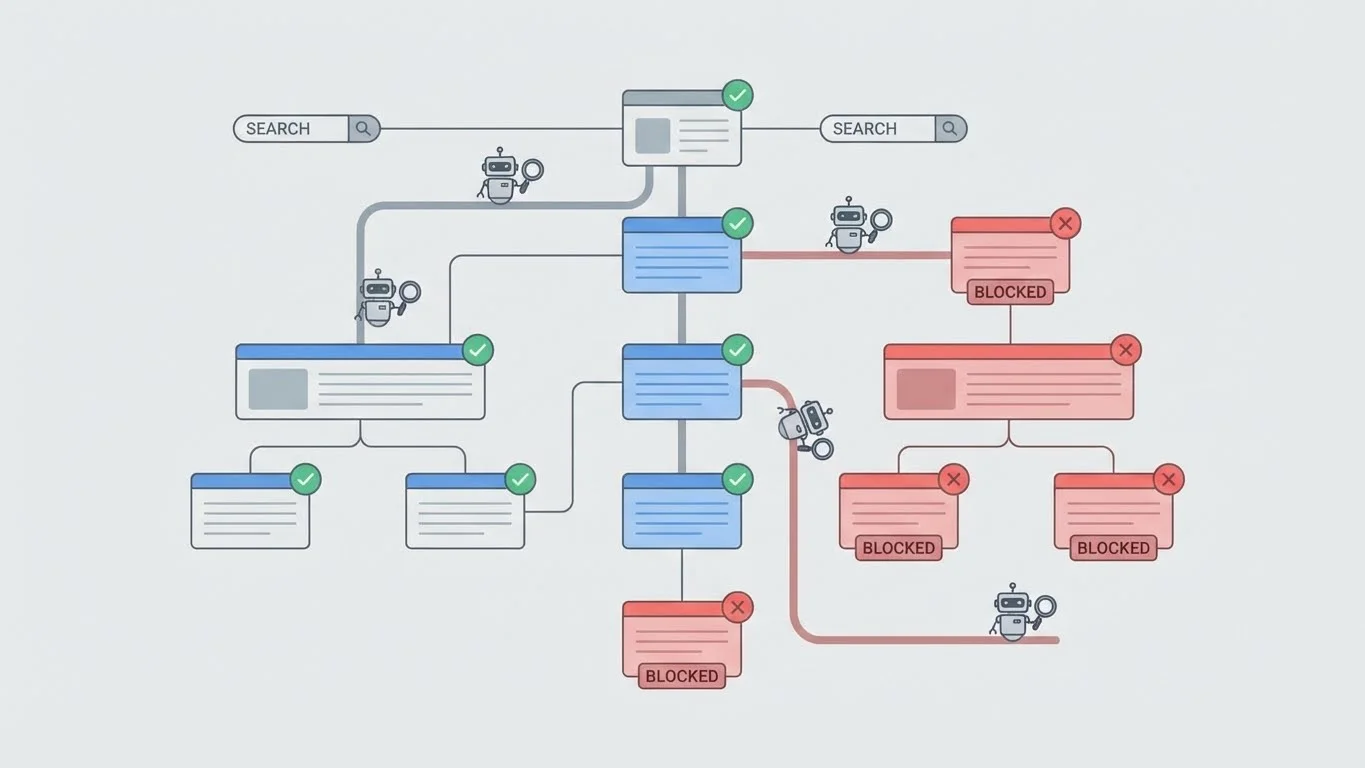
Crawlability determines whether search engines can access your pages, while indexability determines whether those pages are stored in the search index.
For large sites, inefficient crawling can waste crawl budget and delay indexing of important pages.
Key areas to review:
- Pages blocked by robots.txt or meta robots tags
- Incorrect use of noindex directives
- Crawl depth of important pages
- Crawl budget allocation across key templates
2. Site Architecture & URL Structure

A clear and logical site architecture helps search engines understand page relationships and importance.
Enterprise sites often suffer from inconsistent URL structures due to legacy systems and multiple teams.
Audit considerations:
- Logical folder and category hierarchy
- Clean, readable URLs without unnecessary parameters
- Consistent URL patterns across templates
- Proper handling of tracking and session parameters
3. JavaScript Rendering & Framework SEO
Many enterprise sites rely heavily on JavaScript frameworks. While search engines can process JavaScript, it still introduces risk.
Issues often appear when content or links are not available in the initial HTML.
Things to evaluate:
- Whether critical content is rendered server-side
- Delays in rendering that affect indexing
- JavaScript-generated links that search engines may miss
- Differences between rendered and raw HTML
4. Core Web Vitals & Page Performance
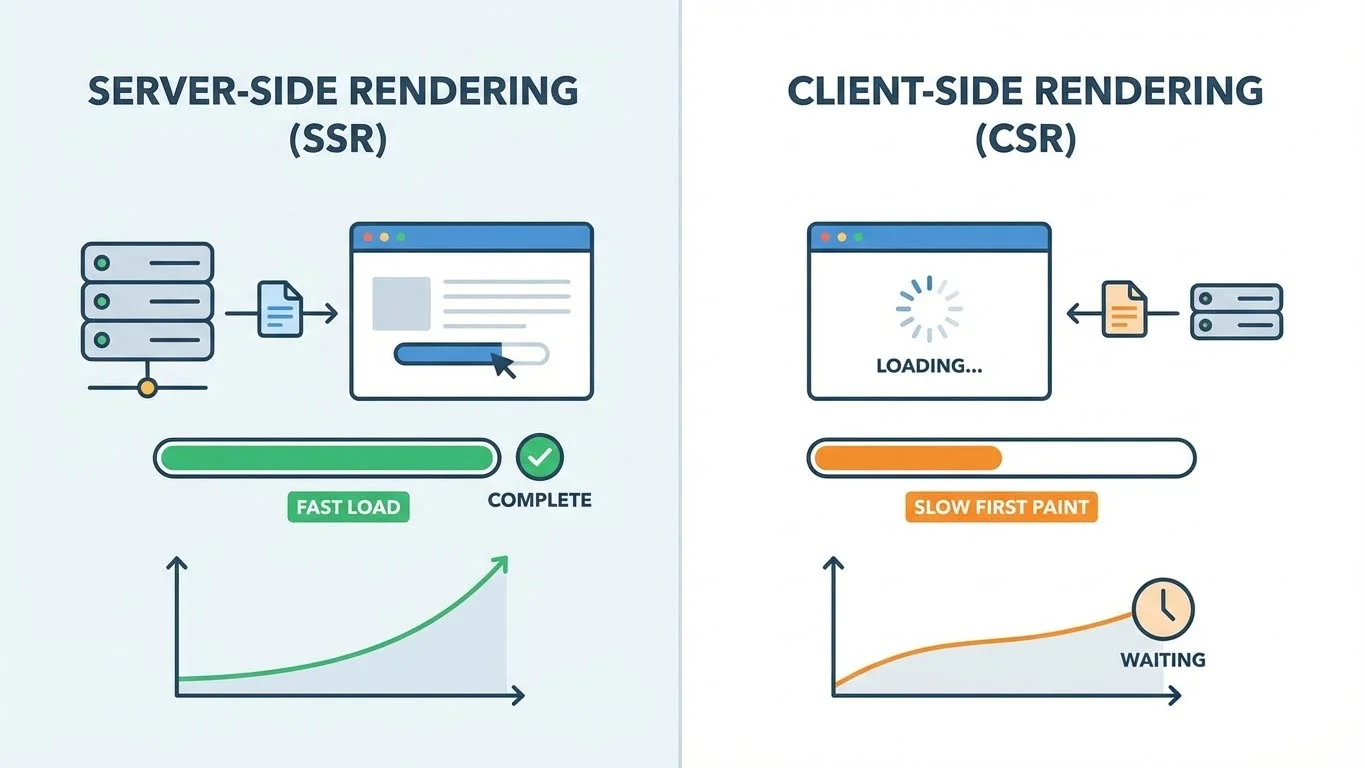
Performance issues scale quickly on large sites. A slow template can impact thousands of pages.
Core Web Vitals help measure real-world user experience related to speed and stability.
Audit focus areas:
- Performance consistency across page templates
- Mobile and desktop performance differences
- Server response time issues
- Impact of third-party scripts on load speed
5. Mobile SEO & Device Parity
With mobile-first indexing, the mobile version of a site is the primary version evaluated by search engines.
Enterprise sites sometimes show reduced content or features on mobile.
Key checks include:
- Content parity between mobile and desktop
- Mobile navigation and internal linking
- Mobile usability issues
- Page speed on mobile devices
6. Duplicate Content & Canonicalization

Duplicate content is common on enterprise sites due to filters, sorting options, and content reuse.
Canonical tags help consolidate signals, but they must be implemented correctly at scale.
Important audit points:
- Correct canonical placement across templates
- Self-referencing canonicals on indexable pages
- Handling of faceted navigation URLs
- Prevention of cross-domain canonical errors
7. Pagination & Infinite Scroll Handling
Large content libraries often rely on pagination or infinite scroll.
If implemented incorrectly, search engines may not discover deeper pages.
Audit considerations:
- SEO-friendly pagination links
- Crawl access to paginated content
- Proper handling of infinite scroll with crawlable URLs
- Avoiding index bloat from paginated parameters
8. XML Sitemaps & Robots Directives
XML sitemaps guide search engines to important pages, especially on large sites.
Robots directives must be precise to avoid blocking valuable content.
Things to review:
- Sitemap segmentation by content type
- Inclusion of only canonical, indexable URLs
- Sitemap freshness and update frequency
- Robots.txt rules that may unintentionally block crawling
On-Page & Content SEO Audit
9. Enterprise Keyword Mapping & Cannibalization
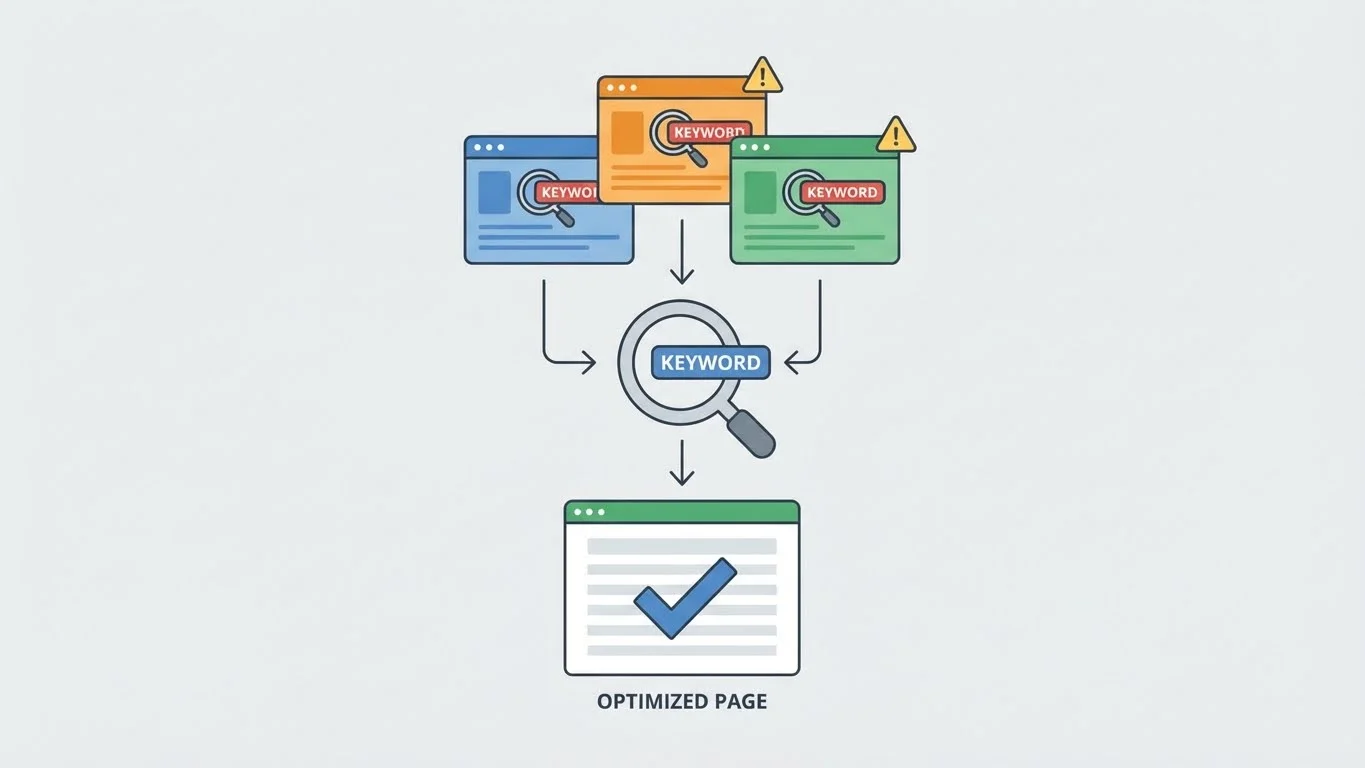
Keyword cannibalization happens when multiple pages target the same search intent.
In enterprise environments, this often occurs across teams or regions.
Audit focus:
- Overlapping keyword targets across templates
- Multiple pages ranking for the same queries
- Clear primary and secondary keyword assignments
- Alignment between keyword intent and page purpos
10. Content Quality & Thin Content Detection
At scale, low-quality content can dilute site-wide performance.
Thin content may exist due to automated pages, outdated assets, or incomplete templates.
Key areas to evaluate:
- Pages with very low word count or value
- Duplicate or near-duplicate content
- Pages with no clear search intent
- Opportunities for consolidation or removal
11. Metadata Optimization at Scale
Titles and meta descriptions are often generated using templates on enterprise sites.
Errors at the template level can affect thousands of pages.
Audit points:
- Duplicate or missing title tags
- Overly long or truncated titles
- Non-descriptive meta descriptions
- Scalable rules for metadata generation
12. Heading Structure & Content Hierarchy
Headings help both users and search engines understand content structure.
Inconsistent heading usage can weaken content clarity.
Things to check:
- One clear H1 per page
- Logical heading order (H2, H3, etc.)
- Template-level heading errors
- Alignment with accessibility best practices
13. Internal Linking Strategy
Internal links distribute authority and help search engines discover important pages.
Enterprise sites often suffer from orphaned or poorly linked content.
Audit considerations:
- Identification of orphan pages
- Link depth of high-value pages
- Internal linking consistency across templates
- Use of contextual links within content
14. International & Multilingual SEO (If Applicable)
Global enterprises often operate multiple regional or language versions.
Incorrect international targeting can cause ranking conflicts.
Key audit checks:
- Correct hreflang implementation
- Matching language and regional signals
- Avoiding hreflang conflicts and loops
- Consistent URL structures for regions
Off-Page & Authority Audit
15. Backlink Profile Quality & Risk Assessment
Enterprise sites attract large numbers of backlinks, not all of them beneficial.
A regular backlink audit helps manage risk.
Areas to review:
- Overall link quality and relevance
- Sudden spikes or drops in backlinks
- High-risk or spammy referring domains
- Anchor text distribution
16. Brand Mentions & Unlinked Opportunities
Large brands are often mentioned without receiving links.
These mentions represent missed SEO opportunities.
Audit focus:
- Frequency of unlinked brand mentions
- High-authority sites mentioning the brand
- Opportunities for outreach and link acquisition
17. Competitive Authority Benchmarking
Understanding authority relative to competitors is essential in enterprise SEO.
This helps identify gaps and realistic growth targets.
Key considerations:
- Domain-level authority comparison
- Link growth trends over time
- Content and link strategies used by competitors
18. Digital PR & Enterprise Link Earning
Sustainable link growth often comes from digital PR and content marketing.
Enterprise SEO benefits from alignment between PR and SEO teams.
Audit points:
- Existing digital PR initiatives
- Link acquisition scalability
- Integration between SEO, content, and PR efforts
Data, Analytics & Governance Audit
19. Analytics & Tracking Accuracy
SEO decisions depend on accurate data.
Tracking issues can mislead teams and slow progress.
Things to review:
- Analytics implementation consistency
- Cross-domain and subdomain tracking
- Conversion and event tracking accuracy
20. Search Console Coverage & Insights
Search Console provides direct feedback from search engines.
At enterprise scale, coverage issues can be widespread.
Audit focus:
- Index coverage errors
- Excluded pages and reasons
- Query and page-level performance trends
21. SEO Automation & Tool Stack Evaluation
Enterprise SEO relies heavily on tools and automation.
An audit should assess whether the current stack supports scale.
Key areas:
- Tool overlap or gaps
- Automation for audits and reporting
- Data accuracy and reliability
22. SEO Governance & Workflow Processes
Without governance, SEO issues can be introduced repeatedly.
Clear ownership and workflows reduce risk.
Audit considerations:
- SEO involvement in development cycles
- Approval processes for content and technical changes
- Documentation and internal guidelines
Security, Compliance & Risk Audit
23. Security, HTTPS & Compliance Signals
Security is a trust signal for both users and search engines.
Enterprise sites must maintain consistency across all assets.
Key checks:
- HTTPS implementation across all URLs
- Mixed content issues
- Secure handling of user data
24. SEO Risk Management & Change Control
Enterprise sites change frequently, increasing SEO risk.
Proactive monitoring helps prevent major losses.
Audit focus:
- SEO impact assessments before releases
- Monitoring systems for sudden traffic drops
- Rollback plans for critical SEO issues
Turning Audit Findings Into an Enterprise SEO Roadmap
An enterprise SEO audit is only valuable if insights are acted upon.
Findings should be translated into:
- Prioritized action items
- Clear ownership and timelines
- Alignment with business goals
- Phased execution plans
This approach ensures long-term SEO improvements rather than short-term fixes.
Conclusion
Enterprise SEO audits require depth, structure, and consistency. Unlike smaller sites, large organizations must focus on scalable systems, governance, and risk management.
By following this 24-point enterprise SEO audit framework, organizations can identify critical issues, reduce risk, and build a strong foundation for sustainable search performance. An enterprise SEO audit is not a one-time task—it is an ongoing process that supports long-term growth.

Passionate about blogging and focused on elevating brand visibility through strategic SEO and digital marketing. Always tuned in to the latest trends, I’m dedicated to maximizing engagement and delivering measurable ROI in the dynamic world of digital marketing. Let’s connect and unlock new opportunities together!