
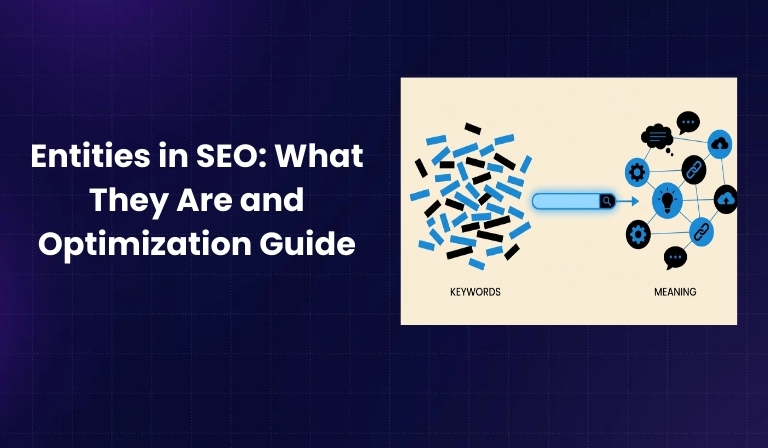

Search engines are no longer just matching words typed by users. They are designed to understand meaning, context, and intent behind every search query. Because of this shift, traditional keyword-only SEO strategies are becoming less effective over time.
Modern SEO focuses on what a piece of content is about rather than which exact words it uses. This is where entities play a critical role. Entities help search engines understand real-world things, concepts, and their relationships. When your content is optimized around entities, it aligns better with how search engines interpret and rank information.
In this guide, you will learn what entities are in SEO, why they matter, how search engines use them, and how to optimize your content using an entity-based approach.
What Are Entities in SEO?

In SEO, an entity is a uniquely identifiable thing that a search engine can clearly recognize and understand. An entity has a distinct meaning and identity, regardless of how it is written or phrased in content.
For example, a company, a person, a city, or a clearly defined concept can all be entities. Unlike keywords, which are just text strings, entities represent real-world or conceptual objects with specific meanings. Search engines use entities to understand what your content refers to, not just how it is written.
Types of Entities Search Engines Recognize
Search engines recognize and categorize different kinds of entities to understand content more accurately. These commonly include:
- Named entities, such as brands, people, organizations, and locations
- Conceptual entities, such as topics, industries, or ideas
- Physical entities, including products, landmarks, or places
- Abstract entities, such as strategies, processes, or theories
By identifying these entity types, search engines can build a more accurate understanding of your content and its relevance.
Why Entities Matter in Modern SEO

Entities are essential because they allow search engines to move beyond keyword matching and focus on meaning. Words can have multiple meanings, but entities have a clear and specific identity.
When content is structured around entities, search engines can reduce ambiguity and understand context more effectively. This improves relevance, ranking stability, and accuracy in search results. Entity-based content also performs better across related queries because it covers a topic more comprehensively instead of focusing on a single phrase.
How Search Engines Use Entities
Entity Recognition and Disambiguation
Search engines analyze content to identify entities mentioned on a page. Once detected, they determine which specific entity is being referenced. This process is known as disambiguation.
For example, the same term can refer to different things depending on context. By analyzing surrounding words and topics, search engines can identify the correct entity and deliver more accurate search results.
Entity Relationships and Connections
Entities are connected to other entities through relationships. Search engines analyze these relationships to understand context more deeply.
For instance, a brand may be connected to its products, industry, and location. A topic may be linked to subtopics, tools, and use cases. Clearly defined relationships help search engines understand the full scope of your content.
Entity Databases and Knowledge Systems
Search engines store entity information in large-scale knowledge systems. These systems organize entities along with their attributes and relationships.
Google uses such knowledge systems to support features like knowledge panels, enhanced search results, and improved relevance. These systems ensure consistent understanding of entities across different searches.
Entities vs Keywords: Key Differences
Keywords are the words or phrases users type into search engines. Entities represent the meaning behind those words.
Keyword-based SEO focuses on matching exact phrases, which can lead to repetitive or narrow content. Entity-based SEO focuses on covering a topic thoroughly, including all related concepts. This approach results in more natural content and stronger long-term performance, even as search behavior evolves.
Examples of Entities in SEO
Entities can appear in many forms within SEO content. A brand name can function as an entity, a city can be a location-based entity, and a well-defined topic can be an informational entity.
A single page can also include multiple related entities naturally. For example, a service page may reference tools, industries, locations, and processes. When structured properly, this helps search engines understand the full context of the page.
How to Identify Entities for Your Content

Using SERPs to Discover Entities
Search engine results pages provide strong signals about important entities related to a topic. By reviewing top-ranking pages, you can identify recurring concepts and themes.
Related searches and contextual result features often highlight supporting entities that search engines consider relevant.
Content and Topic Research for Entity Discovery
Identifying entities starts with understanding the topic in depth. This includes recognizing the main subject and the supporting concepts that naturally connect to it.
Mapping these entities to user intent ensures your content addresses real search needs instead of focusing only on isolated keywords.
Competitor-Based Entity Analysis
Analyzing competitor content helps identify commonly used entities within a topic. This reveals what search engines already associate with that subject.
By comparing competitor coverage with your own, you can find missing entities and improve content completeness without copying or over-optimizing.
How to Optimize Content for Entities (Step-by-Step Guide)

1. Create Entity-Focused Content
Entity-focused content is built around topics rather than individual keywords. The goal is to explain the subject thoroughly by covering all relevant aspects and related entities.
This results in content that is more informative, useful, and aligned with how search engines evaluate relevance.
2. Use Clear Context and Semantic Signals
Clear context helps search engines connect entities accurately. This means using related terms and concepts naturally throughout the content.
Maintaining consistency in language and topic coverage strengthens entity recognition and understanding.
3. Optimize Headings and Content Structure
Headings help highlight key entities and organize content logically. Well-structured headings make it easier for search engines to identify the main topic and its subtopics.
A clear hierarchy also improves readability, benefiting both users and search engines.
4. Internal Linking for Entity Reinforcement
Internal linking connects related entities across your website. Linking between pages covering similar or supporting topics strengthens topical relevance and authority.
This also helps search engines understand how different pieces of content relate to each other.
Role of Structured Data in Entity Optimization
Structured data provides explicit information about entities and their attributes. Schema markup helps search engines identify and classify entities more accurately.
Common schema types support organizations, products, articles, and other entity categories. While structured data does not directly guarantee rankings, it improves clarity and can enhance visibility in search results.
Entity SEO and Topical Authority
Topical authority is built by consistently covering a subject and its related entities in depth. Entity-based optimization supports this by ensuring that all relevant concepts are clearly addressed.
By creating interconnected content around core entities, websites can demonstrate expertise, trust, and consistency over time.
Common Mistakes to Avoid in Entity SEO
A common mistake is focusing only on keywords while ignoring meaning and relationships. Creating disconnected or shallow content weakens entity signals.
Another issue is relying entirely on tools without understanding context. Tools can assist with research, but effective entity optimization requires thoughtful analysis and subject knowledge.
Conclusion
Entities form the foundation of modern SEO. They help search engines understand content in terms of meaning, context, and relationships instead of just keywords.
By focusing on entities, you can create more relevant, comprehensive, and durable content. As search technology continues to evolve, entity-based optimization will remain a key factor in achieving long-term SEO success.

Passionate about blogging and focused on elevating brand visibility through strategic SEO and digital marketing. Always tuned in to the latest trends, I’m dedicated to maximizing engagement and delivering measurable ROI in the dynamic world of digital marketing. Let’s connect and unlock new opportunities together!