
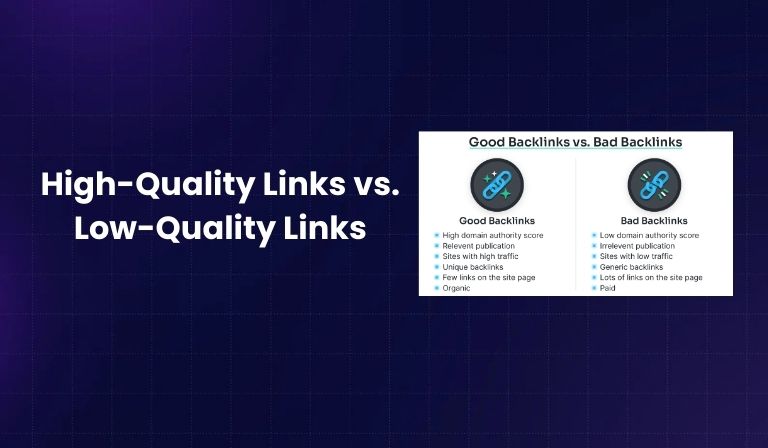

Backlinks remain one of the most powerful ranking factors in SEO. However, not all links are created equal. A single high-quality backlink from a trusted, relevant website can outweigh hundreds of low-quality links from spammy or irrelevant sources. Understanding the difference between high-quality links and low-quality links is critical if you want to build sustainable rankings, protect your website from penalties, and grow organic traffic long-term.
In this in-depth guide, we will explore how search engines use links, what makes a link valuable, what defines low-quality backlinks, how authority and relevance interact, and how to identify truly high-quality links. By the end, you will understand how to build a safe, effective link-building strategy based on quality rather than quantity.
Why Link Quality Matters More Than Ever
In the early days of SEO, link building was largely about numbers. The more backlinks a website had, the better it ranked. This led to widespread abuse—link farms, directory spam, blog comment spam, and automated link schemes flooded the internet.
Search engines evolved. Today, link evaluation is far more sophisticated. Algorithms now assess:
- The authority of the linking domain
- The relevance of the linking page
- The context of the link
- Anchor text usage
- Link placement
- Editorial integrity
This shift makes understanding high-quality links vs. low-quality links more important than ever.
How Do Search Engines Use Links?
To understand link quality, you first need to understand how search engines interpret links.
1. Links as Trust Signals
Backlinks function as endorsements. When one website links to another, it signals trust and credibility. The stronger the reputation of the linking site, the more weight that endorsement carries.
2. Links as Authority Indicators
Search engines use links to measure authority. If many reputable sites link to a page, it suggests that the content provides value and expertise.
3. Links Help Discover Content
Search engine crawlers follow links to discover new pages. A page with strong internal and external links is easier to index and evaluate.
4. Anchor Text Context
Anchor text provides context about the linked page. Natural, relevant anchor text helps search engines understand topic relationships.
- Internal vs. External Links
- Internal links strengthen site structure and distribute authority.
- External backlinks influence domain-level authority and rankings.
Because links influence discovery, trust, and rankings, their quality significantly impacts SEO performance.
What Is Valuable About a Link?
The value of a backlink primarily depends on two core elements: authority and relevance.
Authority
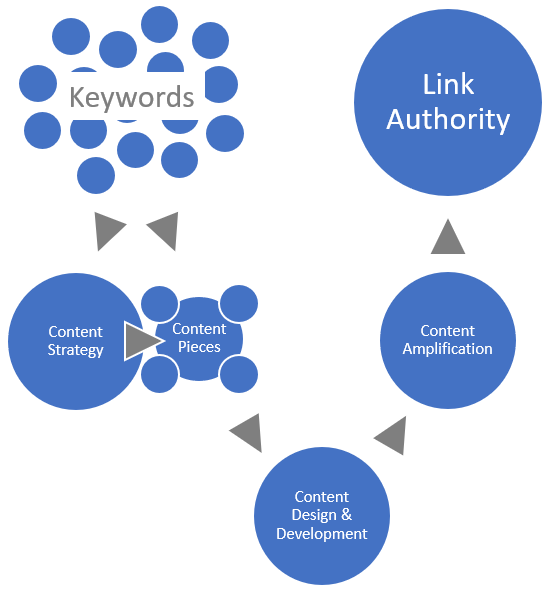
Authority refers to the credibility and trustworthiness of the linking website.
High-authority websites typically:
- Have strong backlink profiles themselves
- Publish high-quality, original content
- Maintain editorial standards
- Receive consistent traffic
Examples include well-known industry publications, educational institutions, government sites, and respected media platforms.
A link from an authoritative website carries significant ranking weight because it signals trust.
Relevance
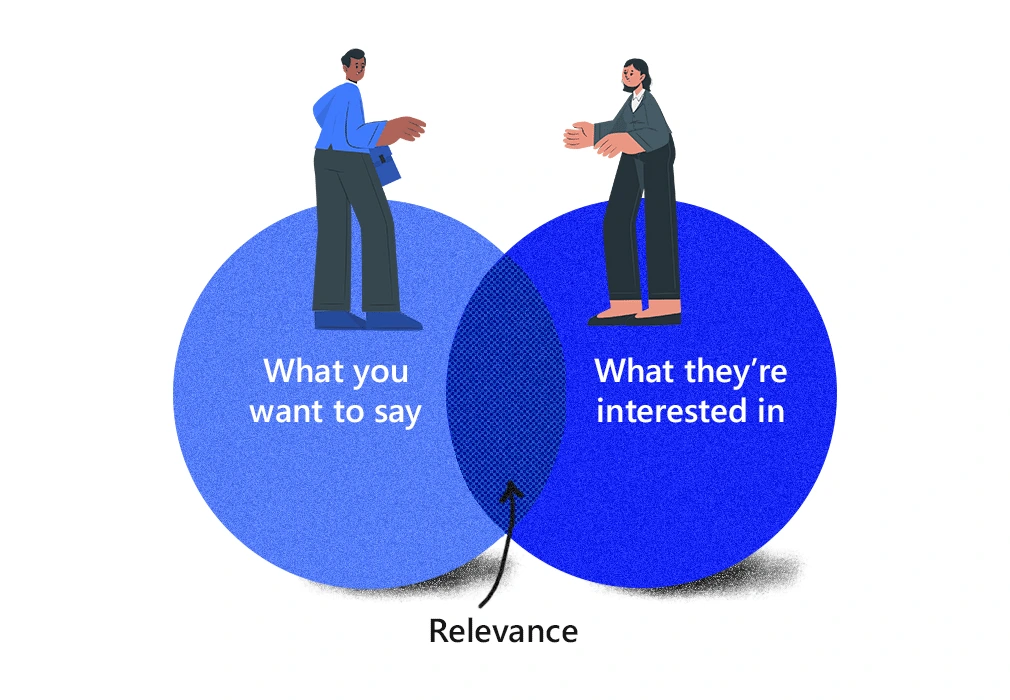
Relevance refers to how closely related the linking website is to your niche or topic.
For example:
- A medical blog linking to a healthcare site is relevant.
- A casino website linking to a healthcare site is not relevant.
Relevance increases the contextual value of the link. Search engines prioritize topical alignment because it reflects genuine editorial relationships rather than manipulation.
Authority & Relevance Together
The strongest links combine both authority and relevance.
For example:
- A top industry publication linking to your detailed guide.
- A respected niche blog referencing your case study.
If authority is high but relevance is low, the link still holds value—but less contextually.
If relevance is high but authority is low, the link may still help within your niche.
The best SEO strategies aim to secure links that maximize both.
What Makes a Link Low-Quality?
Not all backlinks help your SEO. In fact, some can actively damage your rankings, credibility, and long-term growth. Low-quality links usually share certain characteristics that signal manipulation, poor editorial standards, or lack of relevance.
Below is a detailed breakdown of the most common traits of low-quality backlinks and why they can harm your website.
1. Spammy Domains
Spammy domains are websites created primarily to manipulate rankings rather than provide real value to users. These domains often have the following characteristics:
- Poor website design with little to no user experience focus
- Generic, scraped, or spun content
- Large volumes of outbound links to unrelated websites
- No clear brand identity or author information
- Suspicious domain names or unnatural URL structures
Many spammy domains exist solely to sell links. They may promise “high DA backlinks” at cheap rates, but in reality, they operate as link marketplaces with no editorial standards.
Why this is dangerous:
Search engines evaluate the overall trustworthiness of a linking domain. If a domain itself has low authority, spam signals, or a toxic backlink profile, any link from that site carries little to no value. In severe cases, accumulating links from spammy domains can trigger algorithmic penalties or manual actions.
2. Link Farms
Link farms are networks of websites built specifically to link to one another or to paying clients. They are designed to artificially inflate backlink counts.
Common characteristics of link farms include:
- Hundreds of low-quality websites under common ownership
- Thin content published solely to place backlinks
- Repetitive keyword-rich anchor text
- Articles that feel unnatural and unrelated to the site’s theme
- Identical templates across multiple domains
These networks attempt to manipulate search engine algorithms by creating artificial authority signals.
Why this is dangerous:
Search engines are highly sophisticated at identifying link schemes and private blog networks (PBNs). Once detected, websites benefiting from these links may experience ranking drops or penalties. Even if a link farm initially boosts rankings, the long-term risk far outweighs the short-term gain.
3. Irrelevant Niches
Relevance is one of the strongest factors in link quality. When a backlink comes from an unrelated industry, it sends weak or confusing signals to search engines.
For example:
- A fitness website linking to a cryptocurrency platform
- A gambling site linking to a healthcare provider
- An automotive blog linking to a legal consulting firm
While occasional cross-industry mentions may occur naturally, a pattern of irrelevant links suggests manipulation.
Why this is dangerous:
Search engines prioritize contextual alignment. Links from unrelated niches dilute your topical authority. If your backlink profile is filled with irrelevant sources, it weakens your credibility within your own industry.
In extreme cases, irrelevant backlinks from spam-heavy industries (such as gambling, adult content, or pharmaceuticals) can harm your trust signals.
4. Excessive Outbound Links
When a single webpage links out to hundreds of websites, the value of each individual link decreases significantly.
Signs of excessive outbound linking include:
- Pages that look like directories of unrelated businesses
- Articles filled with dozens of commercial anchor texts
- “Resource pages” linking to hundreds of unrelated domains
- Footer sections overloaded with outbound links
Search engines view outbound links as endorsements. If a website links indiscriminately to hundreds of pages, those endorsements lose credibility.
Why this is dangerous:
Authority and trust are diluted when a page spreads its link equity across too many outgoing links. Additionally, excessive outbound links are often a sign that the page is selling links rather than providing genuine recommendations.
5. Thin or Duplicate Content
A link placed within low-effort content provides minimal SEO value.
Thin content typically includes:
- Articles under 300 words with no depth
- Generic blog posts lacking originality
- Spun content created by rewriting existing articles
- Pages with no clear structure or useful information
- Duplicate content copied from other websites
When your backlink appears in content that lacks substance, search engines recognize that the page offers little value to users.
Why this is dangerous:
Backlinks embedded within high-quality, authoritative content carry weight. Conversely, links placed inside low-quality or duplicate content lack editorial credibility. Over time, a pattern of such backlinks signals manipulative practices rather than earned authority.
6. Automated Link Building
Automated link building involves using software or bots to create backlinks at scale. These tools may generate:
- Mass blog comments
- Forum profile links
- Directory submissions
- Web 2.0 spam pages
- Social bookmarking spam
While automation may create hundreds or thousands of backlinks quickly, the quality of those links is typically extremely low.
Common red flags of automated links:
- Identical anchor text repeated across dozens of domains
- Links from random blogs with unrelated content
- Sudden spikes in backlink volume
- Foreign-language spam sites
Why this is dangerous:
Search engines are highly effective at detecting unnatural link patterns. Rapid acquisition of low-quality automated links can lead to ranking suppression or penalties. Moreover, these links rarely generate real traffic or engagement.
Automated link building is often a shortcut strategy that sacrifices long-term stability for short-term illusionary gains.
The Real Risk of Low-Quality Backlinks
Low-quality backlinks do more than fail to help. They can:
- Reduce domain trust
- Trigger algorithmic ranking drops
- Invite manual penalties
- Damage brand credibility
- Waste SEO resources
A backlink profile filled with spammy or manipulative links undermines the foundation of your SEO strategy.
Why Quality Always Wins
Modern SEO prioritizes:
- Editorial integrity
- Relevance
- Authority
- User value
One high-quality, relevant backlink from a trusted source can outperform hundreds of low-quality links.
Instead of focusing on link volume, successful strategies emphasize:
- Building relationships
- Creating valuable content
- Earning mentions naturally
- Publishing authoritative resources
In the long run, sustainable SEO growth depends on trust—not shortcuts.
A Word About Paid Links
Buying links directly for ranking manipulation violates search engine guidelines.
Paid links that pass ranking value without proper disclosure can result in penalties.
However, sponsored placements with proper tagging (rel=”sponsored”) are acceptable when transparent.
The safest strategy is to focus on earning links through value rather than purchasing them.
A Word About NoFollow Links
NoFollow links instruct search engines not to pass traditional ranking authority.
However, they can still:
- Drive referral traffic
- Build brand awareness
- Diversify link profiles
- Enhance credibility
A healthy backlink profile includes a natural mix of follow and nofollow links.
What Do High-Quality Links Look Like?
Understanding link tiers helps evaluate opportunities effectively.
Low Quality: Low Authority / Low Relevance
Example:
- Random directory listing unrelated to your niche.
- Spam blog linking to dozens of industries.
These links offer minimal SEO value.
Low Quality: Low Effort & NoFollow
Examples:
- Blog comment links.
- Forum signatures.
- Automatically generated profiles.
They rarely impact rankings.
Medium Quality: Low Authority but High Relevancy
Examples:
- Small niche blog covering your industry.
- Local community website.
While authority may be limited, relevance adds value.
Medium Quality: Medium Authority & Medium/Low Relevancy
Examples:
- General business blog mentioning your company.
- Broad lifestyle site referencing your research.
These provide moderate authority but limited topical alignment.
High Quality: High Authority but Medium/Low Relevancy
Examples:
- Major news publication citing your study.
- National media outlet referencing your brand.
Authority boosts trust even if niche alignment is imperfect.
High Quality: Medium Authority but High Relevancy
Examples:
- Leading niche publication in your industry.
- Respected specialist blog.
These often drive strong, targeted traffic and topical authority.
High Quality: High Authority & High Relevancy
These are the most powerful links.
Examples:
- Top-tier industry websites.
- Authoritative educational platforms.
- Government resources referencing your research.
Such links can significantly impact rankings and brand credibility.
Big Industry Brands
Links from established global brands carry immense authority.
However, editorial context still matters. A contextual mention within meaningful content is far more valuable than a random listing.
Bad & Toxic Backlinks You Should Avoid
Some backlinks actively harm SEO performance.
Examples:
- Private blog networks (PBNs)
- Hacked websites
- Malware-infected domains
- Irrelevant foreign language spam
- Excessively optimized anchor text spam
Regular backlink audits help identify and manage toxic links.
How To Get Quality Backlinks: 11 Strategies That Work
- Publish original research
- Create in-depth guides
- Develop case studies
- Build relationships with industry bloggers
- Contribute guest articles on reputable sites
- Leverage digital PR
- Participate in expert roundups
- Create linkable visual assets
- Offer tools or calculators
- Publish thought leadership content
- Strengthen internal linking strategy
Quality link building requires patience and consistent value creation.
5 SEO Insights About Outbound Links
- Linking to authoritative sources increases trust.
- Outbound links improve topical clarity.
- Proper citation strengthens credibility.
- Excessive outbound linking dilutes value.
- Strategic outbound links enhance user experience.
Outbound linking done correctly complements backlink strategy.
Conclusion
The difference between high-quality links and low-quality links lies in authority, relevance, editorial integrity, and contextual value.
Quantity alone no longer guarantees rankings. Instead, sustainable SEO growth depends on earning trusted endorsements from credible, relevant sources.
High-quality links:
- Strengthen domain authority
- Improve search rankings
- Drive referral traffic
- Build long-term trust
Low-quality links:
- Provide little to no value
- Risk penalties
- Harm brand credibility
A strategic focus on quality over quantity ensures long-term SEO success.
Frequently Asked Questions
What is the main difference between high-quality and low-quality links?
High-quality links come from authoritative, relevant websites with editorial integrity. Low-quality links typically originate from spammy, irrelevant, or manipulative sources.
Can low-quality links hurt my website?
Yes. Toxic or spammy backlinks can trigger ranking penalties or algorithmic suppression.
Are nofollow links useless?
No. While they may not pass traditional ranking authority, they provide traffic, brand exposure, and link profile diversity.
How many backlinks do I need to rank?
There is no fixed number. A few strong, high-quality links often outperform hundreds of weak ones.
How long does it take for backlinks to impact rankings?
Backlink impact varies, but noticeable improvements often take weeks or months depending on competition and domain strength.
Building an effective link strategy requires careful evaluation, patience, and consistent content quality. When you prioritize high-quality links over shortcuts, you build authority that lasts.