
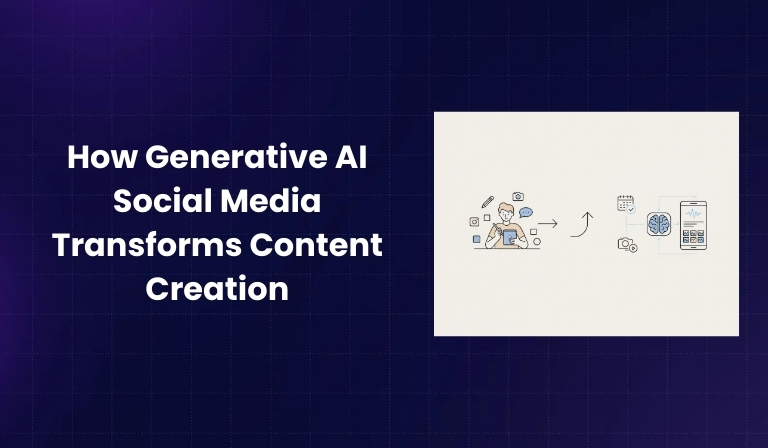

Social media content creation has changed a lot over the years. Earlier, brands and creators relied completely on manual work. Every post, caption, image, and video had to be planned, created, edited, and published by humans. This process took time, money, and a lot of effort.
As social media platforms grew, the demand for content also increased. Brands now need to post daily, sometimes multiple times a day, across many platforms. This made content creation more complex and stressful.
Generative AI has emerged as a major shift in this process. It is not just helping creators work faster, but also changing how content is planned, created, and personalized. By 2026, Generative AI has become an essential part of social media content creation for brands, agencies, and creators.
What Is Generative AI in Social Media?
Generative AI in social media refers to artificial intelligence systems that can create new content instead of only managing or scheduling existing content. These systems can generate text, images, videos, and even ideas based on data and instructions.
Unlike traditional automation tools, Generative AI does not only follow predefined rules. It learns patterns from large amounts of data and produces original outputs that match the given input or context.
Key differences between traditional tools and Generative AI include:
- Traditional tools automate repetitive tasks like scheduling or posting
- Generative AI creates captions, visuals, videos, and content ideas
- Traditional tools depend on fixed templates
- Generative AI adapts content based on trends, tone, and audience behavior
In simple terms, Generative AI does not just assist social media teams; it actively participates in content creation.
Why Generative AI Matters More Than Ever in 2026
By 2026, social media platforms are more crowded than ever. Millions of posts are published every minute, making it harder for brands to stand out.
At the same time, user attention spans are shorter. People scroll quickly and expect content that feels relevant, engaging, and timely. Creating such content manually at scale is extremely difficult.
Generative AI has become important because it helps solve these challenges.
Reasons why Generative AI matters more in 2026 include:
- Growing demand for high-volume content across platforms
- Increased competition for user attention
- Need for faster content creation without compromising consistency
- Rising expectation for personalized content experiences
Generative AI allows brands to keep up with these demands while maintaining quality and relevance.
How Generative AI Is Changing Social Media Content Creation
Generative AI is not changing just one part of the content process. It is reshaping the entire workflow, from ideation to publishing.
AI-Powered Content Ideation
Coming up with fresh content ideas regularly is one of the biggest challenges for social media teams. Generative AI helps by analyzing trends, audience interests, and past performance to suggest ideas.
How AI helps with ideation:
- Generates post ideas based on trending topics
- Suggests hooks and opening lines for posts
- Helps plan content themes for weeks or months
This reduces creative fatigue and keeps content ideas aligned with audience interests.
Automated Content Creation at Scale
Creating content in large volumes is difficult when done manually. Generative AI makes it easier to produce multiple pieces of content in less time.
AI supports scalable content creation by:
- Generating captions for different platforms
- Creating visuals and carousel designs
- Maintaining a consistent brand tone across posts
This allows brands to publish more content without increasing team size.
Personalized Content for Every Audience Segment
Modern audiences expect content that feels personal. Generative AI enables personalization by creating multiple variations of the same message.
Personalization benefits include:
- Different captions for different audience groups
- Platform-specific content styles
- Region or language-based content variations
This helps improve relevance and engagement without creating content manually for each segment.
Faster Content Production and Publishing
Speed is critical in social media, especially when trends change quickly. Generative AI reduces the time needed to go from idea to published post.
Ways AI improves speed:
- Quick generation of captions and creatives
- Faster approval and editing cycles
- Real-time content creation for trending topics
This helps brands stay timely and competitive.
Types of Generative AI Content Used in Social Media
Generative AI is used to create different types of social media content, each serving a specific purpose.
AI-Generated Text Content
Text is a core part of social media communication. AI-generated text is widely used for everyday content needs.
Common text content created by AI includes:
- Captions and post descriptions
- Hashtags and calls-to-action
- Replies and comment suggestions
AI also adapts tone and language to suit different platforms.
AI-Generated Visual Content
Visual content is essential for grabbing attention on social media. Generative AI helps create visuals quickly while following brand guidelines.
Examples of AI-generated visuals:
- Images and illustrations
- Carousel graphics
- Design elements aligned with brand colors
This reduces dependency on manual design work for routine posts.
AI-Generated Video Content
Video content dominates social media in 2026. Generative AI helps simplify video creation for short-form formats.
AI-driven video capabilities include:
- Script generation for short videos
- Automatic editing and formatting
- Converting text into visual video content
This makes video creation accessible even to small teams.
Impact of Generative AI on Social Media Teams
Generative AI has changed how social media teams work and what skills are most important.
Shift in Creator and Marketer Roles
With AI handling execution, human roles are shifting toward strategy and creativity.
Role changes include:
- Focus on creative direction instead of manual creation
- Reviewing and refining AI-generated content
- Ensuring content aligns with brand values
Humans now guide AI rather than replace creativity.
Improved Productivity and Efficiency
Generative AI helps teams achieve more with fewer resources.
Productivity improvements include:
- Reduced workload for repetitive tasks
- Faster campaign execution
- Less creative burnout
This makes social media management more sustainable.
Benefits of Using Generative AI for Social Media Content
Generative AI offers clear advantages when used correctly.
Key benefits include:
- Faster content creation
- Lower production costs
- Consistent brand messaging
- Better engagement through personalization
These benefits make AI an important tool rather than a luxury.
Challenges and Limitations of Generative AI in Social Media
Despite its advantages, Generative AI also comes with limitations that need careful management.
Quality and Originality Concerns
AI-generated content can sometimes feel repetitive or generic.
Common issues include:
- Similar phrasing across posts
- Lack of unique brand voice
- Overused content patterns
Human editing is necessary to maintain originality.
Ethical and Authenticity Issues
Audiences value authenticity, and excessive AI use can raise trust concerns.
Ethical challenges include:
- Transparency about AI-generated content
- Risk of misleading communication
- Maintaining human connection
Clear guidelines help manage these concerns.
Overdependence on Automation
Relying too much on AI can weaken creative thinking.
Risks of overdependence include:
- Reduced human creativity
- Loss of emotional depth in content
- Uniform and predictable messaging
AI should support, not replace, human creativity.
Best Practices for Using Generative AI in Social Media in 2026
Using Generative AI effectively requires balance and planning.
Best practices include:
- Treat AI as a co-creator, not a replacement
- Always review and refine AI-generated content
- Provide clear brand guidelines to AI tools
- Balance automation with human creativity
This ensures high-quality and authentic content.
Conclusion
Generative AI has transformed social media content creation by 2026. It has made content creation faster, more scalable, and more personalized than ever before. However, it works best when combined with human creativity and judgment.
Brands that use Generative AI thoughtfully can create better content while saving time and effort. The future of social media content lies in a balanced partnership between human creativity and artificial intelligence.

Passionate about blogging and focused on elevating brand visibility through strategic SEO and digital marketing. Always tuned in to the latest trends, I’m dedicated to maximizing engagement and delivering measurable ROI in the dynamic world of digital marketing. Let’s connect and unlock new opportunities together!