

Ad Rank decides whether an ad shows at all and where it appears on the results page, making it foundational to Google Ads performance and cost efficiency. While many assume higher bids win, Google evaluates multiple real-time signals, meaning relevance and experience can outrank bigger budgets.
What is Ad Rank?
Ad Rank is a value Google calculates in each auction to determine an ad’s eligibility and position relative to other ads on the page. It is computed at auction time—first to decide if an ad can show, then to set its position among eligible ads. Because it’s recalculated for every query with dynamic context, ad position can fluctuate from impression to impression.

Why Ad Rank matters
- Visibility and clicks: Higher Ad Rank increases the chance of appearing in top placements that typically drive more clicks and conversions.
- Lower costs: Better ad quality can reduce actual CPC, improving ROAS without increasing bids.
- Eligibility thresholds: If Ad Rank doesn’t meet minimum thresholds, ads won’t show even if bids are high enough.
Ad Rank vs. ad position
Ad Rank is an internal score that determines if and where ads show, while ad position is the resulting placement on the page for that auction. The same bid can yield different positions across auctions due to competition and context at that moment.
How Google calculates Ad Rank (2025)
Google bases Ad Rank on multiple factors evaluated at auction time for every query.
- Bid amount: The maximum CPC a campaign is willing to pay.
- Ad quality: Auction-time assessments including expected CTR, ad relevance, and landing page experience.
- Ad Rank thresholds: Minimum scores required to show in any position and especially in top positions.
- Competitiveness of the auction: The strength and count of eligible advertisers competing in that query.
- Context of search: Signals such as location, device, time, query nature, and other page content.
- Expected impact of assets and formats: Estimated contribution of sitelinks, images, calls, and other assets to CTR and prominence.
Quality Score vs. Ad Rank
Quality Score is a diagnostic metric summarizing expected CTR, ad relevance, and landing page experience, helping pinpoint weak links, but Ad Rank is the live, auction-time calculation that includes more context and thresholds. Improving Quality Score inputs typically improves Ad Rank outcomes, but the two are not identical measures.
The components of ad quality
- Expected CTR: Prediction of click likelihood based on historical and contextual signals.
- Ad relevance: How closely ad copy and assets reflect the user’s intent and query.
- Landing page experience: Relevance, speed, mobile friendliness, and ease of completing the intended action.
How to improve Ad Rank without raising bids
1. Align ad copy to intent
- Use the language and value propositions that directly answer the user’s query to lift expected CTR and relevance.
- Test multiple headlines and descriptions with responsive formats to discover message-market fit faster.
2. Strengthen landing page experience
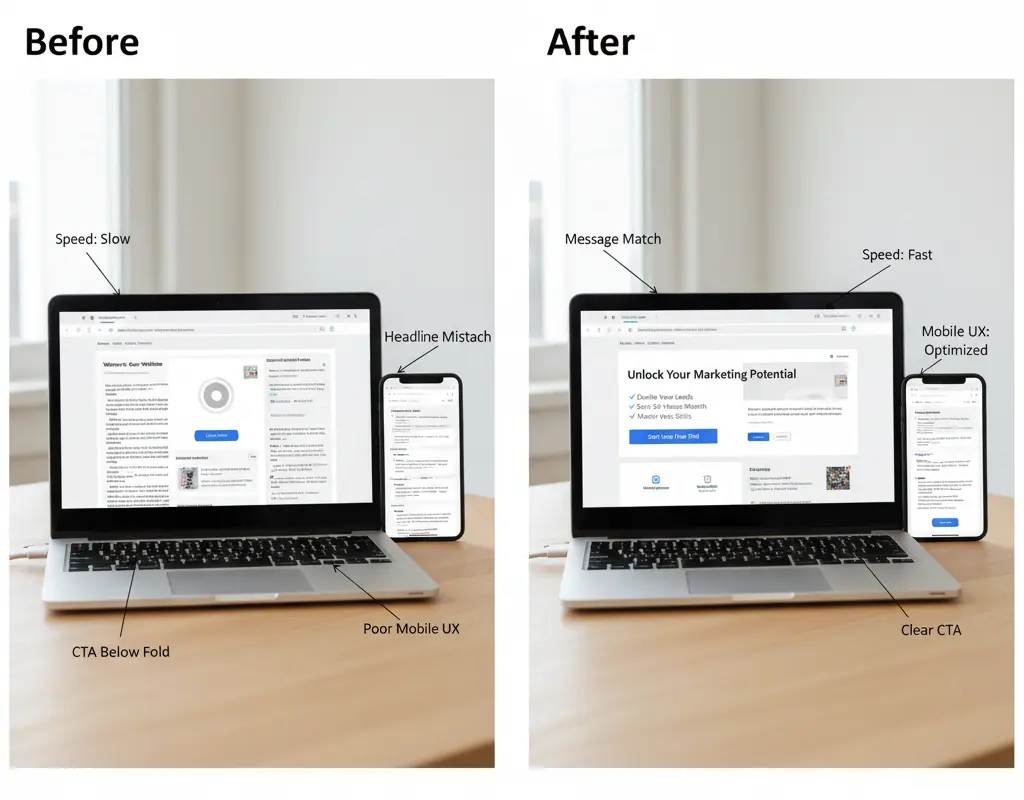
- Ensure message match between ad and page, minimize friction, and provide a clear above-the-fold CTA aligned to the query.
- Improve page speed and mobile UX to reduce bounce and increase conversions, signaling higher landing page quality.
3. Use high-impact assets strategically
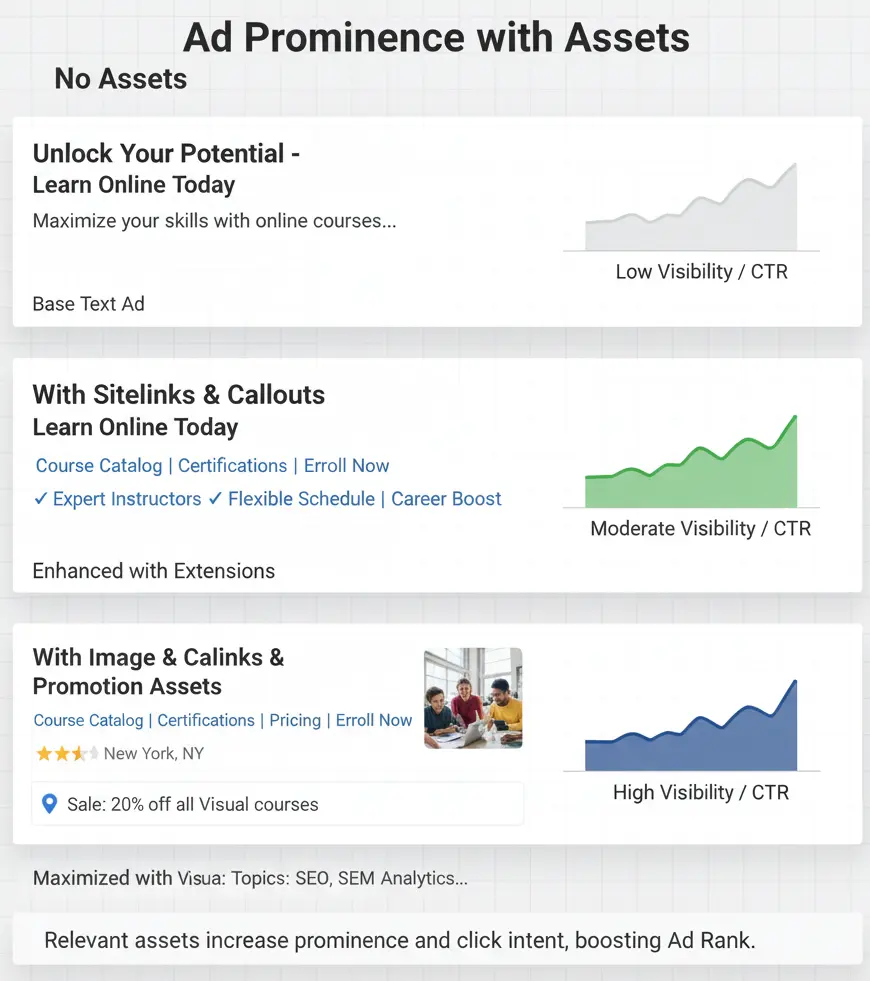
- Add sitelinks, callouts, structured snippets, images, calls, promotions, prices, and locations based on campaign goals to increase prominence and CTR.
- Prioritize asset relevance to the query and ensure accurate destination URLs to avoid diluting performance.
4. Improve campaign structure and targeting
- Group tightly themed keywords so ads speak precisely to intent variations, increasing ad relevance and CTR.
- Apply device, location, and time-focused adjustments to appear with the most relevant experience when the user is most likely to convert.
5. Maintain negative keyword hygiene
- Regularly mine search terms to exclude irrelevant queries, improving CTR and concentrating budget on qualified intent.
- Segment by match types and themes to better control query matching and intent coverage.
6. Iterate with experimentation
- A/B test creatives, assets, audience segments, and landing variants to systematically lift expected CTR and conversion rates.
- Use diagnostics and Auction Insights patterns to prioritize where improvements will have the largest effect on Ad Rank.
Monitoring Ad Rank performance
There is no direct Ad Rank field in the interface, so use proxy metrics and reports to track progress over time.
- Top and absolute top impression rates (and their shares) show how often ads appear in premium placements.
- Quality Score and its components highlight where to focus improvements for expected CTR, relevance, or landing experience.
- Auction Insights helps interpret competitive dynamics that influence fluctuating positions and eligibility.
Common mistakes to avoid
- Relying on bids alone: Over-bidding without quality improvements can inflate costs without sustainably improving position.
- Ignoring mobile UX: Slow or clumsy mobile pages depress landing experience and CTR, weakening Ad Rank.
- Generic assets: Irrelevant or redundant assets reduce expected impact and can lower overall prominence.
Advanced optimization ideas
- Seasonal and time-based tuning: Match creatives, promotions, and schedules to peak demand windows to raise expected CTR and conversion rates.
- Geo and device personalization: Localize offers and tailor copy for mobile vs. desktop behavior to improve intent satisfaction.
- Creative breadth with control: Maintain diverse headlines and descriptions in responsive formats while pinning proven must-show elements where needed.
Conclusion
Ad Rank is the real-time gatekeeper of visibility and cost efficiency in Google Ads. Brands that consistently align ads to user intent, deliver fast and relevant landing experiences, and deploy the right assets can earn higher placements at lower CPCs—without simply raising bids. Treat Ad Rank as an ongoing optimization system: refine message match, improve UX, and iterate with testing to compound results over time.
FAQs
1. What’s the difference between Ad Rank and ad position?
Ad Rank is the internal score that determines eligibility and relative placement; ad position is the actual slot an ad receives in the auction outcome.
2. Can Ad Rank improve without increasing bids?
Yes. Enhancing ad relevance, expected CTR, landing page experience, and asset strategy can improve Ad Rank and reduce actual CPC.
3. Is Quality Score the same as Ad Rank?
No. Quality Score is a diagnostic metric; Ad Rank is calculated live at auction time and also factors in thresholds, competition, context, and asset impact.
4. Why does my position change between impressions?
Ad Rank is recalculated for each auction. Competition, query context, device, location, and time can all shift outcomes.
5. How do I monitor Ad Rank if it isn’t visible?
Use proxy signals: top/absolute top impression rate and share, Quality Score components, and Auction Insights to infer progress and identify opportunities.
6. Which assets have the biggest impact on Ad Rank?
Sitelinks, images, structured snippets, callouts, promotions, location, and call assets tend to lift CTR and prominence when they’re relevant and well-implemented.
7. What are common causes of low Ad Rank?
Misaligned ad copy, slow or irrelevant landing pages, thin or irrelevant assets, broad targeting without negatives, and limited testing typically depress Ad Rank.

Passionate about blogging and focused on elevating brand visibility through strategic SEO and digital marketing. Always tuned in to the latest trends, I’m dedicated to maximizing engagement and delivering measurable ROI in the dynamic world of digital marketing. Let’s connect and unlock new opportunities together!