

Enterprise SaaS delivers cloud software built for large, complex organizations that need scale, security, and deep integrations across teams and systems. It differs from standard B2B SaaS in scope, customization, governance, and support, helping enterprises accelerate time-to-value while reducing infrastructure burden.
What is Enterprise SaaS?
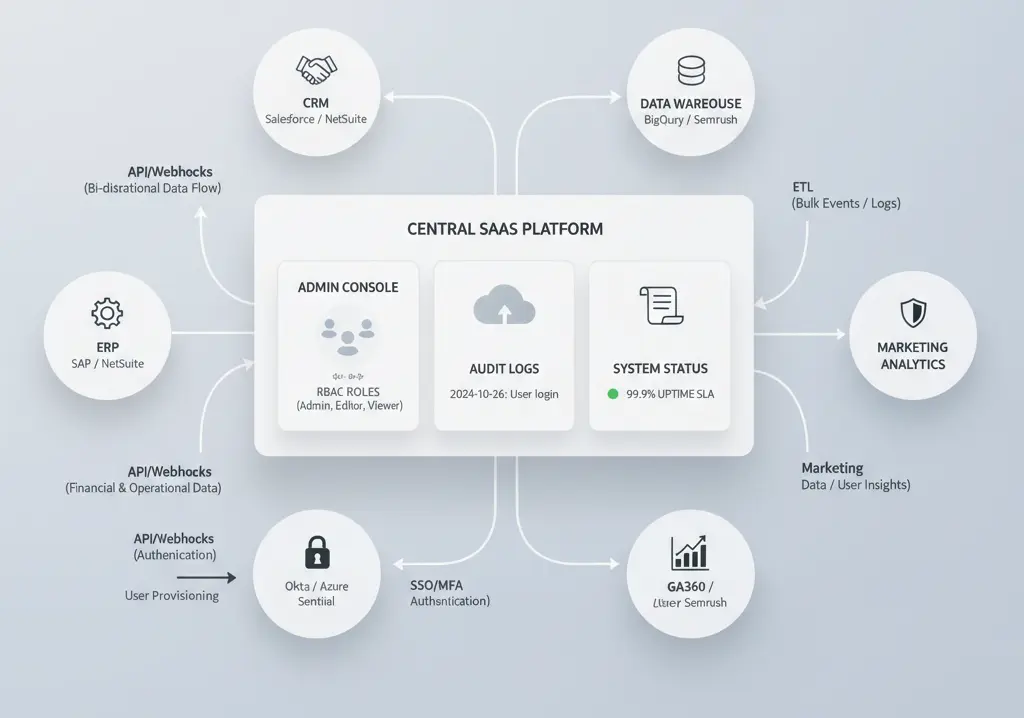
Enterprise SaaS refers to subscription-based, cloud-hosted applications designed for large organizations, typically featuring advanced security, compliance, role-based access, and high availability. It emphasizes multi-tenant architectures, centralized governance, and global data controls to meet enterprise standards.
Core definition and characteristics
- Cloud-native or cloud-hosted delivery with SLA-backed uptime.
- Multi-tenant architecture with strong tenant isolation and RBAC.
- Integrations with identity (SSO/MFA), ERP, CRM, data lakes, and SIEM.
- Advanced admin tooling, audit logs, sandboxing, and API-first extensibility.
- Compliance support (SOC 2, ISO 27001, GDPR, HIPAA, PCI DSS depending on vertical).
Enterprise SaaS vs. traditional enterprise software
- Deployment: Cloud versus on-premise data centers.
- Licensing: Subscription/usage versus perpetual licenses and maintenance.
- Updates: Continuous delivery versus scheduled major releases.
- TCO: Lower capex, more predictable opex versus high capex and ongoing maintenance.
Enterprise SaaS vs. B2B SaaS
Scale and complexity
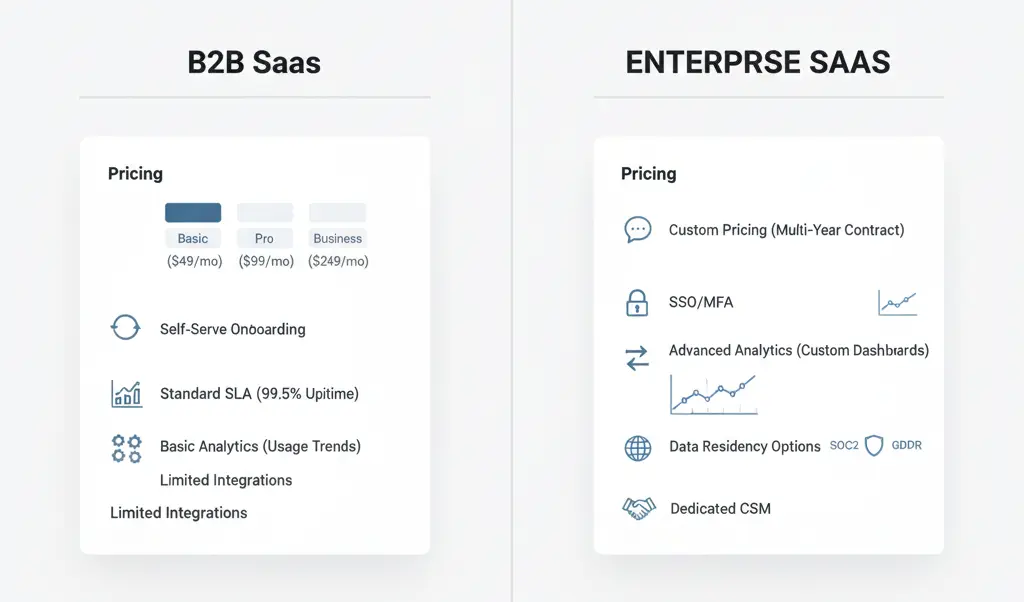
- Enterprise: Thousands of users, complex org structures, multi-region data needs, advanced admin and governance.
- SMB/B2B: Fewer users, simpler org models, lighter governance and change management.
Pricing and contracts
- Enterprise: Custom quotes, multi-year contracts, volume discounts, premium SLAs, and professional services.
- SMB/B2B: Public tiers, monthly billing, self-serve trials, standard SLAs.
Implementation and support
- Enterprise: Dedicated onboarding teams, solution architects, white-glove implementation, success plans.
- SMB/B2B: Self-serve setup, knowledge bases, community forums, limited support tiers.
Key benefits of Enterprise SaaS
Cost efficiency and ROI
- Reduces infrastructure and data center costs.
- Predictable budgeting with subscription pricing.
- Faster time-to-value versus multi-quarter on-prem deployments.
Scalability and flexibility
- Elastic resources for spikes, seasonality, and global growth.
- Rapid deployment across regions and business units.
- Modular add-ons and APIs for tailored workflows.
Security and compliance
- Encryption in transit and at rest, SSO/MFA, least-privilege access.
- Policy-based controls, DLP, and audit trails.
- Built-in compliance reporting and certifications.
Innovation and advantage
- Continuous feature delivery and AI-assisted capabilities.
- Standardized integrations for data-driven operations.
- Frees teams to focus on core initiatives versus maintenance.
Market overview and trends
- Enterprises prioritize consolidation of tools, stronger governance, and measurable ROI from AI-enabled features.
- Vertical SaaS (healthcare, BFSI, manufacturing) grows as compliance and domain depth matter more.
- FinOps and usage governance become executive priorities to optimize spend.
Also Read: Yelp SEO: How to Optimize Your Listings & Rank Higher
Enterprise SaaS pricing models and strategies
Common pricing approaches
- Flat-rate: Predictable fees for a defined package.
- Tiered: Feature and limit-based plans with “Good/Better/Best.”
- Usage-based: Pay per seat, event, GB, request, or API call.
- Hybrid: Base subscription plus usage overages.
- Custom enterprise: Bundled features, higher limits, add-ons, and negotiated SLAs.
Key pricing considerations
- Volume discounts, committed-use, and multi-year terms.
- Professional services for implementation, migration, and integrations.
- Training, admin enablement, and change management costs.
- Security assessments and compliance attestations included in procurement.
Enterprise SaaS examples
CRM and revenue
- Salesforce: Enterprise-grade CRM with extensive customization, SSO, robust APIs, and industry clouds. Marketing and analytics
- Google Analytics 360: Advanced attribution, unsampled reporting, BigQuery export, and enterprise SLAs. SEO and growth
- Ahrefs: Enterprise access control, unlimited history windows, API access, and audit logging.
- Semrush: Custom limits, historical data, API, enterprise reporting and governance. Collaboration and productivity
- Microsoft 365 and Slack Enterprise Grid: Enterprise security, data residency, and admin controls at scale. HR and finance
- Workday (HCM/Financials) and BambooHR: Enterprise workflows, compliance, and analytics. ERP and operations
- Oracle NetSuite and SAP S/4HANA Cloud: Financials, supply chain, and analytics at global scale. BI and data
- Tableau and Power BI Premium: Data governance, large model capacity, and enterprise distribution.
Implementation best practices
Deployment approaches
- Big-bang: Single cutover for urgency-driven programs.
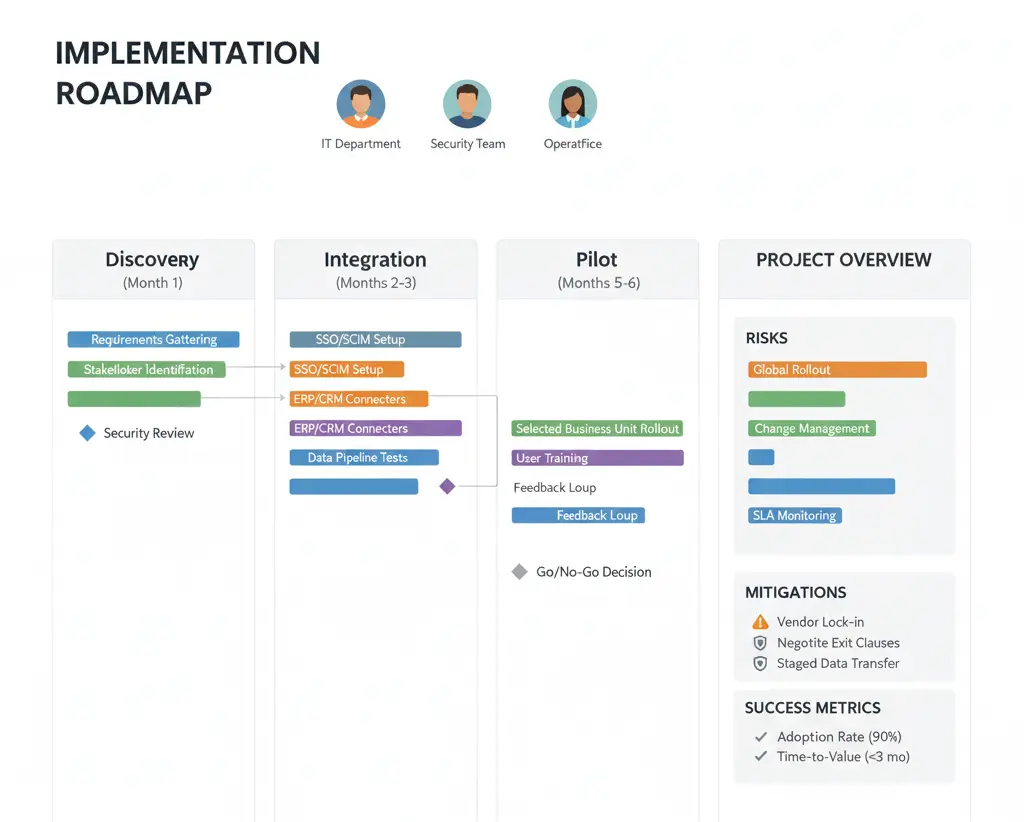
- Phased: Rollout by business unit, geography, or feature set to reduce risk.
- Parallel: Legacy and new systems run together for safety; higher cost.
- Hybrid: Tailored approach mixing speed and risk mitigation.
Implementation checklist
- Define business outcomes, KPIs, and success metrics.
- Establish a cross-functional steering committee and RACI.
- Plan data migration, mapping, deduplication, and quality gates.
- Validate integrations (SSO, MDM, ERP, CRM, data warehouse, SIEM).
- Configure security, roles, and data loss prevention.
- Deliver role-based training and change management.
- Pilot, gather feedback, iterate, then scale.
Common challenges
- Data privacy and sovereignty, especially cross-border.
- Integrations with brittle legacy systems.
- User adoption, process re-engineering, and governance.
- Vendor dependence and SLA enforcement.
Security and compliance essentials
Security foundations
- SSO/MFA, SCIM provisioning, fine-grained RBAC.
- Key management, data encryption, and tokenization.
- Audit logs, anomaly detection, and admin activity trails. Compliance frameworks
- SOC 2 Type II and ISO/IEC 27001 for security maturity.
- GDPR and regional equivalents for privacy and data rights.
- HIPAA for PHI, PCI DSS for card data, and industry attestations. Risk management
- Vendor risk assessments and penetration testing.
- Backup, disaster recovery, and business continuity tests.
- Incident response runbooks and tabletop exercises.
Choosing the right Enterprise SaaS
Evaluation criteria
- Scalability for users, data, and geographies.
- Integration fit with identity, data, and core systems.
- Security posture, compliance evidence, and roadmap transparency.
- Vendor viability, support model, and customer references.
- Total cost of ownership and value realization timeline. Selection process
- Requirements workshop and prioritization with stakeholders.
- RFP/RFI, shortlisting, and solution demos mapped to scenarios.
- Proof of concept/pilot with success criteria and timelines.
- Executive alignment on contract, SLAs, data residency, and exit terms.
Challenges and limitations
- Vendor lock-in: Address with open standards, export tooling, and contractual exit clauses.
- Internet dependency: Plan redundancy and offline workflows when applicable.
- Customization limits: Use extensibility and APIs; avoid brittle one-off custom code.
- Data sovereignty: Choose regions and providers that meet regulatory needs.
Measuring ROI and success
Financial metrics
- TCO reduction versus legacy stack.
- Productivity gains and process cycle-time improvements.
- Revenue influence (pipeline velocity, retention, expansion). Operational metrics
- Adoption and engagement by role and region.
- Uptime, latency, and incident MTTR.
- Time-to-value from contract to first outcomes. Strategic metrics
- Speed of innovation and time-to-launch.
- Cross-functional visibility and decision latency.
- Competitive advantage through differentiated capabilities.
FAQs
1. How is Enterprise SaaS different from regular SaaS?
Greater scale, governance, compliance, customization, and support; typically multi-year custom contracts.
2. What does Enterprise SaaS cost?
Varies widely; expect custom pricing, volume discounts, professional services, and premium SLAs.
3. How long does implementation take?
From weeks (lightweight tools) to several months for complex, multi-system programs.
4. Can it integrate with legacy systems?
Yes—evaluate native connectors, iPaaS options, and custom APIs; plan for robust testing.
5. What compliance should vendors have?
Commonly SOC 2 Type II, ISO 27001, GDPR; sector-specific frameworks like HIPAA and PCI DSS as needed.
Conclusion
Enterprise SaaS empowers large organizations to scale securely, integrate data and processes, and innovate faster through continuous delivery and AI-enabled capabilities. Selecting the right platform requires a disciplined evaluation of security, integrations, governance, and ROI, plus a structured rollout with strong change management. With the right approach, Enterprise SaaS becomes a durable advantage—speeding execution while lowering operational burden.

Passionate about blogging and focused on elevating brand visibility through strategic SEO and digital marketing. Always tuned in to the latest trends, I’m dedicated to maximizing engagement and delivering measurable ROI in the dynamic world of digital marketing. Let’s connect and unlock new opportunities together!