


If you’ve been learning SEO or creating content for a while, you’ve probably heard this advice more times than you can count:
Use your main keyword in the beginning.”
Put the keyword in the title and intro.”
Don’t hide the keyword in the last paragraph.”
That advice is not random. It’s tied to a powerful on-page SEO concept known as keyword prominence.
In this guide, I’ll explain what is keyword prominence, why it matters for SEO, whether it works as a Google ranking factor, and how to use it naturally in content without falling into keyword stuffing.
You’ll also learn the exact best practices SEO experts follow to improve rankings using better keyword placement—plus FAQs at the end.
What Is Keyword Prominence?
Let’s start with the basics.
What is keyword prominence?
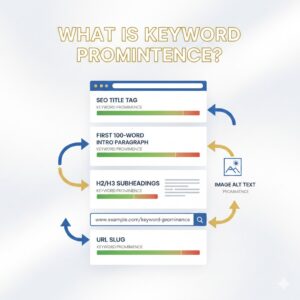
Keyword prominence refers to how early and how visibly your target keyword appears on a webpage—especially in key sections like:
- Title tag / SEO title
- H1 heading
- Intro paragraph (first 100 words)
- Subheadings (H2, H3)
- Image alt text (when relevant)
- URL slug (optional but helpful)
So, the keyword prominence meaning is simple:
👉 The more prominent your keyword is, the easier it becomes for both users and Google to quickly understand what the page is about.
Keyword Prominence in SEO (Simple Definition)
Keyword prominence in SEO is the practice of placing the primary keyword close to the beginning of important page elements, which helps clarify topical relevance.
Think of it like this:
If your blog is about “keyword prominence,” but you only mention that keyword once at the bottom of the page, you’re sending mixed signals.
Google and readers should not have to “hunt” to figure out the topic.
Why Keyword Prominence Matters (For Google + Humans)

Many people talk about SEO like it’s only about rankings. But the truth is, Google wants the same thing humans want:
clarity
relevance
useful content
Keyword prominence helps in both directions.
1) Keyword Prominence Helps Google Understand Your Topic Faster
Google crawls your content to understand what it’s about. When the keyword appears early, it becomes a clear topic signal.
If your keyword is hidden deep inside the content, Google might still understand your page, but you lose one important advantage:
early relevance confirmation.
Google is basically thinking:
- “This title says it’s about keyword prominence.”
- “The H1 matches.”
- “The intro also confirms it.”
- “Okay, this page is clearly focused.”
That focus increases your chances of ranking for your target keyword and closely related terms.
2) It Improves User Experience (Which Indirectly Helps SEO)
Most readers don’t read every word.
They scan.
They skim.
They look at:
- headline
- first paragraph
- subheadings
- bold points
If they don’t immediately see that your page matches their search intent, they’ll hit the back button.
And when too many people bounce quickly, your content performance can suffer.
So keyword prominence is not only about SEO signals—it’s also about keeping the user engaged.
Is Keyword Prominence a Google Ranking Factor?
Now let’s answer the big question.
Yes—keyword prominence is widely considered a real, practical ranking factor, because Google’s systems use early keyword mentions to understand content relevance.
But you need to understand something very important:
Keyword prominence doesn’t mean repeating the same keyword 50 times.
It means placing it strategically in key spots.
Google has repeatedly suggested that the most important topic of a page should be obvious in visible areas like titles, headings, and early content.
So while Google may not always call it “keyword prominence” officially, the concept is consistent with how search engines interpret content.
Keyword Prominence vs Keyword Density (Don’t Confuse These)
A lot of beginners mix this up.
Keyword Prominence = Where the keyword appears
Keyword Density = How often the keyword appears
Example:
Keyword prominence is when your keyword appears early like:
- Title: “Keyword Prominence in SEO: What It Is & How It Works”
- First paragraph includes the keyword
Keyword stuffing happens when you force it everywhere like:
“Keyword prominence in SEO is keyword prominence meaning keyword prominence…”
This is bad writing and poor SEO.
So remember:
Prominence is about placement, not repetition.
How Keyword Prominence Works (With Real Example)
Let’s say your target keyword is:
keyword prominence in seo
Good Keyword Prominence Example
Title: Keyword Prominence in SEO: What It Is & Why It Matters
H1: What Is Keyword Prominence in SEO?
Intro line: Keyword prominence in SEO means placing your primary keyword early in key areas of a page.
This tells Google and users instantly what the page covers.
Bad Keyword Prominence Example
Title: Improve Your Website Rankings Today
H1: The Best SEO Strategies
Keyword appears first time in paragraph 12
This content might still be helpful, but it’s unclear and unfocused. It reduces your chances of ranking for that keyword.
Where to Place Keywords for Strong Keyword Prominence
Now let’s get practical.
Here are the top placements that make keyword prominence stronger.
Also Read: BCG Matrix Analysis of Adida
1. Use the Keyword in the SEO Title (Title Tag)
The title tag is one of the strongest SEO signals on the page.
Best practice: Put your primary keyword closer to the beginning.
Example:
Keyword Prominence Meaning: The SEO Factor You Must Know
The SEO Factor You Must Know: Keyword Prominence Meaning
Both can work, but the first one gives the keyword more prominence.
2. Add Keyword in the H1 (Main Heading)
The H1 is the main headline users see on the page.
Google also uses headings to understand structure and topic.
Example H1 options:
- What Is Keyword Prominence? (Simple Explanation)
- Keyword Prominence in SEO: Complete Guide for Better Rankings
3. Place the Keyword in the First 100 Words
This is the easiest and most powerful tactic.
If your keyword appears naturally in the first paragraph, you’re giving clarity right away.
Example:
“What is keyword prominence? It’s an SEO practice where your main keyword appears early and clearly in important areas of a page.”
That single line builds relevance instantly.
4. Use the Keyword in H2 and H3 Subheadings
Subheadings make content scannable and structured.
They also give you a chance to naturally include the keyword or variations.
Examples:
- Keyword Prominence in SEO: Why It Works
- Keyword Prominence Meaning in Simple Words
- How to Improve Keyword Prominence Without Stuffing
5. Use It in the URL (Optional)
URL is not the biggest ranking factor, but it helps with clarity.
Example:
- ✅ yoursite.com/keyword-prominence-in-seo
- ❌ yoursite.com/blog12345
Keep it short, clean, and relevant.
6. Use Keywords in Image Alt Text (When Relevant)
Alt text helps with accessibility and image-based SEO.
If your page includes a chart or screenshot related to the topic, you can do:
Alt text example:
“keyword prominence in SEO example in title and headings”
But don’t force it into every image.
7. Use Keyword Near the Start of the Meta Description (For CTR)
Meta description isn’t a direct ranking factor, but it impacts clicks.
And clicks = traffic.
Example:
“Keyword prominence in SEO helps Google understand your page topic faster. Learn what keyword prominence means and how to optimize it correctly.”
Keyword Prominence and Click-Through Rate (CTR)
Here’s something many writers miss:
Even if you rank, you still need people to click.
When users see a keyword match in the title, it increases the chance they’ll choose your page.
For example, if someone searches:
what is keyword prominence
They’re more likely to click titles like:
✅ “What Is Keyword Prominence? Best Explanation + Examples”
Instead of:
❌ “SEO Tips That Actually Work”
Why? Because the first title confirms relevance instantly.
What Happens When Keyword Prominence Is Weak?
Let’s be honest—Google is smarter today.
But weak prominence can still hurt, especially in competitive niches.
Here’s what may happen when keyword prominence is poor:
- Your content ranks for unrelated terms
- Google doesn’t fully trust your page relevance
- Your rankings become unstable
- Users bounce because they don’t see what they came for
- Lower click-through rates even if you rank
So while keyword prominence isn’t the only SEO factor, it’s one of the easiest on-page improvements you can make.
Common Mistakes to Avoid (Very Important)
Many people misunderstand keyword prominence and make their content worse.
Here are the biggest mistakes:
1. Stuffing the Keyword Everywhere
Wrong:
“keyword prominence keyword prominance keyword prominence…”
That’s not SEO. That’s spam.
2. Using the Keyword Too Late
If your target keyword appears after 800 words, you’re basically “burying the topic.”
3. Writing Titles That Don’t Match the Content
Your title and intro should align with your keyword focus.
If they don’t, rankings may suffer.
4. Ignoring Variations and Synonyms
Google understands context.
You can naturally include variations like:
- what is keyword prominence
- keyword prominence meaning
- keyword prominence in seo
Also, some people search misspellings like keyword prominance (yes, it happens), and including it once naturally in FAQs can help capture that traffic without ruining the content.
How to Improve Keyword Prominence (Step-by-Step)
If you already have an article written and it’s not ranking, try this simple checklist:
Step 1: Check Your Title
Does it include your main keyword early?
Step 2: Check Your H1
Does your H1 match your target keyword?
Step 3: Rewrite the Intro Paragraph
Mention the keyword once naturally in the first 1–2 lines.
Step 4: Add Keyword to 1–2 Subheadings
Don’t overdo it—keep it natural.
Step 5: Improve Internal Linking
Link this blog to:
- other SEO guides on your website
- related pages like on-page SEO, content writing, keyword research
Internal linking helps Google understand topic clusters.
Step 6: Update Meta Description for Better CTR
Use the keyword near the beginning.
Does Keyword Prominence Alone Guarantee Rankings?
No.
Let’s be very clear.
Keyword prominence helps, but ranking depends on many combined factors like:
- Search intent match
- Content quality & depth
- Backlinks and authority
- Page experience and performance
- Helpful structure and readability
- Competition level
So think of keyword prominence as a strong on-page SEO foundation.
It’s like placing a signboard on your shop.
Even if your shop is beautiful inside, people need the signboard first to know what you sell.
Conclusion
So, what is keyword prominence and why should you care?
Keyword prominence in SEO is the practice of placing your target keyword early and visibly in important areas of a webpage—so both Google and users quickly understand the topic.
If you want stronger rankings, better clicks, and improved user engagement, keyword prominence is one of the smartest and simplest SEO best practices you can apply.
Just remember the balance:
Make the keyword prominent
Don’t make it repetitive
Do it naturally, write for humans, and structure your content clearly—SEO results will follow.
FAQs
What is keyword prominence in SEO?
Keyword prominence in SEO refers to placing your main keyword early in important sections like the title, headings, and first paragraph to improve relevance and visibility.
What is keyword prominence meaning in simple words?
Keyword prominence meaning is “how noticeable your keyword is” on a page, especially near the beginning of the content.
Is keyword prominence a Google ranking factor?
Yes, keyword prominence is considered an important on-page SEO factor because early keyword usage helps Google understand what the page should rank for.
How is keyword prominence different from keyword density?
Keyword prominence is about keyword placement (where it appears). Keyword density is about frequency (how many times it appears).
Can keyword prominance (misspelling) affect SEO?
People often type “keyword prominance” by mistake in searches. Google usually understands intent, but using the correct keyword is best. You can include the misspelling once in FAQs if it fits naturally.
Where should I place my keyword for best results?
To improve keyword prominence, place it in:
SEO title
H1 heading
first 100 words
at least one subheading
meta description (optional)
URL slug (optional)