
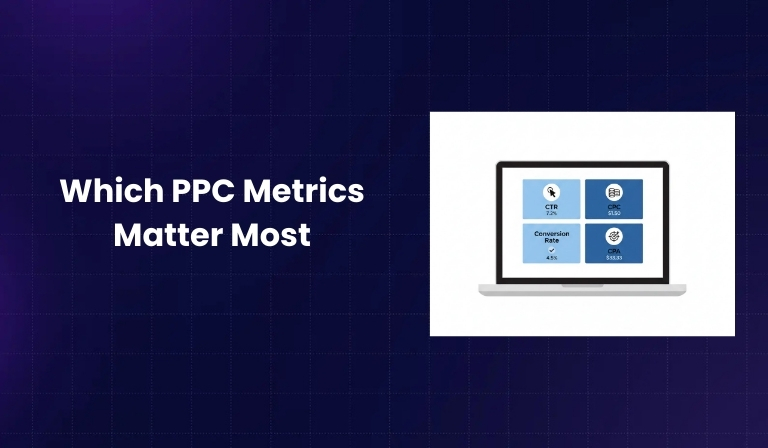

Pay-per-click advertising continues to evolve rapidly in 2026. Automation, AI-driven bidding, privacy regulations, and advanced attribution models have changed how marketers measure success. Simply looking at clicks and impressions is no longer enough. Businesses now need to focus on metrics that directly connect advertising spend to revenue and long-term growth.
Tracking the right PPC metrics helps marketers make better decisions about budget allocation, audience targeting, bidding strategies, and creative performance. On the other hand, focusing on the wrong metrics can lead to wasted ad spend and misleading conclusions.
In this guide, you will learn which PPC metrics matter most in 2026, why they matter, and how to use them to improve performance across platforms.
What Is PPC and Why Metrics Define Success?
PPC (Pay-Per-Click) advertising is a digital advertising model where advertisers pay a fee each time someone clicks on their ad. It is commonly used on search engines, social media platforms, display networks, and video platforms.
Major PPC platforms in 2026 include:
- Google Ads
- Meta Ads (Facebook and Instagram)
- LinkedIn Ads
- YouTube Ads
- Microsoft Advertising
In PPC, every action can be tracked. This makes measurement one of the biggest advantages of paid advertising. However, having access to data is not the same as understanding which data matters.
Metrics define success because they:
- Show whether campaigns are profitable
- Help compare performance across channels
- Guide budget decisions
- Identify weak points in funnels
There is also a difference between vanity metrics and performance-driven metrics:
- Vanity metrics look impressive but do not directly impact revenue (for example, impressions without engagement).
- Performance-driven metrics directly connect to business outcomes such as leads, sales, or revenue.
In 2026, performance-focused measurement is the foundation of successful PPC campaigns.
Core PPC Metrics That Still Matter in 2026
Core metrics remain important because they form the base of campaign evaluation. Even with automation and AI, these metrics still indicate campaign health.
1. Click-Through Rate (CTR)
Click-Through Rate measures the percentage of users who click on an ad after seeing it. It is calculated as clicks divided by impressions.
CTR indicates how relevant and attractive your ad is to your audience. A higher CTR generally means:
- Your ad copy matches user intent
- Your targeting is accurate
- Your creative is engaging
In 2026, CTR still affects:
- Ad relevance
- Auction performance
- Cost efficiency in platforms like Google Ads
However, CTR alone does not guarantee profitability. It must be evaluated alongside conversion-related metrics.
Ways to improve CTR include:
- Writing clear and benefit-focused ad copy
- Using strong calls to action
- Matching keywords to search intent
- Testing multiple creatives
2. Cost Per Click (CPC)
Cost Per Click represents the amount you pay for each click on your ad.
CPC matters because it directly impacts total ad spend. If CPC increases without improvement in conversions, profitability declines.
In 2026, CPC is influenced by:
- Competition in the auction
- Quality Score or relevance score
- Automated bidding strategies
- Audience targeting precision
Managing CPC effectively requires:
- Improving ad relevance
- Optimizing landing pages
- Using smart bidding strategies aligned with goals
CPC should not be minimized blindly. A higher CPC can still be profitable if conversion rate and revenue justify it.
3. Conversion Rate (CVR)
Conversion Rate measures the percentage of users who complete a desired action after clicking on an ad.
Conversions may include:
- Purchases
- Form submissions
- App installs
- Phone calls
Conversion Rate is critical because traffic alone does not generate business value. If a campaign has a high CTR but low conversion rate, the problem may lie in:
- Landing page experience
- Offer clarity
- Page speed
- Trust signals
Improving conversion rate often includes:
- Optimizing landing page design
- Reducing friction in forms
- Matching ad messaging with landing page content
- Conducting A/B testing
In 2026, conversion rate remains one of the strongest indicators of campaign effectiveness.
4. Cost Per Acquisition (CPA)
Cost Per Acquisition measures how much you spend to generate one conversion.
CPA connects ad spend directly to results. It helps answer the question: “How much does it cost to acquire one customer or lead?”
CPA becomes especially important in competitive industries where advertising costs are high.
Target CPA strategies allow advertisers to:
- Automate bidding
- Optimize toward specific cost goals
- Maintain profitability thresholds
However, CPA should always be evaluated alongside revenue metrics. A low CPA does not always mean high profit if the customer value is low.
5. Quality Score (Google Ads)
Quality Score is a diagnostic metric used in Google Ads to measure ad relevance and landing page quality.
It is influenced by:
- Expected click-through rate
- Ad relevance
- Landing page experience
A higher Quality Score generally results in:
- Lower CPC
- Better ad positions
In 2026, Quality Score still matters because it reflects overall campaign alignment between keywords, ads, and landing pages.
Improving Quality Score includes:
- Tight keyword grouping
- Relevant ad copy
- Fast-loading landing pages
- Clear user intent matching
Advanced PPC Metrics That Matter More in 2026
As digital marketing matures, advanced metrics are becoming more important than surface-level numbers.
1. Return on Ad Spend (ROAS)
ROAS measures revenue generated for every unit of ad spend.
For example, a ROAS of 4 means you generate four units of revenue for every one unit spent.
ROAS is especially important for e-commerce and revenue-focused campaigns.
However, ROAS must be interpreted carefully:
- High ROAS with low volume may limit growth
- It does not account for operational costs
- It does not measure long-term customer value
In 2026, value-based bidding strategies rely heavily on ROAS tracking.
2. Customer Acquisition Cost (CAC)
Customer Acquisition Cost includes all costs required to acquire a new customer, not just advertising spend.
CAC may include:
- Ad spend
- Marketing tools
- Sales team costs
CAC is broader than CPA and provides a clearer picture of business sustainability.
Reducing CAC may involve:
- Improving conversion rates
- Enhancing targeting
- Retaining customers longer
3. Lifetime Value (LTV)
Lifetime Value measures the total revenue expected from a customer over their relationship with a business.
LTV is essential for:
- Subscription businesses
- SaaS companies
- E-commerce brands with repeat purchases
The LTV:CAC ratio helps determine scalability. A healthy ratio indicates sustainable growth.
In 2026, predictive analytics tools estimate LTV based on historical data and behavior patterns.
4. Impression Share
Impression Share measures the percentage of total possible impressions your ads receive.
It highlights missed opportunities caused by:
- Budget limitations
- Low ad rank
If Impression Share is low due to budget, increasing budget may scale performance. If it is low due to rank, optimization is required.
5. Engagement Metrics (Video & Social PPC)
Video and social campaigns rely on engagement-based metrics such as:
- Video completion rate
- Engagement rate
- Click-through engagement
- Scroll depth
These metrics help measure audience interest beyond clicks. In awareness campaigns, engagement signals content effectiveness.
AI & Automation-Focused PPC Metrics in 2026
Automation has changed how campaigns are optimized.
1. Conversion Value Optimization
Instead of optimizing only for conversions, advertisers now optimize for conversion value.
This approach:
- Assigns different values to different actions
- Prioritizes high-revenue customers
- Uses value-based bidding strategies
Tracking micro and macro conversions provides a deeper view of the customer journey.
2. Predictive Performance Metrics
AI-powered systems now forecast:
- Conversion probability
- Revenue potential
- Bid adjustments
Modeled conversions are also used when tracking data is incomplete due to privacy restrictions.
3. First-Party Data Performance Metrics
With stricter privacy regulations, first-party data has become more important.
Key performance tracking methods include:
- CRM integration
- Offline conversion tracking
- Enhanced conversions
These methods improve data accuracy and reduce reliance on third-party cookies.
Attribution & Tracking Metrics in a Privacy-First Era
Privacy updates have made attribution more complex.
1. Attribution Models in 2026
Attribution models determine how credit is assigned across touchpoints.
Common models include:
- Data-driven attribution
- Multi-touch attribution
- Last-click attribution
Data-driven attribution uses algorithmic models to distribute credit based on user behavior.
2. Assisted Conversions
Assisted Conversions measure the role of a channel in supporting conversions.
Some channels may not generate the final click but still influence decisions.
Understanding assisted conversions helps avoid underestimating upper-funnel campaigns.
3. Modeled Conversions & Consent-Based Tracking
With cookie limitations and consent requirements, modeled conversions estimate missing data using statistical modeling.
Consent-based tracking ensures compliance while maintaining performance insights.
Metrics That Matter by Business Goal
Different goals require different primary metrics.
1. Lead Generation Campaigns
Important metrics include:
- Cost Per Lead (CPL)
- Lead quality score
- Conversion rate by source
Lead quality is especially important because not all leads generate revenue.
2. E-commerce Campaigns
Key metrics include:
- ROAS
- Average Order Value (AOV)
- Cart abandonment rate
These metrics directly connect ads to revenue performance.
3. Brand Awareness Campaigns
Important metrics include:
- Reach
- Frequency
- Brand lift measurements
Awareness campaigns focus more on exposure and perception than immediate sales.
Vanity Metrics to Stop Obsessing Over in 2026
Not all metrics indicate business success.
Common vanity metrics include:
- High impressions without engagement
- High CTR with no conversions
- Traffic that does not generate revenue
Surface-level metrics may look impressive but fail to reflect profitability.
In 2026, marketers must focus on revenue-driven indicators instead of appearance-based performance.
How to Build a PPC Reporting Dashboard in 2026
A strong dashboard focuses only on metrics aligned with business goals.
Key steps include:
- Defining primary KPIs
- Connecting ad platforms with analytics tools
- Integrating CRM data
- Tracking revenue and customer value
Weekly tracking helps identify issues early. Monthly reporting helps evaluate strategic performance.
Dashboards should prioritize clarity, not complexity.
PPC Metrics Benchmarks for 2026 (Industry-Wise Overview)
Benchmarks vary significantly by industry.
E-commerce businesses often prioritize:
- ROAS
- Conversion rate
- Average Order Value
SaaS companies focus on:
- CAC
- LTV
- Trial-to-paid conversion rate
Real estate campaigns prioritize:
- Cost per qualified lead
- Appointment bookings
Local businesses track:
- Call conversions
- Store visits
- Cost per lead
B2B services often focus on:
- Cost per marketing-qualified lead
- Sales-qualified lead conversion rate
- Pipeline value
Industry benchmarks should always be compared with historical internal data rather than external averages alone.
Conclusion
In 2026, successful PPC campaigns depend on tracking the right metrics, not just collecting more data. Core metrics like CTR, CPC, and Conversion Rate still matter, but they must be supported by advanced indicators such as ROAS, CAC, LTV, and conversion value.
Modern PPC measurement goes beyond clicks and impressions. It focuses on profitability, long-term customer value, and strategic growth. By aligning metrics with business goals, building accurate attribution systems, and leveraging automation responsibly, marketers can make smarter decisions and scale campaigns sustainably.