


Summary
The BCG Matrix of BMW provides a comprehensive strategic analysis of how Bayerische Motoren Werke AG (BMW), one of the world’s leading luxury automotive manufacturers, manages its diverse portfolio of vehicles, electric models, performance divisions, and mobility solutions. By evaluating BMW’s product categories based on the Boston Consulting Group (BCG) Matrix, this analysis identifies which segments drive growth, which produce stable cash flow, which require strategic investment, and which are losing market relevance.
The BCG Matrix of BMW (2025) reveals that the company’s electric vehicles under the BMW i-Series are emerging as strong Stars, the traditional 3 Series and 5 Series continue to act as Cash Cows, certain hybrid and compact models fall under Question Marks, and declining ICE sports coupes represent the Dog category. This detailed evaluation explains how BMW maintains its position against competitors like Mercedes-Benz, Audi, Lexus, Tesla, Porsche, and Volvo in a rapidly evolving luxury automotive landscape.
BMW, founded in 1916, has grown into one of the most respected names in the global automotive industry. Renowned for its precision engineering, sporty driving dynamics, luxurious build quality, and technological innovation, BMW serves millions of customers across more than 150 countries.
The company’s product portfolio includes:
Premium sedans
Luxury SUVs
Electric vehicles
Hybrid models
Sports cars
Performance M models
Compact urban mobility vehicles
Motorcycles (BMW Motorrad)
Mobility solutions and digital services
BMW’s slogan “The Ultimate Driving Machine” reflects its strong heritage in performance and engineering excellence. However, global shifts toward electrification, digital connectivity, sustainability, and autonomous driving have dramatically reshaped the automotive industry.
In this competitive landscape, the BCG Matrix of BMW helps explain how BMW strategically manages its product offerings to maintain market leadership while adapting to new realities.
What is the BCG Matrix
The Boston Consulting Group Matrix is a strategic management tool that evaluates business units or products based on:
Market Growth Rate
Shows whether the segment is expanding rapidly or maturing.
Relative Market Share
Shows how dominant a company is compared to competitors in that segment.
These two variables create four categories:
Stars – High market share, high market growth
Cash Cows – High market share, low market growth
Question Marks – Low market share, high market growth
Dogs – Low market share, low market growth
Using these classifications, the BCG Matrix of BMW offers a structured view of BMW’s diverse product portfolio, shedding light on where the company should invest, maintain, or divest resources.
BCG Matrix of BMW
Stars (High Market Share, High Market Growth)

BMW i-Series Electric Vehicles (i3, i4, iX1, iX3, iX, i7)
BMW’s electric vehicle lineup has become a major growth engine for the company. With global EV adoption increasing rapidly due to stricter emission norms, government incentives, rising fuel prices, and shifting consumer preferences, BMW’s electric portfolio benefits greatly from market expansion.
BMW’s EV strengths include:
Advanced battery technology
Strong brand value in sustainable luxury
Innovative digital interiors and OS8 system
Premium driving experience
Fast-charging infrastructure partnerships
A growing reputation for EV performance
Popular EV models such as the BMW i4 and the BMW iX have strengthened BMW’s presence in the premium electric segment, competing directly with Tesla, Mercedes EQ, Audi e-tron, and Volvo Recharge series.
Because BMW i-Series vehicles demonstrate both high market share and participate in one of the fastest-growing automotive segments, the EV division is a clear Star in the BCG Matrix of BMW.
BMW X-Series Luxury SUVs (X3, X5, X7)
The premium SUV market is expanding faster than almost any other segment due to:
Lifestyle changes
Increased family mobility
Demand for higher seating and comfort
Improved off-road capabilities
BMW’s X-Series SUVs compete strongly with:
Mercedes GLC, GLE, GLS
Audi Q5, Q7, Q8
Volvo XC60, XC90
Range Rover Velar and Sport
BMW’s X5 and X7, in particular, enjoy strong sales across North America, Europe, and China. The X3 continues to be one of BMW’s best-selling models worldwide.
High demand and high share make BMW’s X-Series SUVs essential Star products.
Cash Cows (High Market Share, Low Market Growth)

BMW 3 Series and BMW 5 Series (Luxury Sedans)
BMW’s sedan lineup forms the backbone of the company’s global success. The 3 Series and 5 Series continue to be highly profitable due to:
Strong brand heritage
Corporate sales demand
Consistent consumer trust
Balanced performance and luxury
Efficient petrol and diesel variants
Even though sedans face slower industry growth because SUVs dominate the market, BMW continues to hold a high share and earns strong margins.
Thus, traditional sedans are Cash Cows in the BCG Matrix of BMW.
BMW Performance Division – BMW M Models
BMW’s M division includes high-performance vehicles such as:
BMW M2
BMW M3
BMW M4
BMW M5
BMW X5 M and X6 M
These models enjoy premium pricing and strong enthusiast demand, generating substantial profits.
However, performance ICE vehicles face long-term decline due to:
Stricter emission rules
Shift to electric vehicles
Changing youth preferences
The market growth may be slow, but BMW remains a leader in this niche segment.
Thus, BMW M models are Cash Cows.
BMW Motorrad (Motorcycles)
BMW Motorrad produces adventure bikes, touring bikes, and sports motorcycles, popular among high-income riders worldwide. Motorcycle market growth is moderate, but BMW has a solid market position in the adventure and touring categories.
Popular models include:
BMW GS series
BMW S1000RR
BMW RT series
Strong share but moderate growth keeps Motorrad in the Cash Cow quadrant.
Question Marks (Low Market Share, High Market Growth)
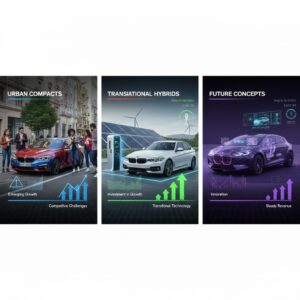
BMW Plug-in Hybrid Models (330e, 530e, X5 PHEV)
The plug-in hybrid electric vehicle (PHEV) market is expanding rapidly as consumers transition gradually from ICE vehicles to full electric models.
Although BMW offers strong PHEVs, competition from Volvo Recharge, Mercedes EQ Power, Audi TFSI-e, and Lexus hybrid models is intense.
The PHEV market has high growth but BMW’s share is still developing, making this a Question Mark.
Compact BMW Models (1 Series and 2 Series)
Compact luxury segments grow rapidly among:
Urban buyers
Young professionals
Budget luxury consumers
But BMW’s dominance is lower here compared to sedans and SUVs, because of strong competition from:
Mercedes A-Class
Audi A3 and Q2
Volvo XC40
Mini Cooper (ironically BMW-owned but competitive)
Compact BMWs therefore fall under Question Marks.
BMW Autonomous Driving and Digital Mobility
Autonomous driving has enormous global potential, but BMW faces intense competition from:
Tesla Autopilot
Waymo
Mercedes Drive Pilot
Cadillac Super Cruise
BMW is investing heavily in Level 3 autonomy and collaborative projects with Intel and Mobileye. However, market share is limited, making autonomy a Question Mark with high potential.
Dogs (Low Market Share, Low Market Growth)
BMW i3 (Discontinued)
The BMW i3 was one of the earliest modern EVs but eventually lost relevance due to:
Limited range
Small size
High competition from Tesla Model 3 and Model Y
Shift toward larger luxury EVs
Its production has already ended, placing it in the Dogs category.
Also Read: BCG Matrix of Tata Steel
BMW ICE Sports Coupes (BMW Z4 and BMW 8 Series Coupe)
Sports coupes face declining demand worldwide due to:
Shift to SUVs
High insurance and maintenance costs
Low practicality
Electrification trends
The Z4 and 8 Series Coupe generate limited sales, making them Dogs in the BCG Matrix of BMW.
Diesel BMW Models
Global demand for diesel vehicles has collapsed for reasons including:
Government regulations
Environmental concerns
EV adoption
Higher taxation on diesel cars
BMW’s diesel lineup holds low share and low growth, placing it in the Dogs quadrant.
Strategic Insights from the BCG Matrix of BMW
The BCG Matrix of BMW provides several important insights into BMW’s overall strategy:
Electric vehicles are the future growth engine
The i-Series will define BMW’s long-term competitiveness
SUVs remain the strongest profit and growth drivers
BMW’s X-Series maintains global leadership
Traditional sedans still generate stable profits
3 Series and 5 Series provide financial backbone
BMW must invest more in hybrids and compact luxury
These segments show growth but remain underdeveloped
ICE sports cars and diesel models face decline
BMW must phase out or transform these categories
Overall, BMW’s strategy must continue prioritizing electrification, digitalization, and sustainability to secure long-term leadership.
Challenges of Applying BCG Matrix to BMW
Applying the BCG Matrix to an automaker like BMW has complexities:
Automotive markets differ regionally
Technology evolves quickly
Government regulations affect product demand
Luxury consumer preferences change rapidly
Supply chain issues impact market share
Despite these challenges, the BCG Matrix remains a valuable strategic tool.
Conclusion
The BCG Matrix of BMW clearly illustrates BMW’s balanced yet evolving product portfolio.
Its Star categories, including electric vehicles and luxury SUVs, will shape BMW’s future dominance.
Its Cash Cows, such as sedans, performance cars, and the motorcycle division, provide financial strength and stability.
Its Question Marks, including compact cars, PHEVs, and autonomous technologies, require investment to unlock long-term potential.
Its Dogs, including older EV models, diesel cars, and sports coupes, reveal segments BMW must eventually phase out or reposition.
With a strong focus on electrification, innovation, and premium mobility, BMW is well positioned to lead the next era of luxury automotive transformation.
FAQs
What is the BCG Matrix of BMW?
It is a strategic framework that categorizes BMW’s product segments based on market growth and relative market share.
Which BMW segments are Stars?
The i-Series electric vehicles and X-Series SUVs.
Which BMW models are Cash Cows?
3 Series, 5 Series, M performance models, and BMW Motorrad.
Which BMW divisions are Question Marks?
Compact cars, plug-in hybrids, and autonomous driving technologies.
Which BMW segments fall under Dogs?
Diesel vehicles, BMW Z4, 8 Series Coupe, and discontinued BMW i3.

A digital marketer with a strong focus on SEO, content creation, and AI tools. Creates helpful, easy-to-understand content that connects with readers and ranks well on search engines. Loves using smart tools to save time, improve content quality, and grow online reach.