


Summary
The BCG Matrix of Ford Motor Company provides an in-depth strategic understanding of how one of the oldest and most influential automobile manufacturers in the world manages its diverse portfolio. Ford has undergone a significant transformation over the years—from traditional combustion engine vehicles to electric mobility, autonomous driving technology, and global expansion. The Ford Motor BCG analysis classifies its products and divisions into four categories — Stars, Cash Cows, Question Marks, and Dogs — based on their market growth rate and relative market share.
This detailed and descriptive blog explores how Ford Motor utilizes the Boston Consulting Group (BCG) Matrix to evaluate its position in the global automotive industry, how it allocates resources efficiently, and how its strategic decisions are shaping its future in an evolving market dominated by electric vehicles, digital connectivity, and sustainability goals.
Ford Motor Company is an iconic name in the global automotive industry. Founded by Henry Ford in 1903, Ford revolutionized automobile manufacturing through the assembly line model, making cars affordable for the masses. Today, the company operates in over 100 countries, employs more than 170,000 people, and produces vehicles under brands such as Ford and Lincoln.
The automotive industry has been evolving rapidly due to technological innovation, environmental concerns, and changing consumer preferences. Companies like Ford have had to rethink their strategies to remain competitive. The BCG Matrix of Ford Motor Company helps analyze how different segments of the business perform in this dynamic environment. It offers insight into which divisions are growing rapidly, which remain stable, and which face challenges or decline.
By placing Ford’s business units and product categories into the Stars, Cash Cows, Question Marks, and Dogs quadrants, this model helps us understand Ford’s current position and its roadmap for future growth and sustainability.
About Ford Motor Company
Ford Motor Company, headquartered in Dearborn, Michigan (USA), is one of the largest automobile manufacturers in the world. It produces a wide range of vehicles including sedans, SUVs, trucks, vans, electric vehicles, and luxury models under the Lincoln brand.
Ford operates in major global markets including North America, Europe, South America, Asia-Pacific, and Africa. Its product portfolio includes iconic models like the Ford F-Series, Mustang, Escape, Explorer, Ranger, and Bronco.
The company’s core vision is to drive human progress through mobility. In recent years, Ford has committed heavily to electrification, autonomous driving technology, and sustainable vehicle manufacturing to align with global environmental and technological trends.
What is the BCG Matrix
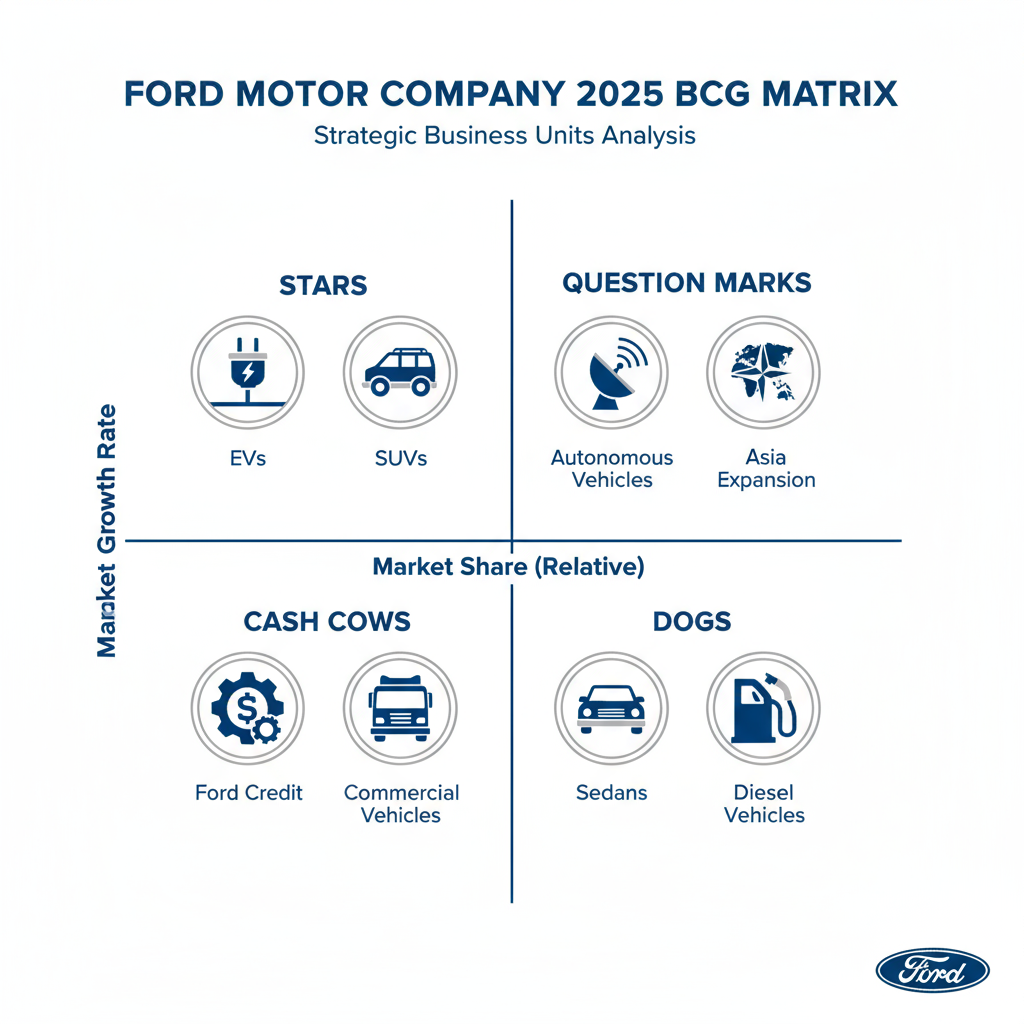
The Boston Consulting Group (BCG) Matrix is a strategic framework used to analyze a company’s product portfolio based on two important dimensions:
Market Growth Rate: Represents the potential or attractiveness of the market in which the business operates.
Relative Market Share: Represents the company’s position or dominance in that particular market compared to competitors.
Based on these two dimensions, the BCG Matrix classifies business units into four categories:
Stars: High market share and high market growth. These divisions drive future growth and require significant investment.
Cash Cows: High market share but low market growth. These are stable and mature businesses generating consistent revenue.
Question Marks: Low market share but high market growth. These require investment and strategic direction to become Stars.
Dogs: Low market share and low market growth. These have limited profitability and may need divestment or restructuring.
The BCG Matrix of Ford Motor helps identify where the company should invest, sustain, or divest to maximize overall profitability and long-term success.
Importance of the BCG Matrix for Ford Motor
The automotive market is highly competitive, with players like Toyota, Tesla, General Motors, Volkswagen, and Hyundai constantly innovating. The Ford Motor BCG analysis allows the company to:
- Identify strong-performing segments and prioritize resources toward them.
- Evaluate underperforming or declining divisions.
- Plan future investments in high-growth markets like electric and autonomous vehicles.
- Balance short-term revenue generation with long-term innovation.
- Optimize its global product strategy to adapt to different regional markets.
This strategic model ensures Ford remains agile and future-ready in an industry defined by disruption.
Detailed BCG Matrix of Ford Motor Company
Stars (High Market Share, High Market Growth)

The Star quadrant represents Ford’s business units that hold a dominant position in fast-growing markets. These are the company’s growth engines that require continuous investment.
Electric Vehicles (EVs)
The global shift toward electric mobility has positioned Ford’s EV division as a major growth area. With models like the Ford Mustang Mach-E, F-150 Lightning, and E-Transit, Ford has established a strong foothold in the EV market.
- The Mustang Mach-E competes directly with Tesla’s Model Y and has received positive global acclaim.
- The F-150 Lightning, an all-electric version of America’s best-selling pickup truck, has seen massive pre-orders and growing market demand.
- The E-Transit targets the commercial EV market, offering an eco-friendly alternative for fleet operators.
Electric vehicles represent high market growth globally due to stricter emission regulations, rising fuel prices, and increased government support for EV adoption. Ford’s investment of over $50 billion in EV development by 2026 highlights its commitment to this segment.
Also Read: BCG Matrix of Titan
This division’s rapid expansion, combined with consumer acceptance, positions Ford’s EV business as a Star in the BCG Matrix.
SUVs and Pickup Trucks
Ford’s SUV and truck lineup, including the Ford F-Series, Ranger, Bronco, and Explorer, continues to dominate key markets.
- The Ford F-Series has been the best-selling vehicle in the United States for over four decades.
- The Ford Bronco revival was a major success, tapping into the adventure and off-road vehicle segment.
- SUVs like Explorer and Escape cater to global consumers seeking versatility and comfort.
The growing global demand for SUVs, combined with Ford’s strong market share, makes this division another Star in the company’s portfolio.
Cash Cows (High Market Share, Low Market Growth)

Cash Cows are mature businesses with stable market positions that generate steady cash flow, allowing Ford to invest in emerging opportunities.
Commercial Vehicles (Vans and Fleets)
Ford’s commercial vehicle division, particularly its Transit van series, dominates the European and North American fleet markets. These vehicles are essential for logistics, construction, and delivery services.
Although the market growth rate for commercial vehicles is steady rather than explosive, Ford’s high market share and reliable revenue make it a Cash Cow.
The upcoming electrification of this segment (E-Transit) ensures continued profitability while aligning with sustainability goals.
Ford Credit (Financial Services)
Ford Credit, the financial services division of the company, provides loans, leasing, and insurance options for customers and dealers.
This division contributes steady profits with minimal volatility, acting as a financial backbone for Ford.
Despite low market growth, Ford Credit remains critical for customer loyalty and vehicle sales support.
Both the commercial vehicle segment and Ford Credit business ensure cash inflow that sustains Ford’s R&D and innovation in newer technologies.
Question Marks (Low Market Share, High Market Growth)

Question Marks represent divisions or products with potential in fast-growing markets but currently limited dominance. They need strategic attention and investment to become Stars.
Autonomous Vehicle Technology
Ford’s investment in autonomous driving technology through Ford BlueCruise and partnerships like Argo AI demonstrates its commitment to future mobility solutions.
However, the autonomous vehicle market remains in an early stage with high uncertainty and competition from companies like Tesla, Waymo, and Cruise (GM).
Although the growth potential is immense, Ford currently holds a smaller share compared to pioneers in this segment.
With further R&D and regulatory development, Ford’s autonomous driving initiatives could evolve from Question Marks into Stars in the next decade.
International Markets (Asia and South America)
While Ford performs strongly in North America, its presence in regions like Asia and South America has been inconsistent.
In 2020, Ford exited India’s mass-market segment due to declining profitability. However, it continues to explore re-entry through electric and niche premium products.
The Asia-Pacific region, particularly China and India, represents significant growth potential. To regain its position, Ford needs strategic partnerships, localization, and product diversification.
These areas currently remain Question Marks with opportunities for future transformation through strategic investments.
Dogs (Low Market Share, Low Market Growth)
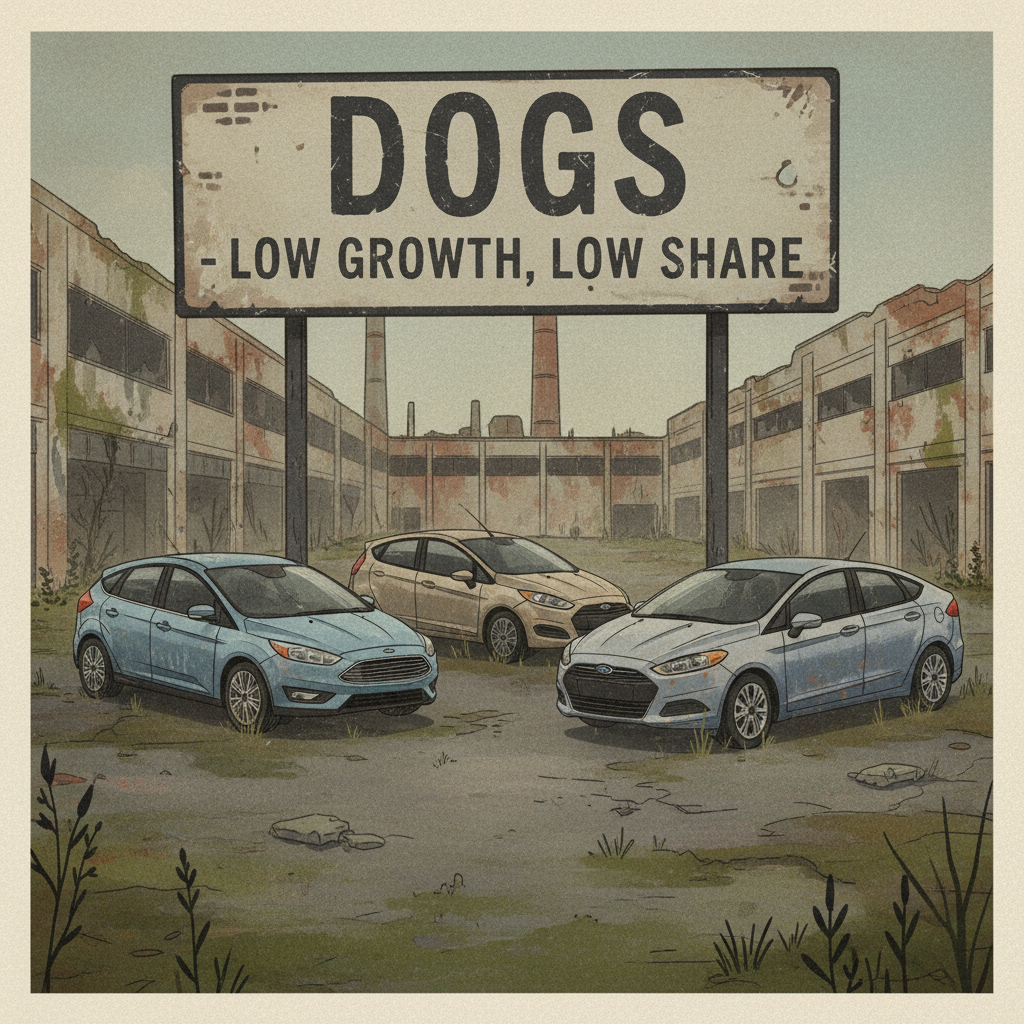
The Dog quadrant includes Ford’s segments that face declining demand, low profitability, and little potential for future growth.
Traditional Sedans and Compact Cars
Ford has significantly reduced production of sedans and compact cars such as the Ford Focus, Fiesta, and Fusion in many markets, especially the United States.
Consumer preferences have shifted toward SUVs and trucks, leading to decreased demand for smaller cars.
High competition, low margins, and limited growth prospects have made this category a Dog in the BCG Matrix.
Diesel-Powered Vehicles
Tighter global emission regulations and rising environmental awareness have caused a decline in the diesel vehicle market.
Ford has gradually phased out diesel engines in many models to focus on hybrids and electrics.
This shift aligns with Ford’s broader sustainability agenda but leaves diesel vehicles in the low-growth, low-profit quadrant.
Strategic Insights from Ford’s BCG Matrix
The BCG Matrix of Ford Motor highlights the company’s strategic adaptability in a highly dynamic automotive landscape.
The EV and SUV divisions demonstrate strong market dominance and growth potential, securing Ford’s position among global leaders in innovation and performance.
Its Cash Cow divisions ensure stable financial health, supporting heavy investments in R&D and electrification.
The Question Mark segments underline the importance of future-oriented technologies like autonomous vehicles and geographic expansion.
Meanwhile, the phasing out of unprofitable sedans and diesel models showcases Ford’s ability to realign with changing global trends.
By leveraging its core strengths in engineering, brand legacy, and sustainability, Ford is well-positioned to maintain profitability while driving technological advancement.
Challenges and Limitations of the BCG Matrix for Ford Motor
While the Ford Motor BCG analysis provides valuable insights, it also has limitations:
The automotive industry is deeply interconnected, making it hard to isolate divisions entirely. Success in one category often supports another.
Global economic fluctuations, regulatory changes, and fuel price volatility can alter market growth rates suddenly.
The BCG Matrix focuses primarily on quantitative data like market share and growth, ignoring qualitative factors such as brand equity and innovation potential.
Emerging technologies like EVs and autonomous vehicles take years to mature, so short-term matrix placement may not fully reflect their future significance.
Despite these constraints, the BCG Matrix remains a useful tool for understanding Ford’s strategic balance between profitability and innovation.
Conclusion
The BCG Matrix of Ford Motor Company (2025) provides a clear picture of how the automaker manages its product and business portfolio amid a global transformation in mobility.
Stars like electric vehicles and SUVs lead Ford’s innovation and market expansion.
Cash Cows such as commercial vehicles and Ford Credit provide financial stability.
Question Marks like autonomous driving technology and international operations represent future opportunities for growth.
Dogs, including traditional sedans and diesel vehicles, are gradually being phased out in favor of more sustainable and profitable models.
This strategic approach ensures that Ford maintains a healthy balance between its legacy strengths and forward-looking innovation. The Ford Motor BCG analysis highlights the company’s resilience, adaptability, and commitment to shaping the future of transportation.
FAQs
What is the BCG Matrix of Ford Motor Company?
The BCG Matrix of Ford Motor analyzes its different business divisions based on market growth and relative market share to guide resource allocation and long-term strategy.
Which divisions of Ford are considered Stars?
Ford’s Electric Vehicles (EVs) and SUV segments are considered Stars due to high market share and strong growth potential.
What are the Cash Cows in Ford’s portfolio?
The Commercial Vehicle division and Ford Credit are Cash Cows, generating stable profits with low market growth.
Which divisions fall under Question Marks?
Autonomous vehicle technology and Ford’s international markets like Asia and South America fall under Question Marks.
Why are sedans and diesel vehicles considered Dogs?
They face declining global demand, low profitability, and stricter environmental regulations, making them low-growth, low-share divisions.

A digital marketer with a strong focus on SEO, content creation, and AI tools. Creates helpful, easy-to-understand content that connects with readers and ranks well on search engines. Loves using smart tools to save time, improve content quality, and grow online reach.