

Apple Inc. is one of the most influential technology companies in the world. Known for its innovative products, sleek design, and unmatched brand loyalty, Apple has become a global leader in consumer electronics, software, and digital services.
This SWOT analysis of Apple highlights the company’s strengths, weaknesses, opportunities, and threats in 2025, offering a deeper understanding of how Apple maintains its dominance in a competitive technology-driven landscape.
Overview of Apple
- Industry: Consumer electronics, Software services, Online services
- Founded: April 1, 1976, Los Altos, California, U.S.
- Founders: Steve Jobs, Steve Wozniak, Ronald Wayne
- Headquarters: Cupertino, California, U.S.
- Number of Locations: 528 retail stores (2023)
- Key People: Arthur D. Levinson (Chairman), Tim Cook (CEO), Jeff Williams (COO), Luca Maestri (CFO)
- Revenue (2023): $383.29 billion
- Operating Income (2023): $114.30 billion
- Net Income (2023): $97 billion
- Total Assets (2023): $352.58 billion
- Total Equity (2023): $62.15 billion
- Employees: 161,000 (2023)
- Market Cap (March 2024): $2.638 trillion
- Website: www.apple.com
SWOT Analysis of Apple
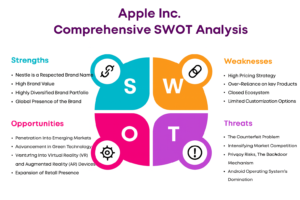
Strengths of Apple
- Global Presence – Apple operates in 26 countries and has an extensive retail and digital presence worldwide, making it a globally recognized brand.
- Most Valuable Brand – With a market capitalization of $2.916 trillion in early 2024, Apple remains the most valuable publicly traded company globally.
- Financial Strength – Apple reported $89.5 billion in sales and $22.956 billion net income in Q4 2023, proving its strong financial position.
- Investment in Research & Development – Apple spent $22.61 billion on R&D in 2023, fueling innovation across its product lines.
- Effective Marketing – Apple’s emotional storytelling and sleek campaigns create strong connections with customers, boosting loyalty.
- Leading Innovation – Apple consistently pushes technological boundaries, with the iPhone, iPad, and latest iPhone 15 showcasing advanced innovation.
- Brand Loyalty – Millions of customers remain loyal to Apple, willing to pay premium prices for its ecosystem.
- Sustainability Initiatives – Programs like Liam, the iPhone recycling robot, show Apple’s commitment to environmental responsibility.
- Design Excellence – Apple’s reputation for premium, elegant design sets it apart from competitors.
- Integrated Ecosystem – Seamless connection between iCloud, iOS, macOS, watchOS, and services encourages repeat purchases.
- Diverse Product Portfolio – Apple offers hardware (iPhone, Mac, iPad, Watch, AirPods, TV) and services (Apple Music, TV+, Arcade, iCloud).
- Strong Retail Network – With over 528 stores worldwide, Apple’s retail strategy builds brand experience and customer engagement.
- Expansion in Services – Services generated over $20 billion annually, showing Apple’s diversification beyond hardware.
- Efficient Supply Chain – Apple’s global supply chain ensures timely product launches and consistent quality.
- Customer Service – Apple Stores and Genius Bars strengthen trust and customer satisfaction.
- Focus on Privacy – Apple’s emphasis on security and data protection enhances consumer trust in its products.
Weaknesses of Apple
- Declining Market Share – Android dominates with 70.89% global share compared to iOS’ 28.36%, limiting Apple’s growth.
- Frequent Legal Challenges – Ongoing lawsuits, including disputes over intellectual property and antitrust, drain resources and harm reputation.
- High Pricing Strategy – Apple’s premium pricing limits its reach in cost-sensitive markets.
- Over-Reliance on iPhone – Nearly half of Apple’s revenue depends on iPhone sales, exposing financial risks.
- Closed Ecosystem – While effective, Apple’s closed system restricts compatibility with third-party products, deterring some consumers.
- Limited Customization – Tech-savvy users often find Apple devices less flexible compared to Android devices.
- Incompatibility with External Software – Apple’s restrictive ecosystem can discourage developers and customers seeking open platforms.
- Perceived Lack of Innovation – Some critics argue that Apple’s recent launches focus on incremental updates rather than groundbreaking products.
- OS Adjustment Issues – New users from Android or Windows may struggle with Apple’s unique OS designs.
- Restrained Advertising Strategy – Apple relies on retail stores and prestige branding, limiting broader promotional opportunities.
- Diversification Risks – Expansions into streaming, gaming, and payments put Apple against dominant market leaders.
- App Store Criticism – High commissions and disputes with developers (e.g., Epic Games) damage Apple’s developer relations.
- Allegations of Anti-Competitive Practices – Apple faces global scrutiny over monopolistic behavior.
- Repairability Concerns – Devices criticized for being hard to repair, raising sustainability issues and customer frustration.
Opportunities for Apple
- Expanding into Emerging Markets – Growth in India, Africa, and Southeast Asia presents strong opportunities.
- Gaming Industry Expansion – Apple Arcade could help Apple gain traction in the booming gaming market.
- Wearables Market Growth – Smartwatches and AirPods can strengthen Apple’s presence in wearables.
- Service Ecosystem Expansion – Apple TV+, News+, Music, Pay, and Arcade hold strong growth potential.
- Green Technology Adoption – Shifting to renewable energy and eco-friendly production can enhance Apple’s reputation.
- VR and AR Development – Apple’s focus on mixed reality devices could shape the future of entertainment and education.
- Retail Expansion – Opening more Apple Stores globally can improve accessibility.
- Streaming Growth – Apple TV+ and Music can compete in the expanding digital content market.
- Artificial Intelligence (AI) – Building advanced AI capabilities could improve personalization and user experience.
- Technological Innovation – Continued focus on chips, hardware, and software development strengthens Apple’s edge.
- Advertising Market Entry – Apple can leverage digital advertising opportunities for revenue growth.
- Ecosystem Expansion – Products like iTV and integration with home automation can deepen user engagement.
- Cloud Services Growth – Expanding iCloud in an era of data-driven business is a major opportunity.
- Autonomous Car Technology – Project Titan could position Apple as a player in the self-driving car market.
- Educational Sector Expansion – Apple’s devices and software can gain traction in schools and universities.
- Mergers & Acquisitions – Acquiring startups or established firms can strengthen Apple’s technology base.
- Smart Home Automation – HomeKit and smart devices offer entry into the home automation sector.
- Chip Manufacturing Expansion – In-house chips (like M1/M2) improve performance and reduce dependency on suppliers.
- Financial Services Expansion – Apple Pay Later strengthens Apple’s entry into fintech.
- Skilled Workforce Development – Hiring skilled researchers and developers enhances competitiveness.
Threats to Apple
- Counterfeit Products – Fake Apple products damage brand image and reduce consumer trust.
- Intense Competition – Competitors like Samsung, Google, and Huawei pose ongoing challenges.
- Privacy Risks – Government pressure for backdoor access risks Apple’s privacy-first image.
- Android Domination – Android’s wider affordability and flexibility hurt Apple’s global share.
- Music Sector Competition – Spotify, Amazon Music, and YouTube Music challenge Apple Music.
- Currency Fluctuations – Exchange rate volatility affects international profits.
- User-Tracking Allegations – Accusations of data misuse harm trust.
- Tariffs on Chinese Goods – Dependence on China for manufacturing exposes Apple to U.S.–China trade tensions.
- Supply Chain Disruptions – Political instability or natural disasters could impact Apple’s production.
- Misuse of AirTags – Concerns around stalking and theft tarnish product reputation.
- Antitrust Investigations – Regulators in India, EU, and the U.S. are examining Apple’s business practices.
- USB-C Regulation in EU – Forced switch from Lightning to USB-C increases production costs.
- Rapid Technological Change – Falling behind competitors can weaken Apple’s leadership.
- Emerging Market Challenges – High pricing limits Apple’s adoption in low-income economies.
- Data Breach Threats – A major data breach could severely harm Apple’s reputation.
- Changing Consumer Preferences – Demand for cheaper or customizable devices may affect Apple’s premium model.
- Economic Recession – Inflation and global slowdowns reduce demand for expensive Apple devices.
- Regulatory Pressures – New antitrust and privacy laws could limit Apple’s operations.
Conclusion
This SWOT analysis of Apple company reveals that Apple’s strengths in brand value, innovation, financial power, and ecosystem integration keep it at the top of the tech industry. However, challenges such as high prices, reliance on the iPhone, antitrust scrutiny, and tough competition cannot be ignored.
Apple’s future success depends on leveraging opportunities in emerging markets, AI, green technology, and services expansion while addressing threats like regulation, supply chain risks, and rapidly changing consumer needs.

A digital marketer with a strong focus on SEO, content creation, and AI tools. Creates helpful, easy-to-understand content that connects with readers and ranks well on search engines. Loves using smart tools to save time, improve content quality, and grow online reach.