

Summary
Dell Technologies is one of the most recognized names in the global technology sector. Founded in 1984 by Michael Dell, the company grew from a small start-up selling custom-built computers to a worldwide technology leader. Today, Dell is known for its personal computers, laptops, servers, storage, cloud solutions, and enterprise services, making it a dominant player in both consumer and business markets.
In 2025, Dell stands at a critical point. With strong financial performance, an impressive global presence, and a reputation for quality, Dell continues to thrive. However, the company also faces challenges such as high debt, intense competition, and slowing growth in the laptop market. At the same time, opportunities in cloud computing, AI, 5G, and cybersecurity present Dell with potential for expansion.
This blog provides a detailed SWOT Analysis of Dell, exploring its strengths, weaknesses, opportunities, and threats to understand its current position and future strategy.
Company Overview
- Company type: Subsidiary
- Industry: Personal computers, Computer software, IT solutions
- Founded: May 3, 1984
- Founder: Michael Dell
- Headquarters: Round Rock, Texas, US
- Area served: Worldwide
- Key people: Michael Dell (Chairman & CEO), Jeff Clarke (Vice Chair & COO)
- Products: Personal computers, Servers, Storage, Peripherals, Enterprise solutions
- Revenue (Q1 2024): US$22.9 billion
- Operating income (Q1 2024): US$1.2 billion
- Net income (Q1 2024): US$455 million
- Website: www.dell.com
SWOT Analysis of Dell
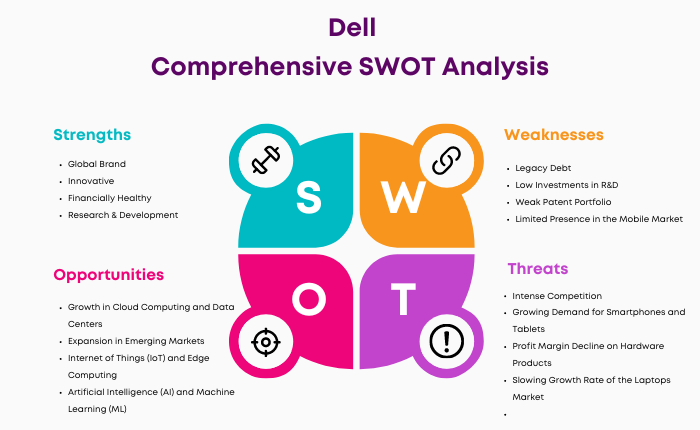
Strengths of Dell
- Global Brand Presence
Dell is the second-largest PC manufacturer in the world, with a 17.5% market share, behind only HP. Its reach extends across 30,000+ stores globally, ensuring wide accessibility. This presence creates strong customer recognition and trust, allowing Dell to compete aggressively in global markets. - Innovation Leadership
Dell has consistently been recognized for innovation. Ranked 10th in Fortune’s list of most innovative companies in 2023, Dell focuses on cutting-edge design, performance improvements, and customer-driven customization. Its innovations in data centers, rugged laptops, and modular designs highlight its leadership. - Financially Healthy
Despite global challenges like supply chain disruptions and economic downturns, Dell has remained financially stable. Revenue grew by 0.2% in FY2024, proving its resilience. A healthy financial base allows Dell to invest in R&D, acquisitions, and sustainability initiatives. - Strong R&D Investments
Dell invested $8.2 billion in R&D from FY22 to FY24, highlighting its commitment to staying competitive. This investment supports advancements in servers, storage solutions, AI-driven platforms, and enterprise software—critical areas for future growth. - Diversified Product Portfolio
Dell doesn’t rely solely on laptops. Its portfolio spans personal computers, servers, data storage, cloud infrastructure, and peripherals. This diversification spreads risk across multiple revenue streams and ensures long-term stability. - Brand Recognition & Awards
Dell is consistently recognized as a trusted employer and ethical company. In 2024, Dell was listed among the World’s Most Ethical Companies by Ethisphere and ranked in Forbes’ Top 10 Best Employers. Awards enhance customer trust and attract top talent. - Customized Laptops
Dell offers customers the ability to customize laptops and desktops—a rare feature in today’s standardized market. From RAM upgrades to specialized graphic cards, customization strengthens Dell’s direct-to-consumer appeal and improves customer satisfaction. - Vertical Integration & Direct Sales Model
Dell’s direct-to-consumer approach eliminates intermediaries, improving cost efficiency, product pricing, and customer service. Its vertical integration model allows Dell to control manufacturing, supply chain, and sales, giving it a competitive advantage. - High Quality Products
Dell’s products are associated with durability and reliability. For example, the Latitude Rugged Express laptop is popular among industries requiring tough, long-lasting devices. This focus on quality drives repeat purchases and loyalty. - Direct Sales Channel
By selling directly through its website and brand stores, Dell retains greater control over pricing, margins, and customer experience. This direct feedback loop also helps Dell adapt quickly to consumer demands.
Weaknesses of Dell
- Legacy Debt
After acquiring EMC Corporation, Dell accumulated a massive debt of $23 billion (2023). Although repayment is ongoing, the debt restricts Dell’s flexibility to make aggressive investments in new sectors. - Low R&D Allocation (vs. Competitors)
While Dell invests heavily in R&D, its R&D-to-revenue ratio is lower than competitors like Apple and Microsoft. This limited allocation has already cost Dell opportunities in smartphones and tablets, leaving it behind in mobile-first markets. - Weak Patent Portfolio
Dell’s relatively weak patent portfolio, especially compared to giants like Apple and IBM, makes it harder to secure intellectual property dominance in emerging areas like mobile devices and AI. This could limit Dell’s competitiveness in the future. - Limited Mobile Market Presence
Dell exited the smartphone and tablet markets after poor performance. With the world moving toward mobile-first ecosystems, this absence creates a strategic gap, leaving Dell dependent on PCs and servers. - Few Retail Locations
Dell relies heavily on online sales and customization, resulting in fewer physical retail outlets. While efficient, this reduces product visibility and hands-on experience for consumers who prefer in-store shopping. - Low Product Differentiation
In many markets, Dell laptops and desktops appear similar to competitors’. With thin differences in pricing and features, Dell risks losing ground to rivals who offer unique design, better marketing, or lower prices. - Commoditized Products
Most of Dell’s revenues still come from PC and laptop sales, an industry with thin profit margins. As laptops become commoditized, Dell struggles to differentiate and sustain high profitability. - Complex Organizational Structure
The acquisition of EMC added complexity to Dell’s corporate structure. Decision-making slowed down, and integrating new acquisitions became challenging. This complexity reduces Dell’s agility in responding to market shifts. - Poor Customer Service Reputation
Dell’s customer service suffered after outsourcing support to call centers. While improvements are ongoing, its service reputation lags behind Apple and HP. In tech, poor support can hurt loyalty significantly.
Opportunities for Dell
- Growth in Cloud Computing & Data Centers
With cloud adoption surging, Dell has a chance to expand enterprise infrastructure solutions. Already strong in servers, storage, and networking, Dell can become a key partner for organizations migrating to the cloud. - Expansion in Emerging Markets
Emerging economies in Asia, Africa, and Latin America are driving demand for affordable PCs, enterprise solutions, and IoT infrastructure. Dell can expand aggressively here, leveraging its brand recognition and customizable solutions. - IoT & Edge Computing
As more devices get connected, Dell can design infrastructure to process data closer to the source. Edge computing is a high-growth area where Dell’s server and hardware expertise makes it well-positioned. - Artificial Intelligence & Machine Learning
AI and ML adoption across industries presents an opportunity. Dell can integrate AI-driven solutions into data centers, enterprise software, and cybersecurity tools, adding more value to customers. - Strengthening Cybersecurity Offerings
Cybersecurity is no longer optional. By building integrated, enterprise-grade security solutions, Dell can create a new revenue stream while ensuring customer trust in its hardware and cloud solutions. - Sustainability & Environmental Initiatives
Customers now value green companies. Dell can lead with energy-efficient devices, recycling programs, and circular economy initiatives, positioning itself as an eco-conscious tech leader. - 5G Technology Adoption
The rise of 5G enables faster connectivity and low-latency computing. Dell can capitalize on this through products designed for smart cities, autonomous vehicles, and immersive experiences (AR/VR). - Expanding Services & Enterprise Solutions
Shifting from pure hardware to services and enterprise solutions could improve margins and reduce reliance on PC sales. Growth in cloud consulting, managed IT services, and infrastructure solutions will be key. - Acquisitions for Patents & Capabilities
Dell can acquire startups in AI, cybersecurity, and cloud tech to quickly expand its patent portfolio and innovation capacity—faster than developing solutions internally.
Threats to Dell
- Intense Competition
Dell faces strong competition from HP, Lenovo, Apple, Acer, and IBM. Competitors challenge Dell across pricing, design, innovation, and brand loyalty, making market share retention costly. - Growing Shift to Smartphones & Tablets
With consumers moving to smartphones and tablets for daily use, laptop demand is declining. This shift poses a serious risk for Dell’s PC-heavy business model. - Declining Profit Margins
As raw material and labor costs rise, Dell’s hardware-heavy portfolio faces margin pressure. Competitors offering cheaper alternatives worsen the challenge. - Slowing Growth in Laptop Market
The laptop segment, once Dell’s crown jewel, is nearing saturation. Growth is slowing, pushing Dell to diversify into cloud, enterprise, and AI services. - Global Economic Recession Risks
Economic slowdowns reduce discretionary spending, leading to lower PC and server sales. This makes Dell vulnerable to global downturns. - Tariffs & Trade Barriers
Trade policies and tariffs increase Dell’s costs, especially given its global supply chain dependency. - Legal Issues & Brand Risks
Lawsuits, such as child labor allegations in 2019, harm Dell’s reputation. With rising expectations for ethical practices, compliance lapses can hurt credibility. - Regulatory & Compliance Challenges
Operating globally means Dell faces multiple data privacy, cybersecurity, and environmental regulations. Non-compliance can lead to fines and reputational damage. - Supply Chain Disruptions
Global events like geopolitical conflicts or pandemics disrupt Dell’s complex supply chains. This results in delivery delays, higher costs, and customer dissatisfaction. - Currency Fluctuations
Operating across markets exposes Dell to exchange rate risks. Currency swings can affect revenues and profitability, complicating financial planning.
Conclusion
Dell remains a technology powerhouse in 2025. Its brand equity, strong financials, innovative solutions, and global presence are unmatched. At the same time, challenges like debt, slowing PC market, and competition force Dell to rethink its strategy.
The way forward lies in leveraging strengths (innovation, R&D, enterprise solutions) while addressing weaknesses (mobile absence, customer service). If Dell capitalizes on opportunities in AI, cloud, cybersecurity, and 5G, it can stay a global leader despite threats.
Dell’s journey shows how an organization must continuously balance legacy strengths with new innovations to thrive in the evolving tech landscape.
FAQs
What is Dell’s biggest strength in 2025?
Dell’s biggest strengths are its global brand presence, diversified portfolio, and strong financial health, backed by consistent innovation.
What are Dell’s main weaknesses?
Dell’s weaknesses include high debt, lack of presence in smartphones, a weak patent portfolio, and poor customer service reputation.
What opportunities does Dell have in the future?
Dell can grow through cloud computing, AI/ML, IoT, edge computing, cybersecurity, sustainability, and 5G adoption.
Who are Dell’s top competitors?
Dell competes with HP, Lenovo, Apple, Acer, and IBM in the PC and enterprise solutions market.
Why is Dell vulnerable in the laptop market?
The laptop market is slowing, and Dell faces thin margins, high competition, and consumer shifts to smartphones and tablets.