

Ferrari is not just a car manufacturer—it is a global symbol of speed, luxury, and performance. Founded in 1939 by Enzo Ferrari, the brand has established itself as the pinnacle of automotive excellence. With its prancing horse emblem recognized worldwide, Ferrari blends cutting-edge technology with Italian craftsmanship to create cars that are as much works of art as they are engineering marvels.
In this blog, we’ll dive deep into the SWOT Analysis of Ferrari (2025) to understand its strengths, weaknesses, opportunities, and threats in the ever-evolving luxury automotive industry.
Overview of Ferrari
- Industry: Automotive
- Founded: 1939 in Modena, Italy (as Auto Avio Costruzioni)
- Founder: Enzo Ferrari
- Headquarters: Italy
- Area Served: Worldwide
- Key People: John Elkann (Executive Chairman), Piero Ferrari (Vice Chairman), Benedetto Vigna (CEO)
- Products: Sports cars, luxury cars
- Subsidiaries: Scuderia Ferrari S.p.A.
- Production Output (2023): 13,663 units shipped
- Revenue (2023): €5.970 billion
- Operating Income (2023): €1.617 billion
- Net Income (2023): €1.257 billion
- Employees (2023): ~4,988
- Website: www.ferrari.com
Ferrari stands out in the ultra-luxury segment of automobiles, where exclusivity, prestige, and innovation define success. Let’s break down its SWOT analysis.
SWOT Analysis of Ferrari
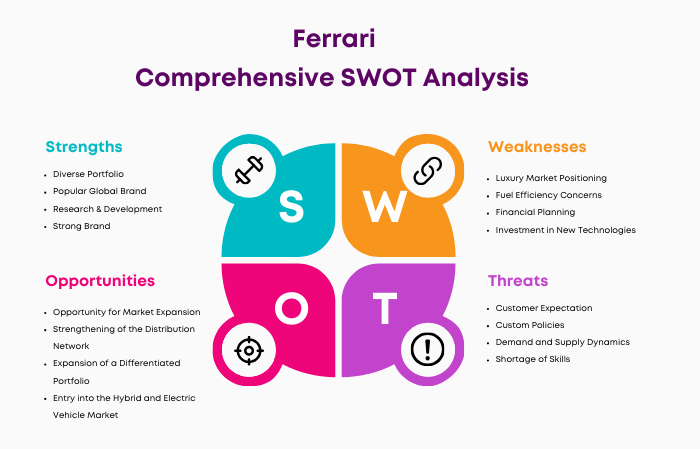
Strengths of Ferrari
- Diverse Portfolio
Ferrari isn’t limited to high-performance cars. The brand has expanded into lifestyle products like eyewear, fashion apparel, and even branded tech (smartphones and laptops). This diversification helps Ferrari strengthen its identity as not just a carmaker but a luxury lifestyle brand. - Popular Global Brand
Ferrari ranked 70th in the Best Global Brands (2023) with a valuation of $10.8 billion. What’s notable is that this success comes with minimal advertising—the brand thrives on reputation, exclusivity, and word-of-mouth, making it one of the most recognizable luxury names worldwide. - Strong R&D Commitment
In 2023, Ferrari invested €1.4 billion in research and development. This ensures each model pushes technological boundaries in design, performance, and safety. Its focus on innovation cements Ferrari’s leadership in high-performance automotive engineering. - High Market Valuation
Ferrari’s market capitalization hit $73.89 billion in 2024, surpassing even giants like Ford and General Motors. This reflects investor confidence in Ferrari’s brand strength and future growth potential. - Motorsport Success
Ferrari’s DNA is deeply tied to Formula 1 victories. With an unmatched legacy on the racetrack, Ferrari uses motorsport success as a marketing tool while feeding racing innovations into its road cars. - Status Symbol
Owning a Ferrari is more than buying a car—it’s buying prestige, exclusivity, and entry into an elite club. This status factor drives aspirational demand globally. - Limited Production Strategy
Ferrari’s deliberate choice to limit production keeps demand higher than supply. This scarcity not only preserves exclusivity but also drives up resale values, making Ferraris highly collectible assets. - Advanced Safety Features
Despite its focus on speed and performance, Ferrari integrates multi-stage airbags, ABS, and stability controls to ensure driver safety without compromising thrill. - Goodwill & Trust
Ferrari enjoys enormous goodwill built over decades of consistency, quality, and innovation. Its after-sales services, warranties, and certified programs further reinforce customer trust. - Certified Pre-Owned Program
Ferrari’s pre-owned program allows aspirational customers to experience the brand. This expands its customer base without diluting exclusivity.
Weaknesses of Ferrari
- Luxury Market Dependence
Ferrari’s premium-only positioning excludes mass markets. While this enhances exclusivity, it also limits growth potential and exposes the brand to economic downturns affecting the ultra-rich. - Fuel Efficiency Concerns
Ferrari’s engines prioritize performance over efficiency, making them less attractive in a world moving toward eco-conscious mobility. - Financial Planning Gaps
Despite strong profits, Ferrari’s asset utilization ratios highlight inefficiencies in financial planning and liquidity management. - Slow Adoption of New Technologies
Compared to EV leaders like Tesla, Ferrari has been slower in transitioning to electric mobility, risking future competitiveness. - Cultural Integration Issues
Ferrari faces challenges integrating different work cultures in acquisitions or global operations, potentially hampering expansion. - Restricted Supply Chain & Distribution
Ferrari’s limited distribution keeps it exclusive but reduces accessibility. Its narrow dealership network is a growth bottleneck. - Customer Support Limitations
Premium car buyers expect top-tier service. Ferrari’s limited after-sales support sometimes results in customer dissatisfaction. - High Attrition Rate
Ferrari experiences higher employee turnover than competitors, increasing costs for recruitment and training.
Opportunities for Ferrari
- Expansion in Emerging Markets
Countries like India, China, and the Middle East present huge opportunities due to growing numbers of ultra-rich consumers. - Strengthening Distribution
Expanding dealer and service networks globally would improve accessibility and customer experience. - Portfolio Diversification
Ferrari can expand into new luxury tech products, hybrid models, and premium lifestyle goods to capture wider markets. - Electric & Hybrid Vehicles
Ferrari has dipped into hybrid models but lags competitors. Investing in EV technology would secure its future relevance and competitiveness. - Favorable Tax Policies
Global trade reforms in some regions ease import/export, offering Ferrari cost benefits and operational advantages. - Technological Innovations
From AI-driven systems to autonomous features, Ferrari has the chance to integrate cutting-edge automotive technologies into its offerings. - Expanding Customer Base
With digital marketing and brand experiences, Ferrari can appeal to younger aspirational buyers while maintaining exclusivity.
Threats to Ferrari
- Shifting Customer Expectations
Consumers now expect sustainability plus performance. Ferrari must adapt without losing its brand DNA. - Customs & Import Policies
High import tariffs in countries like India often double Ferrari’s prices, reducing accessibility. - Demand-Supply Balance
Ferrari must carefully balance exclusivity with demand. Overproduction risks brand dilution; underproduction risks lost sales. - Skilled Labor Shortage
Ferrari’s handcrafted excellence relies on rare talent, and shortages in skilled artisans pose a production challenge. - Carbon Emission Regulations
Stricter global emission laws force Ferrari to accelerate hybrid/EV development, requiring heavy R&D investment. - Rising Labor Costs
Increasing global wages, especially in Europe and Asia, threaten Ferrari’s production costs and margins. - Cybersecurity Risks
With connected cars and digital integration, Ferrari faces potential hacking threats that can compromise safety and customer trust. - Legal & Regulatory Compliance
Different global markets impose varying safety, emissions, and compliance standards, making operations complex. - Luxury Market Saturation
Competitors like Lamborghini, Porsche, Tesla, and Aston Martin are crowding the market, creating intense rivalry in the luxury performance segment.
Conclusion
Ferrari continues to be the gold standard of luxury and performance. Its strengths—brand equity, motorsport legacy, limited production, and strong financials—solidify its dominance in the premium segment.
However, challenges like sustainability demands, rising costs, and regulatory hurdles cannot be ignored. The road ahead lies in electric mobility, emerging markets, and broader lifestyle branding.
By balancing tradition with innovation, exclusivity with accessibility, Ferrari can maintain its iconic status and continue inspiring automotive passion for decades to come.
FAQs
Why is Ferrari considered a luxury brand?
Because of its exclusivity, limited production, high-performance engineering, and association with status and prestige.
How many cars does Ferrari produce annually?
In 2023, Ferrari produced around 13,663 units, maintaining its exclusivity.
Does Ferrari make electric vehicles?
Ferrari has hybrid models but is gradually transitioning into the electric vehicle space to meet future demands.
What are Ferrari’s main strengths?
Its brand reputation, Formula 1 success, limited production, and high R&D investment are its biggest strengths.
What challenges does Ferrari face in 2025? A digital marketer with a strong focus on SEO, content creation, and AI tools. Creates helpful, easy-to-understand content that connects with readers and ranks well on search engines. Loves using smart tools to save time, improve content quality, and grow online reach.
Regulatory compliance, carbon emission standards, high labor costs, cybersecurity risks, and increasing luxury market competition.
