

Summary
Google, the powerhouse behind the world’s most popular search engine, has expanded its reach across various tech domains, including cloud computing, artificial intelligence, digital advertising, and consumer electronics. Despite its industry dominance, Google faces several challenges, including regulatory scrutiny, competition, and privacy concerns.
This SWOT analysis of Google explores the key strengths, weaknesses, opportunities, and threats the company faces as it enters 2025. With its innovative culture and robust financials, Google remains a leading player, but it must adapt to an ever-evolving market to maintain its competitive edge.
Founded in 1998 by Larry Page and Sergey Brin, Google has grown from a simple search engine to a global technology conglomerate under Alphabet Inc. Known for its revolutionary contributions to the internet, cloud computing, artificial intelligence (AI), and digital advertising, Google dominates the tech world. With over 1.68 million employees globally, Google is not just a company; it’s a cornerstone of the digital ecosystem. However, as we dive into the SWOT analysis of Google, it’s essential to look at both its market-leading strengths and the challenges it faces in 2025.
Overview of Google
- Company Type: Subsidiary (Alphabet Inc.)
- Founded: September 4, 1998, by Larry Page and Sergey Brin
- Headquarters: Googleplex, Mountain View, California, USA
- Key People: Sundar Pichai (CEO), Ruth Porat (CFO), Thomas Kurian (CEO of Google Cloud)
- Revenue (2023): $574.8 billion
- Market Capitalization: $577.68 billion (2023)
- Employees: 182,502 (2023)
- Website: www.about.google
- Core Products: Google Search, YouTube, Google Ads, Google Cloud, Android, Google Maps, Google Play
SWOT Analysis of Google
Strengths of Google
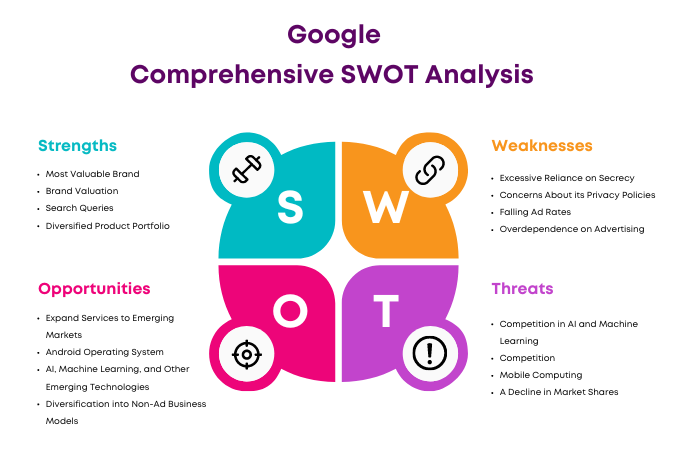
Google’s SWOT analysis showcases several powerful advantages that have solidified its position as one of the most valuable and influential companies in the world.
Most Valuable Brand
Google has long been considered one of the most valuable brands in the world. According to Statista, Google was valued at approximately $577.68 billion in 2023. The brand has established itself as the go-to solution for search, email, maps, and more, creating unparalleled brand recognition across the globe. Google’s market dominance and global reach are key contributors to this high valuation.
Dominance in Search Queries
When it comes to search engines, Google dominates. The company processes more than 40,000 search queries per second, equating to over 3.5 billion searches per day. No other search engine comes close to Google’s reach, which not only makes it the market leader but also a key player in directing web traffic across the internet.
Diversified Product Portfolio
Google’s business extends far beyond its search engine. The company has successfully diversified into multiple sectors, including cloud computing, AI-powered products, YouTube, Android, Google Ads, Google Play, and even hardware products like the Pixel phone. This diversification helps reduce Google’s reliance on a single revenue stream, making it more resilient against market fluctuations.
User Traffic Generation
Google’s ability to drive unmatched traffic remains one of its key strengths. With over 1.2 billion unique monthly users engaging with Google’s ecosystem, the company has a broad and loyal user base. Google’s ability to capture, retain, and convert users through a vast network of platforms gives it a unique advantage in the digital ecosystem.
Financial Stability and Rapid Growth
Google has consistently posted strong revenue growth, with $574.8 billion in net sales in 2023, showing a year-over-year increase. The company’s workforce has expanded from fewer than 300 employees in 2001 to over 182,502 employees by the end of 2023. This impressive growth reflects Google’s ability to innovate, scale, and dominate emerging markets.
Advertising Revenue Leadership
Google’s advertising model has been its core revenue driver. Over 85% of Google’s revenue comes from its digital advertising platform, particularly through Google Ads and YouTube ads. This ability to monetize user traffic and provide businesses with targeted advertising has given Google a steady flow of income and market power.
Brand Awareness and Trust
Google has successfully built a reputation for being fast, reliable, and user-friendly. This brand recognition is instrumental in its ability to maintain a leading position across its various business units. The trust consumers place in Google helps increase its market share, making it easy to introduce new products and services.
Innovation Culture
Google’s culture of innovation is legendary. Through initiatives like the “20% time policy,” which allows employees to spend part of their workweek exploring creative ideas, Google fosters a spirit of innovation that has led to groundbreaking products like Google Assistant, Waymo (self-driving cars), and Google Cloud. The company is also at the forefront of AI and quantum computing.
Weaknesses of Google
Despite its dominance, Google faces several weaknesses that pose risks to its business model. These include challenges in data privacy, dependency on advertising revenue, and the limitations of its hardware offerings.
Excessive Reliance on Secrecy
One of Google’s major weaknesses is its reliance on secrecy, particularly regarding its search engine algorithms. While this secrecy ensures that Google’s search results remain unmanipulated, it also creates a barrier for businesses and developers who rely on understanding how the algorithm works to optimize their content. This lack of transparency can lead to frustration and a sense of distrust among its user base.
Privacy Concerns
Google’s privacy policies have long been a point of contention. The company collects vast amounts of user data from its search engine, Gmail, YouTube, and other services, which has led to concerns about data security and user privacy. Google has taken steps to improve its transparency and security, but it continues to struggle with maintaining trust in the wake of privacy scandals and regulatory scrutiny.
Falling Ad Rates
A decline in advertising revenues has affected Google, particularly as companies shift towards social media platforms (Facebook, Instagram) and Amazon Ads for more targeted and engaging advertising solutions. Google’s ad rates have been under pressure due to increased competition in the digital advertising landscape.
Overdependence on Advertising
Although Google is the dominant player in digital advertising, it is overly reliant on ad revenue, which makes up a significant portion of its total income. This overdependence on advertising leaves Google vulnerable to any fluctuations in the advertising market, such as the rise of ad blockers or increased competition from other platforms like Facebook, Instagram, and Amazon.
Lack of Compatibility with Next-Generation Devices
Despite its leadership in mobile software (Android), Google faces challenges in fully integrating its products with next-generation devices. For example, while Android has a significant market share, Google still lags behind in areas like wearable tech (smartwatches) and smart home devices, where competitors like Apple and Amazon have a more robust offering.
Spammers and Bots Manipulating Search Results
Google’s search algorithm is susceptible to manipulation by spammers and bots who use unethical tactics like black-hat SEO to artificially improve their rankings. This not only diminishes the quality of search results but also puts Google’s reputation as a reliable source of information at risk.
Boycotts and Advertiser Trust Issues
In recent years, major advertisers have pulled their ads from Google and YouTube due to concerns over the platform’s association with controversial content. For instance, brands like L’Oréal and Johnson & Johnson have boycotted advertising on Google’s platform, causing potential long-term damage to Google’s advertising business model.
Opportunities for Google
Despite its challenges, Google has a range of opportunities to expand its market presence, diversify revenue streams, and innovate across new technology domains.
Expansion into Emerging Markets
Google has significant growth opportunities in emerging markets such as Africa and South Asia, where internet penetration is still growing. For example, Google’s balloon-powered internet service in Kenya represents an innovative way to bring high-speed internet to rural areas, which could help increase its user base in these regions.
Android Operating System
Google’s Android operating system remains one of its most lucrative assets. With an estimated 75% market share in the global mobile OS market, Android’s growth potential is immense. The continued adoption of Android by mobile manufacturers, especially in emerging markets, presents Google with a unique opportunity to maintain its mobile dominance.
AI, Machine Learning, and Emerging Technologies
With the rapid evolution of AI and machine learning, Google is well-positioned to capitalize on these technologies. The company’s investments in AI-powered products like Google Assistant, Google Lens, and Google Translate have already enhanced user experience and opened new revenue streams. As AI becomes more pervasive, Google’s deep expertise in this field will allow it to develop even more advanced and profitable products.
Diversification into Non-Ad Business Models
To reduce its reliance on ad revenue, Google has opportunities to expand further into non-advertising business models. For example, Google Cloud offers enterprise solutions that can generate steady income streams. Similarly, Google Play and its hardware products (e.g., Google Pixel) have become significant revenue contributors.
Virtual Reality and Wearables
Google has an opportunity to enter the virtual reality (VR) and wearable markets. With growing interest in AR/VR technologies and the wearables sector expected to reach $30.88 billion by 2025, Google could compete with Apple and Samsung by releasing new devices, like the Google Glass or smartwatches, to capture market share.
3.6 Autonomous Vehicles (Waymo)
Google’s Waymo project, focused on autonomous vehicles, is a promising market opportunity. As the self-driving car market is expected to be worth over $2.3 trillion by 2030, Google is well-positioned to lead in this sector through its investment in Waymo, which aims to transform the transportation industry.
Threats to Google
Google’s dominance comes with significant threats that could erode its market position, ranging from competition to regulatory challenges.
AI and Machine Learning Competition
Google faces growing competition from Apple and Microsoft in the field of artificial intelligence and machine learning. The rapid pace of AI development means that companies like OpenAI and Microsoft’s integration of AI tools into their products pose a direct challenge to Google’s dominance.
Increasing Competition
With strong competitors such as Amazon, Microsoft, Facebook, and Apple, Google must continually innovate to maintain its leadership in search, advertising, cloud computing, and mobile services.
Declining Market Share in Ads
Google’s share of digital ad revenue is declining as platforms like Facebook, Instagram, and Amazon attract more advertisers. This could put pressure on Google’s primary revenue stream, forcing the company to adapt its advertising model.
Ethical and Legal Issues
Allegations of unfair business practices, including anticompetitive behavior and privacy violations, threaten Google’s reputation. Lawsuits and regulatory investigations, especially in the EU and US, could result in costly penalties and damage its public image.
Cybersecurity Threats
As a tech giant handling sensitive user data, Google is a prime target for cyberattacks. A successful breach could lead to the exposure of private data, resulting in financial losses, regulatory penalties, and damaged consumer trust.
Conclusion
Google’s SWOT analysis reveals a company with unmatched strengths in digital advertising, AI, cloud services, and search. While its dominance in these areas continues, Google faces significant challenges from privacy concerns, regulatory pressures, and increasing competition in the tech industry. To maintain its leadership, Google must adapt to the evolving landscape by diversifying revenue streams, expanding into new markets, and continuing to innovate. As it navigates these challenges, Google’s agility, brand strength, and focus on user-centric innovation will determine its continued success in 2025 and beyond.
FAQs
Q1. What makes Google the leader in search engines?
Google dominates the search engine market by processing over 40,000 search queries per second, making it the most reliable and fast platform for online search.
Q2. How does Google make money if it’s not all from advertising?
While advertising constitutes over 85% of Google’s revenue, the company is also expanding into cloud computing, hardware products, and non-advertising business models like Google Cloud.
Q3. What are Google’s weaknesses?
Google faces challenges like over-reliance on advertising revenue, privacy concerns, and competition from other tech giants.
Q4. How does Google plan to grow in 2025?
Google plans to capitalize on emerging technologies such as AI, cloud computing, and virtual reality, and it aims to expand into emerging markets.
Q5. What are the biggest threats to Google?
Google faces threats from growing competition, increasing regulatory scrutiny, and potential cybersecurity breaches that could compromise user data.

A digital marketer with a strong focus on SEO, content creation, and AI tools. Creates helpful, easy-to-understand content that connects with readers and ranks well on search engines. Loves using smart tools to save time, improve content quality, and grow online reach.