

Honda Motors is one of the world’s most admired automotive companies, known for its innovation, durability, and engineering excellence. Founded in 1948 by Soichiro Honda, the company has evolved from a small motorcycle manufacturer into a global powerhouse with cars, motorcycles, power equipment, robotics, and even private jets under its belt.
Operating in 150+ countries and serving millions of customers annually, Honda has consistently adapted to changing times. Its focus on green mobility, hybrid cars, and advanced safety features has strengthened its brand as a forward-looking company. Yet, like any global business, Honda faces challenges in the form of intense competition, regulatory hurdles, and technological disruptions.
In this blog, we’ll explore the SWOT Analysis of Honda Motors (2025) in detail, breaking down its strengths, weaknesses, opportunities, and threats.
Overview of Honda Motors
- Company type: Public
- Industry: Automotive & Manufacturing
- Founded: October 1946 (incorporated September 24, 1948)
- Founder: Soichiro Honda
- Headquarters: Minato, Tokyo, Japan
- Area served: Worldwide
- Key People: Seiji Kuraishi (Chairman), Toshihiro Mibe (President & CEO)
- Revenue (Q1 2024): ¥20,428.8 billion
- Total assets (Q1 2024): ¥29,774.1 billion
- Employees: 204,035 (2022)
- Website: global.honda
Honda has built its success around a simple yet powerful philosophy: affordable innovation, strong engineering, and customer trust. Let’s dive into its SWOT analysis.
Strengths of Honda Motors
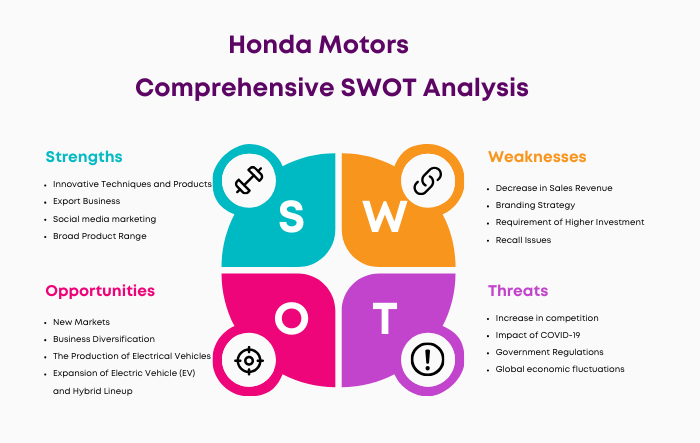
- Innovative Techniques and Products
Honda has a long history of introducing innovations ahead of competitors. From the CVCC engine in the 1970s, which met emission standards without a catalytic converter, to today’s hybrid technology and robotics, Honda continuously proves its engineering strength. The company balances affordability with innovation, making products accessible to the masses while maintaining technological leadership. - Strong Export Business
Honda leverages its large production bases in Asia, Europe, and North America to export vehicles worldwide. In early 2024, Honda’s exports surged by 255% compared to 2023. This growth highlights its effective global supply chain and its ability to meet international demand, especially for motorcycles and small cars that dominate emerging markets. - Global Presence
With dealerships and service centers spread across 150 countries, Honda has created a truly global footprint. It is not overly reliant on one market, which protects it from regional downturns. For instance, even if sales dip in North America, growth in India, Southeast Asia, or Africa cushions the impact. - Financial Stability
Honda’s strong financial health allows it to take risks in R&D and new product lines. In Q1 2024 alone, Honda generated revenue worth ¥20.4 trillion with a robust profit margin. This financial muscle ensures that Honda can invest in next-gen technologies like electric vehicles (EVs), hydrogen fuel cells, and autonomous driving. - Large and Loyal Customer Base
Honda serves around 28 million customers annually. Its products—from the Honda Civic to the Activa scooter—are household names in many countries. Affordability, fuel efficiency, and low maintenance costs have built unmatched customer trust. - Broad Product Range
Unlike many automakers, Honda doesn’t rely solely on cars. Its portfolio spans motorcycles, automobiles, power equipment, marine engines, robotics, and even HondaJet. This diversification spreads risk and ensures multiple revenue streams. - World’s Largest Motorcycle Manufacturer
Honda is the undisputed leader in motorcycles. Its models dominate markets like India, Indonesia, and Vietnam. Motorcycles remain a high-demand segment in developing nations, ensuring Honda’s growth momentum. - Strong Brand Recognition
Honda enjoys a stellar reputation worldwide for reliability, fuel efficiency, and durability. This reputation helps it command customer loyalty even when competition intensifies. - Technical Expertise in Engines
Honda is widely recognized as one of the best engine manufacturers in the world. Its engines are known for their smoothness, efficiency, and longevity, powering everything from cars to motorcycles to boats. - Commitment to R&D
Honda invests billions each year in R&D. This has resulted in innovations like the Honda Clarity Fuel Cell, advanced ADAS (driver-assist systems), and robotics like ASIMO. - Environmental Leadership
Honda was among the first to launch hybrid vehicles like the Honda Insight. Its commitment to sustainability makes it a leader in eco-friendly mobility. - Strong Digital and Social Media Presence
Honda has embraced digital marketing effectively. Campaigns targeting younger audiences and creative storytelling have expanded its reach in the digital era. - High Manufacturing Quality
Honda’s factories are benchmarks in lean manufacturing, automation, and efficiency. This ensures consistent product quality worldwide. - Strategic Alliances
Partnerships with companies like General Motors for EV batteries help Honda innovate faster while sharing costs. - Focus on Safety
Honda vehicles regularly earn high safety ratings, equipped with features like collision mitigation braking, lane-keeping assist, and multiple airbags. - Skilled Global Workforce
With over 200,000 employees worldwide, Honda benefits from a diverse and skilled workforce that drives its global operations. - Recognition and Awards
Honda frequently wins awards for design, innovation, and value. These accolades reinforce its premium reputation. - Robust Supply Chain
A strong supplier network ensures timely delivery of components and minimizes disruptions. - Community Engagement
Honda invests in CSR projects, from environmental sustainability to education, enhancing its goodwill globally. - Flexibility in Production
Honda can quickly adjust production volumes to align with demand, ensuring cost efficiency.
Weaknesses of Honda Motors
- Decline in Sales Revenue
Honda’s sales dipped post-pandemic, reflecting its vulnerability to global disruptions. While demand has rebounded, the slowdown exposed its dependence on traditional markets. - Traditional Branding Strategy
Honda’s branding, while trusted, often feels outdated compared to the bold digital-first campaigns of Tesla or Hyundai. This reduces its appeal among younger customers. - Lag in Technology Investment
Despite strong R&D, Honda has been slower to commit to electric mobility compared to Tesla or Toyota, leaving it at risk of falling behind in EV adoption. - Product Recalls
Recalls have hurt Honda’s image. For example, 750,000 vehicles were recalled over airbag issues. Recalls are costly and shake consumer trust in reliability. - Weak Luxury Presence
Honda’s luxury brand, Acura, has underperformed compared to rivals like BMW, Lexus, and Mercedes-Benz. This limits its share in the high-margin luxury segment. - Overdependence on North America
A significant portion of Honda’s revenue comes from North America. Any economic slowdown there disproportionately affects overall performance. - Intense Competition
Honda operates in a cutthroat market where price wars and innovation races reduce profit margins. - Diesel Engine Controversies
In markets like Europe, Honda faced criticism for polluting diesel engines, damaging its eco-friendly image. - Limited Electric Vehicle Lineup
While rivals expand EV offerings, Honda’s portfolio remains limited, which could reduce relevance in the fast-growing sustainable mobility segment. - Supply Chain Vulnerabilities
Natural disasters, trade wars, and pandemics have exposed weaknesses in Honda’s global supply chain. - High Compliance Costs
Meeting stricter emission and safety standards globally increases costs and slows product launches. - Labor Relations
Managing workforce morale, especially in regions with rising wages, remains a challenge. - Market Saturation
In mature regions like North America, growth has plateaued, forcing Honda to depend on emerging economies for expansion.
Opportunities for Honda Motors
- Growth in Emerging Markets
Nations like India, Indonesia, and Brazil have growing middle classes who aspire to own cars and motorcycles. Honda can capture this demand. - Expansion in EVs and Hybrids
With rising eco-consciousness, Honda has the opportunity to build a strong EV lineup and rival Tesla, BYD, and Toyota. - Autonomous Driving and ADAS
By investing in advanced driver-assist and autonomous technologies, Honda can lead in future-ready vehicles. - Strengthening Acura
Rebranding and improving Acura could help Honda capture the luxury market, boosting profitability. - Sustainability and Green Tech
Honda can cement its leadership by investing more in hydrogen fuel cells and renewable energy integration. - Strategic Partnerships
Collaborations with tech companies like Google or Apple can accelerate innovation. - Digital Transformation
Expanding online sales and virtual showrooms can attract younger, tech-savvy customers. - Flexible Mobility Services
With changing preferences, Honda can enter ride-sharing, car-leasing, and subscription services. - Localized Production
Setting up factories in emerging markets can reduce costs and improve responsiveness. - Mergers and Acquisitions
Acquiring startups in AI, EVs, or battery technology could help Honda stay ahead.
Threats to Honda Motors
- Rising Competition
The entry of new EV players like Tesla, BYD, and Nio, along with traditional giants, increases competitive pressure. - Strict Government Regulations
Countries are tightening emission and safety laws, which increase compliance costs. - Economic Fluctuations
Global recessions or slowdowns directly reduce car and bike sales. - Technological Disruption
If Honda fails to adapt quickly to EVs and autonomous cars, it risks being outdated. - Trade Wars and Tariffs
Political tensions can disrupt supply chains and increase production costs. - Cybersecurity Threats
With more connected cars, Honda faces risks of hacking and data theft, which can damage trust. - Raw Material Price Volatility
Rising steel, aluminum, and lithium prices increase costs, squeezing margins. - Changing Consumer Preferences
Trends toward car-sharing and urban public transport can reduce car ownership demand. - EV Infrastructure Gaps
In many regions, lack of charging stations slows EV adoption, affecting Honda’s future EV sales.
Conclusion
Honda Motors is a company with enormous strengths—engineering excellence, motorcycle dominance, global presence, and strong financial stability. Its innovations in green technology and commitment to R&D place it in a solid position for the future.
However, challenges such as EV adoption delays, recalls, and regulatory pressures cannot be ignored. To thrive in the future, Honda must accelerate digital transformation, expand its EV lineup, and revitalize its branding strategy.
With opportunities in emerging markets, alternative fuels, and luxury branding, Honda is well-positioned to remain a global leader—provided it adapts swiftly to an industry in transition.
FAQs
What is Honda best known for?
Honda is best known for its motorcycles, fuel-efficient cars, and reliable engines. Its reputation for durability makes it a household name worldwide.
How many employees does Honda have?
As of 2022, Honda employs over 204,000 people globally, contributing to its vast operations and product development.
What is Honda’s biggest strength?
Honda’s biggest strengths lie in its global presence, largest motorcycle production capacity, and expertise in engine technology.
Does Honda make electric vehicles?
Yes, Honda has hybrid models and is investing in electric vehicles and hydrogen fuel cell technology to meet the future demand for clean mobility.
What are Honda’s biggest threats in 2025?
Its main threats are intense competition, stricter environmental regulations, technological disruption, and supply chain vulnerabilities.

A digital marketer with a strong focus on SEO, content creation, and AI tools. Creates helpful, easy-to-understand content that connects with readers and ranks well on search engines. Loves using smart tools to save time, improve content quality, and grow online reach.