

Summary
This SWOT analysis of ICICI Bank captures a scale player with a digital-first DNA, strong profitability, and global connectivity.
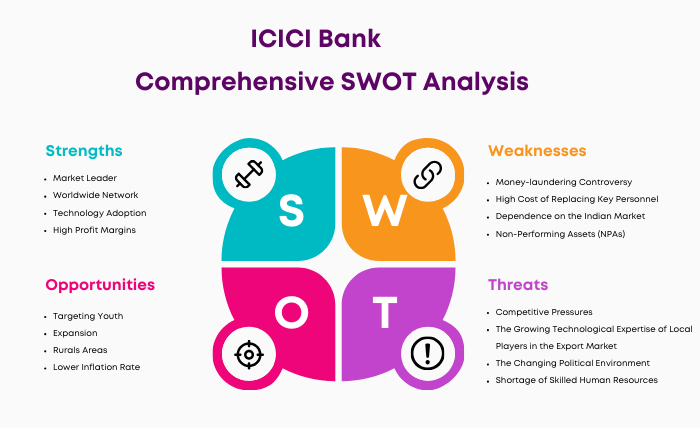
Strengths: leadership in private banking, deep branch–ATM network, aggressive technology adoption, diverse revenue engines, and high customer satisfaction.
Weaknesses: historical controversy overhang, concentration in the Indian market, cyclical NPAs/write-offs, turnover at junior levels, and pockets of under-investment in CX tools.
Opportunities: youth acquisition with app-led journeys, rural and semi-urban expansion, corridor-based international growth, embedded finance/API partnerships, and AI-driven risk and personalization.
Threats: intense competition from ICICI Bank competitors (HDFC, Axis, Kotak, SBI, NBFCs, fintechs), multi-jurisdiction regulation, cybersecurity and privacy risks, and geopolitical volatility.
Bottom line: If ICICI keeps compounding its digital edge while tightening risk, CX, and talent strategies, it can extend leadership in 2025 and beyond.
Since 1994, ICICI Bank has been synonymous with innovation in Indian banking. It rode the liberalization wave, built a strong retail engine, and expanded into corporate, SME, NRI, and international businesses. Over 30 years, it has turned “digital” into a culture—shrinking turnaround times, simplifying journeys, and scaling self-service.
2025 raises the bar. Customers expect instant, mobile-first banking. Regulations evolve fast. Competition multiplies—from large private banks to NBFCs and venture-backed fintechs. This SWOT analysis of ICICI Bank explains where ICICI wins today, where it needs to sharpen execution, and where the next leg of growth can come from.
ICICI Bank
- Company type: Public
- Industry: Financial services
- Founded: 5 January 1994
- Headquarters: Mumbai, Maharashtra (registered office: Vadodara, Gujarat)
- Network (FY23): ~5,900 branches; ~16,650 ATMs/CRMs
- Area served: Worldwide
- Key people: Girish Chandra Chaturvedi (Chairman), Sandeep Bakhshi (MD & CEO)
- FY2024 (selected figures): Revenue ~₹236,037 crore; Operating income ~₹64,146 crore; Net income ~₹44,256 crore; Total assets ~₹2,364,063 crore; Equity ~₹270,032 crore
- Employees: ~130,542 (2022)
- Website: icicibank.com
What Is a SWOT and Why Use It?
- Strengths & Weaknesses: Internal capabilities, culture, economics, and systems.
- Opportunities & Threats: External forces—customers, tech, regulation, macro, and competitors.
A well-built SWOT aligns growth bets with capabilities while exposing the risks that can derail plans. For ICICI, it shapes priorities across product, CX, risk, capital, and talent.
SWOT Analysis of ICICI Bank
Strengths
1) Market Leadership & Scale
Three decades of operating at scale have created durable advantages: a trusted brand, wide distribution, deep data pools, and operating leverage. ICICI is consistently in the leadership pack of India’s private banks on deposits, advances, fee income, and profitability—key proof points for resilience across cycles.
2) Worldwide Network
A large domestic footprint (≈5,900 branches; ≈16,650 ATMs/CRMs in FY23) coupled with international presence supports NRI banking, trade, remittances, and cross-border treasury. The result: sticky franchises in both retail and corporate corridors, and a platform to scale fee businesses (FX, wealth, payments).
3) Technology Adoption (Digital-First DNA)
ICICI was early to mobile and internet banking and continues to push: account opening in minutes, near-real-time payments, card and loan journeys inside the app, and intelligent self-service. APIs and platform thinking let ICICI distribute products in partner ecosystems (travel, e-commerce, fintech), lowering acquisition costs and raising frequency of use.
4) High Profitability & Operating Leverage
With strong core operating profit and disciplined costs, ICICI absorbs credit cycles better than many peers. Higher digital penetration pushes cost-to-serve down. Scale spreads fixed costs across tens of millions of customers, magnifying margins when growth accelerates.
5) Diverse Revenue Engines
ICICI blends interest income with robust fee streams: cards, payments, wealth, insurance partnerships, remittances, trade/FX, and transaction banking. Diversification smooths earnings and reduces dependence on any single product or segment.
6) Marketing & Brand Equity
Omni-channel marketing, sports/celebrity associations, and high-recall campaigns keep ICICI top of mind. Strong brand capital lowers acquisition friction, improves cross-sell, and aids talent attraction.
7) Awards, Culture & CRM Focus
Industry awards and employer-brand recognition reflect disciplined execution. A dedicated CRM approach, analytics-driven retention, and proactive service create a trust flywheel: happier customers stay longer and buy more.
Weaknesses
1) Legacy Controversy Overhang
The 2013 episode around alleged money-laundering lapses is history, yet reputational memory can linger. Sustained transparency, governance signaling, and conservative risk culture remain essential to keep stakeholder confidence high.
2) High Cost of Replacing Key Personnel
Specialist bankers in risk, treasury, data science, and cyber are scarce. Replacing such talent is costly and time-consuming—raising execution risk during rapid growth or transformation.
3) Dependence on the Indian Market
Despite global linkages, ICICI’s profit pool is still heavily India-centric. Domestic macro shocks (rates, inflation, consumption) can move margins, credit costs, and loan demand in tandem.
4) NPAs & Write-offs Are a Constant Vigil
Like all lenders, ICICI navigates credit cycles. Write-offs in difficult pockets (e.g., Q4-2024 gross NPA write-off reference) underscore the need for tight early-warning systems, granular underwriting, and sharp collections to keep slippages contained.
5) Employee Turnover at Junior Levels
Attrition at the front line increases training costs and can affect consistency in service and sales. A strong EVP (career path, incentives, coaching) is vital to stabilize field productivity.
6) Pockets of Under-Investment in CX Tools
Fintechs iterate weekly on micro-journeys—support, claims, dispute resolution, and card controls. ICICI must keep pushing CX tooling so app experiences feel instant, transparent, and human.
7) Declining Per-Unit Revenue in Some Lines
Competitive intensity squeezes fees and spreads. The hedge: value-based bundles, richer loyalty ecosystems, and a mix shift toward profitable segments and behaviors.
Opportunities
1) Targeting Youth With App-Led Journeys
India’s young, digital population wants instant onboarding, UPI, tap-to-pay, BNPL-like credit, micro-investments, and in-app customer care. ICICI can win share with three-tap journeys, proactive nudges, and lifestyle partnerships (gaming, travel, creator economy).
2) Rural & Semi-Urban Penetration
Large swaths of India remain under-served. Assisted onboarding, micro-ATMs, agent networks, vernacular UI, and sachet products (micro-insurance, recurring deposits) can unlock deposits and lending at scale—balanced with strong risk selection.
3) Corridor-Based Global Expansion
Select corridors—Gulf, UK, North America, and Southeast Asia—are rich with NRI flows and SME trade. Focused propositions (NRI wealth, real-estate linkages, seamless remittances, trade finance) can deepen fee pools with prudent risk.
4) Lower-Inflation Windows & Macro Tailwinds
When inflation stabilizes, affordability improves and credit demand broadens. Well-priced retail and SME products, matched with low-cost deposit growth, can expand spreads while protecting asset quality.
5) Embedded Finance & API Distribution
Banking inside partner apps is now table stakes. ICICI can place deposits, credit, and insurance in third-party ecosystems via APIs—testing propositions with low CAC before national rollouts.
6) AI/ML for Risk, Ops, and Personalization
Use AI for underwriting (alternate data, behavioral signals), early-delinquency flags, fraud prevention, and intelligent collections. Personalize “next best offer” in real time to lift ARPU and retention.
7) Entry-Level Customer Formalization
As cash economy users shift to formal finance, no-frills accounts, micro-credit, and sachet protection can seed lifelong relationships—especially when tied to habit-building rewards in-app.
Threats
1) Competitive Pressures
ICICI Bank competitors are formidable: HDFC Bank, Axis Bank, Kotak Mahindra Bank, SBI (public sector scale), IndusInd, IDFC FIRST, Federal—plus NBFC leaders (e.g., Bajaj Finance) and fintechs in payments, lending, and wealth. Consequences: faster product cycles, fee compression, higher marketing intensity.
2) IPR & Local Tech Risks in Certain Markets
Selective international exposure requires strong partner diligence and IP safeguards. Weak IPR regimes increase imitation risk and compliance complexity.
3) Geopolitical & Political Volatility
US-China tensions, Middle-East conflict, or EU policy shifts can affect flows, FX, and risk appetite in global corridors. Hedging and agile portfolio rebalancing are essential.
4) Scarcity of Skilled Digital Talent
Data engineers, product managers, and cyber specialists are expensive and mobile. Wage inflation and attrition can slow execution unless the bank builds internal academies and clear growth paths.
5) Cybersecurity & Privacy
Higher digital adoption expands the attack surface: phishing, account takeovers, malware, and ransomware. A breach can impose financial loss and reputational damage—demanding zero-trust architectures, continuous monitoring, and red-team drills.
6) Pace of Change
Network scale can slow rollouts compared with challenger apps that ship weekly updates. Governance must be nimble without sacrificing control.
7) Multi-Jurisdiction Regulation
Cross-border rules on KYC, data localization, and digital lending demand investment in compliance tech and specialist teams. Delays add cost and slow time-to-market.
ICICI Bank Competitors
When readers search for ICICI Bank competitors, they want context to benchmark performance and strategy. The competitive set includes:
- Large Private Banks: HDFC Bank (low-cost deposits, retail engine), Axis Bank (phygital scale, corporate depth), Kotak Mahindra Bank (affluent/wealth), IndusInd (consumer finance niches), IDFC FIRST (retail build-out), Federal (regional strengths).
- Public Sector Banks: State Bank of India (SBI), Bank of Baroda, Canara Bank, Punjab National Bank—massive deposit franchises and reach.
- NBFCs/Fintechs: Bajaj Finance (retail/SME credit), digital lenders, payment/wealth platforms.
How to differentiate: fintech-grade UX, ecosystem distribution via APIs, advice-led RM models for SME/affluent, and risk excellence (granular underwriting + early-warning analytics).
Strategic Recommendations (2025–2027)
- Own Youth & Affluent: Tiered premium cards, travel and lifestyle bundles, goal-based wealth in-app, and family banking—anchored by superior app journeys.
- API-First Distribution: Place deposits/credit/insurance inside partner ecosystems; run small A/B pilots before scaling nationwide to keep CAC low.
- AI Everywhere: Underwriting using alternate data, dynamic line management on cards, anomaly detection for fraud, and intelligent collections sequencing.
- Operational Excellence: Automate mid/back office; target measurable cost-to-income gains; expand straight-through processing and self-serve.
- Defensible Deposits: CASA growth via salary/student/senior programs, gamified savings, and sweep-in features that create daily habits.
- Cyber Resilience: Zero-trust controls, phishing-resistant authentication, continuous red-teaming, and MTTR (mean time to recover) as a board KPI.
- ESG & Green Finance: EV/home-energy loans, MSME transition finance, and transparent impact KPIs; integrate ESG into underwriting and pricing.
- SME/Trade Corridors: Advice-led RMs, invoice financing, FX toolkits, digital trade documentation, and supply-chain finance.
- Talent Flywheel: Internal academies for data/product/security, rotational programs, and differentiated retention for critical roles.
KPIs to Watch
- Profitability: NIM, cost-to-income, RoA/RoE.
- Asset Quality: Gross/Net NPA, slippage, PCR (provision coverage).
- Digital: MAU/DAU, app NPS, STP (straight-through) rates, feature adoption.
- Funding: CASA ratio, deposit growth, cost of funds.
- Growth Mix: Fee income share, cross-sell per customer, SME and affluent penetration.
- Risk & Resilience: Early-warning hit rate, fraud losses as % of turnover, cyber MTTR.
- People: Critical-role retention, upskilling hours per FTE, frontline productivity.
FAQs
1) Why is ICICI considered a leader among private banks?
Because it combines scale, profitability, and digital intensity. It serves diversified segments (retail, SME, corporate, NRI) with deep product shelves and strong distribution—physical and digital.
2) How does ICICI’s digital strategy improve customer experience?
By compressing steps into a few taps, pushing real-time decisions (cards/loans), and enabling transparent self-service (limits, controls, disputes). APIs let ICICI distribute inside the apps customers already use.
3) What are the most pressing weaknesses in 2025?
Reputational memory from past controversies, dependence on India’s macro, vigilance around NPAs/write-offs, junior-level attrition, and the need to keep pace with fintech-grade CX in micro-journeys.
4) Where can ICICI grow fastest in the next two years?
Youth acquisition via app-led banking, SME corridors (invoice financing, FX, trade), and embedded finance/API partnerships that lower CAC and raise usage frequency.
5) Who are ICICI Bank competitors and how does ICICI compare?
HDFC, Axis, Kotak, SBI and others dominate key pockets; NBFCs and fintechs chip away with niche speed and UX. ICICI’s edge is scale + digital + diversified fee engines; the race is about experience quality and risk excellence.
6) How is ICICI tackling NPAs and credit risk?
Through granular underwriting, bureau + alternate data, early-warning analytics, and disciplined collections. The focus is to keep slippages low and provision proactively.
7) What is ICICI doing on cybersecurity and privacy?
Moving toward zero-trust architectures, stronger authentication, continuous monitoring, and red-team exercises—so detection is earlier and recovery is faster.
8) How should investors interpret this SWOT?
Leadership is intact, with room to expand margins via digital and fees. Watch cost-to-income, asset quality, CASA growth, and execution on API/AI roadmaps.
9) What will customers notice first as ICICI improves?
Faster, clearer, and more personalized app experiences; smoother claims/disputes; proactive alerts and offers that actually feel useful.
10) Is international expansion still attractive?
Yes—when corridor-focused (NRI + trade) with prudent risk and strong compliance. Fee-rich flows can complement domestic growth without undue balance-sheet stretch.
Conclusion
The SWOT analysis of ICICI Bank shows a bank built for scale and speed: strong profitability, wide distribution, and a culture of technology adoption. The path forward is clear—defend deposits, push AI-driven risk and personalization, distribute through APIs, and make the app feel instant and human. External risks will persist: fierce ICICI Bank competitors, cyber threats, and multi-jurisdiction regulation. But with disciplined execution and a relentless focus on experience and resilience, ICICI can extend its leadership in 2025 and set the tone for the next decade of Indian banking.

A digital marketer with a strong focus on SEO, content creation, and AI tools. Creates helpful, easy-to-understand content that connects with readers and ranks well on search engines. Loves using smart tools to save time, improve content quality, and grow online reach.