

Summary
Intel is a global leader in semiconductors and microprocessors. Since 1968, the company has shaped the computer industry with innovation, powerful processors, and strong brand value. This SWOT Analysis of Intel highlights its key strengths, weaknesses, opportunities, and threats in 2025. Intel has clear advantages in market leadership, partnerships, and innovation. However, it also faces challenges such as competition, manufacturing delays, and reliance on the PC market. Understanding this Intel SWOT analysis is critical for business professionals, investors, and students to evaluate Intel’s market position and growth potential.
Intel Corporation is one of the most influential technology companies in the world. It designs and manufactures semiconductors, processors, and solutions for computers, servers, and artificial intelligence. The company is best known for its Intel Inside campaign, which made the brand a household name.
This blog explores the SWOT Analysis of Intel in 2025. The analysis explains Intel’s strengths, weaknesses, opportunities, and threats. It also highlights how the company uses the Intel marketing strategy to compete with rivals like AMD, NVIDIA, and Qualcomm.
About Intel
Company Overview
- Name: Intel Corporation
- Founded: July 18, 1968
- Founders: Gordon Moore, Robert Noyce, Arthur Rock
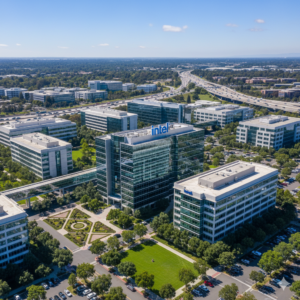
- Headquarters: Santa Clara, California, U.S.
- Industry: Semiconductors, computer hardware, AI, automation, autonomous cars
- Area served: Worldwide
- CEO: Pat Gelsinger
- Revenue (2023): $54.23 billion
- Net income (2023): $1.68 billion
- Employees: 124,800
- Website: intel.com
Intel’s Position in the Industry
Intel is the world’s largest semiconductor manufacturer by revenue. It pioneered the x86 series, which powers most personal computers worldwide. The company is also expanding in artificial intelligence, 5G, autonomous vehicles, and cloud computing.
SWOT Analysis of Intel
Strengths of Intel
Leading Technology Market
Intel leads the global semiconductor and processor market. Its chips power most laptops, desktops, and servers. The Intel Inside campaign built trust with consumers and businesses worldwide. This leadership helps Intel influence industry standards and trends.
High Brand Value
Intel consistently ranks among the top technology brands. In 2023, its brand value was $28.2 billion according to Interbrand. Strong brand recognition makes Intel a preferred choice for OEMs and enterprise clients.
Strong Financial Performance
Intel reported $54.23 billion in revenue and $1.68 billion in net income in 2023. Its financial strength allows investments in R&D, acquisitions, and shareholder returns. Stable revenue streams support long-term innovation.
Dominant Market Position in CPUs
Intel controls more than 70% of the global CPU market. This dominance provides pricing power, customer trust, and market influence. It also gives Intel scale advantages over smaller rivals.
Diversified Product Portfolio
Intel manufactures processors, GPUs, network controllers, memory chips, and data center solutions. This diversification protects the company from relying on one segment. It also allows Intel to serve multiple industries, including AI and cloud.
Strong Reputation for Quality
Intel has built a reputation for delivering reliable and high-performance products. Businesses and consumers trust Intel processors for speed and durability. This reputation is a major competitive advantage.
Large Global Client Base
Intel supplies chips to leading PC makers, server manufacturers, and cloud providers. A large and diverse client base creates consistent demand and revenue.
Partnership with Microsoft
Intel and Microsoft have a long-standing partnership. Most Windows PCs run on Intel processors. This alliance boosts Intel’s credibility and strengthens its product ecosystem.
Innovation and R&D
Intel invests heavily in research and development. In 2023, it spent $21.7 billion on R&D. This commitment ensures the company stays competitive in next-generation chip design and AI.
Global Presence
Intel operates in over 60 countries. Its worldwide presence allows access to multiple markets, customers, and suppliers.
Also Read: SWOT Analysis of Jeep
Weaknesses of Intel
Dependence on the PC Market
Intel still relies heavily on PCs and laptops for revenue. With global PC demand declining, Intel faces slower growth. This dependence makes the company vulnerable to shifts in consumer behavior.
Limited Reach in Developing Countries
Intel has strong services in developed markets but weaker presence in developing economies. Slow expansion in these regions limits growth opportunities.
Falling Profit Margins
Increased competition has reduced Intel’s profit margins since the early 2000s. Companies like AMD and NVIDIA have taken market share, putting pressure on Intel’s profitability.
Overproduction Issues
Intel often produces more chips than required. This overproduction creates excess inventory, forcing price cuts that reduce margins.
High Research Costs
While R&D spending fuels innovation, it also creates financial pressure. Competitors spend less but deliver competitive products, giving them pricing flexibility.
Struggles in New Segments
Intel faces challenges in GPUs and AI chips where NVIDIA has strong dominance. Entering these markets requires significant investment and time.
Failure in Mobile Processor Market
Intel failed to capture the smartphone processor segment. This was a missed opportunity in one of the fastest-growing tech markets.
Manufacturing Delays
Intel has faced delays in moving to smaller nanometer technology. These delays allowed competitors to launch more advanced processors earlier.
Complex Organizational Structure
Decision-making within Intel is often slow compared to agile competitors. This limits its ability to respond quickly to market changes.
Opportunities for Intel
Expansion in Emerging Markets
Intel can grow in Asia, Africa, and Latin America where technology adoption is rising. Expanding in these markets will reduce dependence on the U.S. and Europe.
Growth in Custom Chips and FPGAs
Demand for customized chips and FPGAs is increasing across industries. Intel can capture this demand by offering specialized solutions.
New Business Horizons
Intel can explore new industries such as healthcare technology, smart devices, and industrial automation. Diversification will strengthen revenue sources.
Re-entry into Smartphone Market
Intel can attempt to re-enter the mobile processor market. Smartphones are a high-demand industry, and success here will expand its reach.
Rising Demand for Computers
Global reliance on laptops and desktops for work and education continues. Intel can use this demand to increase its processor sales.
Drone Technology
Drones are widely used in defense, agriculture, and entertainment. Intel’s entry into drone-related technology will open new revenue streams.
Next-Gen Technologies
Intel can lead in quantum computing, AI chips, and 5G technology. Investment in these areas will secure its position in the future.
Strategic Acquisitions and Partnerships
Intel can acquire innovative startups or partner with industry leaders. The acquisition of Mobileye for autonomous vehicles shows Intel’s willingness to diversify.
Focus on Sustainability
Eco-friendly chip production and energy-efficient products can strengthen Intel’s brand appeal. Sustainability is becoming a key factor in consumer and corporate buying decisions.
AI and Data Analytics
Intel can expand into AI-driven analytics and automation. These technologies will be central to future industries and enterprise operations.
Threats to Intel
Intense Competition
AMD, NVIDIA, and Qualcomm are strong competitors. They deliver powerful products at competitive prices, challenging Intel’s dominance.
Dependence on Chips
Intel is heavily dependent on processors for revenue. If a competitor launches a superior product, Intel could lose market share quickly.
Chinese Alternatives
Low-cost Chinese chips threaten Intel in price-sensitive markets. These products may not match Intel’s quality but are attractive due to affordability.
Shifting Consumer Demands
Customers demand IoT devices, voice-enabled products, and smart home solutions. Intel must adapt quickly to capture these markets.
Dependence on Key Customers
Intel depends on PC and server manufacturers. If these clients shift to competitors, Intel’s revenue will be impacted.
Supply Chain Risks
Dependence on external suppliers creates risk. Any disruption in raw material supply affects production.
Geopolitical Risks
Trade disputes, especially between the U.S. and China, can impact Intel’s operations and revenue.
Intellectual Property Issues
Technology companies face risks of IP theft and infringement. Intel must safeguard its patents to protect market advantage.
Economic Slowdowns
Global recessions reduce consumer spending on electronics. This directly impacts Intel’s sales.
Intel Marketing Strategy
Intel uses a strong marketing strategy to maintain its brand value. The Intel Inside campaign created awareness across the globe. Intel also invests in co-branding with PC manufacturers. Sponsorships, advertising, and digital campaigns focus on promoting performance and reliability. Intel’s marketing highlights innovation and trust, positioning the company as a leader in technology.
Conclusion
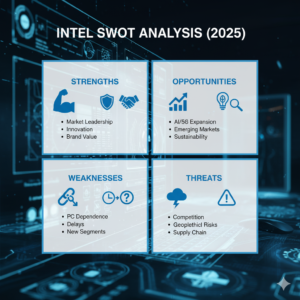
This Intel SWOT analysis shows the company’s strong market leadership, brand value, and financial strength. However, weaknesses such as reliance on PCs, manufacturing delays, and lack of presence in smartphones must be addressed. Opportunities in AI, 5G, sustainability, and emerging markets can drive future growth. Intel also faces threats from strong competitors, Chinese alternatives, and geopolitical risks.
Intel’s success will depend on innovation, partnerships, and effective use of its marketing strategy to maintain leadership in 2025 and beyond.
FAQs
What is Intel’s main strength?
Intel’s main strength is its leadership in microprocessors and semiconductors, supported by strong brand recognition.
Why did Intel fail in the mobile processor market?
Intel failed due to late entry, poor strategy, and dominance of ARM-based processors in smartphones.
What opportunities does Intel have in 2025?
Intel can grow in AI, 5G, quantum computing, and emerging markets.
Who are Intel’s main competitors?
AMD, NVIDIA, Qualcomm, and Chinese chip manufacturers.
What is Intel’s marketing strategy?
Intel focuses on brand campaigns, co-branding, sponsorships, and digital advertising. The Intel Inside campaign is a landmark example.
How much did Intel earn in 2023?
Intel reported revenue of $54.23 billion and net income of $1.68 billion in 2023.
What threats does Intel face?
Competition, geopolitical risks, supply chain issues, and Chinese alternatives.

A digital marketer with a strong focus on SEO, content creation, and AI tools. Creates helpful, easy-to-understand content that connects with readers and ranks well on search engines. Loves using smart tools to save time, improve content quality, and grow online reach.