

Summary
The SWOT Analysis of Maruti Swift highlights why this hatchback remains one of India’s most popular cars since its launch in 2005. Backed by Maruti Suzuki’s brand legacy, Swift enjoys unmatched strengths such as consistent market leadership, strong brand loyalty, wide service network, and affordability. However, it also faces weaknesses like gear shift issues, limited design upgrades, and heavy reliance on Suzuki’s engineering. The opportunities lie in tapping rural markets, entering the growing crossover segment, and meeting modern customer preferences. On the other hand, threats include rising competition, fluctuating costs, and regulatory challenges. This blog provides a detailed breakdown of Swift’s strengths, weaknesses, opportunities, and threats to understand its future prospects in India’s competitive automobile industry.
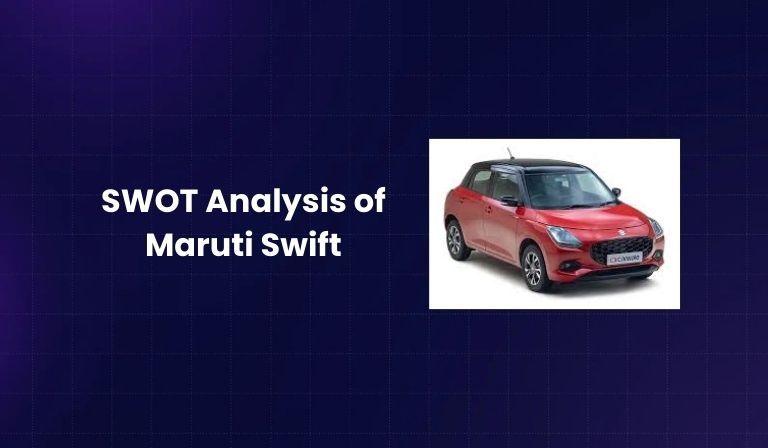
When you think of hatchbacks in India, Maruti Swift is often the first name that comes to mind. Launched in 2005, it quickly became a best-seller, redefining the compact car segment with its sporty design, affordability, and fuel efficiency. Known for its floating roof design, SmartPlay infotainment system, and strong mileage performance, Swift has been a reliable choice for families, first-time buyers, and even young professionals looking for a stylish yet affordable car.
But how does Swift continue to perform in today’s competitive market, almost two decades after its launch? The answer lies in a detailed SWOT Analysis of Maruti Swift—analyzing its strengths, weaknesses, opportunities, and threats in 2025.
Company and Product Overview
- Parent Company: Maruti Suzuki (formerly Maruti Udyog Limited)
- Launch Year in India: 2005
- Variants: Petrol and Diesel (with updates over time, BS6 engines today)
- Compact Version: Maruti Swift Dzire (later renamed Dzire)
- Market Performance: In 2017 alone, Swift contributed significantly to Maruti’s 1.63 lakh unit sales, making it one of the most sold hatchbacks in India.
- Category: Compact hatchback with premium features at an affordable price.
Swift’s journey shows how Maruti has consistently adapted to customer preferences—launching new versions, facelifts, and feature upgrades while keeping pricing competitive.
SWOT Analysis of Maruti Swift
Strengths of Maruti Swift
1. Consistent Market Leadership
From its launch in 2005, Maruti Swift has dominated the hatchback segment. Indian consumers immediately accepted it for its spacious interiors, sporty looks, and smooth performance. Even today, it remains one of Maruti’s top-selling models, competing strongly against Hyundai i20 and Tata Altroz. This consistent dominance is a huge strength, making Swift a trusted choice for buyers.
2. History of Successful Cars under Maruti
Maruti Suzuki has a legacy of creating successful hatchbacks—from Maruti 800 to Alto and WagonR. Swift carried forward this legacy by offering better styling, features, and mileage, ensuring that the company maintained its leadership position in the small car segment.
3. Association with Suzuki’s Engineering
Swift’s design inspiration came partly from Suzuki Hayabusa (motorbike). Its robust engine and Japanese engineering reliability give it an edge. Customers trust the durability and performance of Maruti-Suzuki cars, and Swift benefits from this strong engineering partnership.
4. Strong Brand Loyalty
Maruti is a household name in India. Swift, as one of its flagship models, enjoys immense brand loyalty, especially among the middle class. Many Indian families upgrade from Maruti 800 or Alto to Swift, showing how customer trust flows across models.
5. A True “Driver’s Car”
Swift is often marketed as a driver’s car. Its agility, fuel efficiency, smooth gear shifts, and lightweight build make it fun to drive in both cities and highways. For many, it balances value-for-money with enjoyable driving.
6. Extensive Service Network
One of the biggest advantages of buying a Swift is Maruti’s widespread service network. With thousands of service centers across urban and rural India, after-sales service is never a problem. Spare parts are cheap and easily available, making Swift a very low-maintenance car compared to rivals.
Weaknesses of Maruti Swift
1. Gear Shift and Engine Issues
Many users have reported gear shifting problems, engine rattling sounds, and power window glitches in Swift models. While Maruti addresses these with recalls and fixes, they impact the overall perception of quality.
2. Over-dependence on Suzuki’s Technology
Maruti has always relied heavily on Suzuki for design and engineering inputs. This over-dependence limits Maruti’s ability to innovate independently and often delays introducing cutting-edge features compared to global rivals.
3. Outdated Design Over the Years
Although the Swift has received multiple facelifts, critics argue that its overall design hasn’t evolved drastically since 2005. In contrast, competitors like Hyundai i20 have aggressively innovated in design and features.
4. Rising Customer Expectations
Today’s buyers want premium features like ADAS, connected car technology, sunroofs, and advanced safety. Swift, being a budget-friendly hatchback, lags behind in offering these modern features, which may affect its appeal in 2025 and beyond.
Opportunities for Maruti Swift
1. Expanding into Rural India
While Swift is already a success in urban and semi-urban markets, the real growth potential lies in rural India, where car ownership is rapidly increasing. With affordable finance options, Swift can capture this segment.
2. Growth of the Compact SUV/Crossover Segment
Indian customers are increasingly shifting towards compact SUVs. Swift, with its strong brand image, could evolve into a crossover variant (like Ignis but with Swift’s branding) to capitalize on this booming segment.
3. Changing Customer Preferences
Consumers are moving from price-conscious to value-conscious buyers. They are ready to spend more for quality, safety, and features. This opens opportunities for Maruti to launch premium variants of Swift with upgraded features.
4. Technology and Feature Upgrades
With digital connectivity, touch infotainment, and safety features like 6 airbags becoming a norm, Swift can enhance its product line and attract tech-savvy youth and urban buyers.
Threats to Maruti Swift
1. Rising Competition
Swift faces tough competition from Hyundai i20, Tata Altroz, Ford Figo, and even Maruti’s own Baleno. Each competitor tries to offer more features, better design, and stronger safety ratings, which can impact Swift’s sales.
2. Increasing Costs
The cost of raw materials, fluctuating fuel prices, and stricter emission norms increase the overall cost of production. This either reduces margins for Maruti or increases prices for consumers, making Swift less competitive.
3. Economic and Regulatory Challenges
Government policies like GST, BS6 emission norms, safety regulations, and demonetization’s after-effects affect automobile demand in India. Maruti Swift, being a mass-market car, is highly vulnerable to these changes.
4. Shift in Consumer Demand
With the rise of electric vehicles (EVs) and hybrids, traditional hatchbacks like Swift might lose popularity unless Maruti launches an EV version of Swift to stay relevant in the coming years.
Conclusion
The SWOT Analysis of Maruti Swift shows why it continues to be one of India’s favorite hatchbacks. Its strengths—brand loyalty, service network, affordability, and driver-friendly features—make it a market leader. However, it faces weaknesses like outdated design, gear issues, and over-reliance on Suzuki.
The opportunities lie in rural markets, crossover versions, and premium feature upgrades, while the threats include competition, rising costs, and regulatory changes.
In 2025 and beyond, Maruti must innovate aggressively to keep Swift relevant—possibly introducing hybrid or electric variants, premium trims, and stronger safety features. Swift’s legacy as a trusted, fuel-efficient, and affordable car gives it a strong foundation to adapt to future challenges.
FAQs
Q1. What are the main strengths of Maruti Swift?
Maruti Swift’s biggest strengths are its brand loyalty, fuel efficiency, widespread service network, and strong market presence in the hatchback segment.
Q2. What are the weaknesses of Maruti Swift?
Swift faces weaknesses like gear issues, lack of modern features, and design updates that haven’t evolved much compared to competitors.
Q3. What opportunities does Maruti Swift have in the future?
Opportunities include tapping rural markets, launching a crossover/EV variant, and offering premium trims with advanced technology and safety features.
Q4. What are the threats to Maruti Swift?
Major threats include competition from Hyundai i20 and Tata Altroz, rising production costs, stricter regulations, and the global shift toward electric vehicles.
Q5. Is Maruti Swift still a good buy in 2025?
Yes, Swift remains a strong value-for-money hatchback in 2025, but buyers looking for premium features and EV options may consider alternatives unless Maruti updates its lineup.

A digital marketer with a strong focus on SEO, content creation, and AI tools. Creates helpful, easy-to-understand content that connects with readers and ranks well on search engines. Loves using smart tools to save time, improve content quality, and grow online reach.