

Summary
Madras Rubber Factory (MRF) is India’s largest tyre manufacturer and one of the most respected brands in the global tyre industry. Over the decades, MRF has built a strong reputation for producing durable, high-quality tyres across all categories—from two-wheelers to fighter aircraft. This swot analysis of MRF tyres highlights its major strengths, weaknesses, opportunities, and threats. The analysis helps us understand why MRF is a leader, where it struggles, and how it can continue to grow in the global market.
MRF Tyres, founded in 1946, started as a toy balloon manufacturer in Chennai, Tamil Nadu. Within a few years, it expanded into tyre production and has never looked back. Today, it is not only the largest tyre manufacturer in India but also one of the top tyre companies worldwide in terms of market capitalization.
The company’s success lies in its ability to blend quality, brand value, and innovation. Yet, like every business, MRF also faces internal challenges and external threats. This detailed MRF SWOT analysis explains each factor clearly, giving a full picture of where the company stands in 2025.
Company Overview: MRF at a Glance
- Founded: 1946 by K. M. Mammen Mappillai
- Headquarters: Chennai, Tamil Nadu, India
- Industry: Tyres and allied products
- Employees: ~18,000
- Annual Revenue: ₹16,321 Crores (2020)
- Market Cap: ~₹32,873 Crores (2020)
- Exports: More than 65 countries
Products and Divisions:
- Tyres (for two-wheelers, passenger cars, trucks, buses, tractors, off-road vehicles, and aviation)
- Tubes and treads
- Conveyor belts
- Paints and coats
- Sports equipment and toys (Funskool)
- Sports associations (MRF Racing, MRF Pace Foundation)
Key Competitors: CEAT, Apollo Tyres, JK Tyre, Birla Tyres, Bridgestone, Michelin.
SWOT Analysis of MRF Tyres
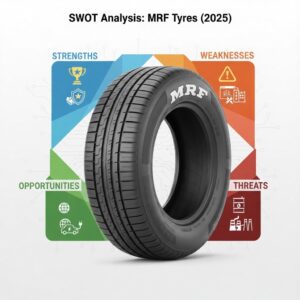
Now let’s dive deep into the swot analysis of MRF tyres—its strengths, weaknesses, opportunities, and threats.
Strengths of MRF Tyres
1. Strong Brand Value
MRF enjoys one of the highest levels of brand trust in India. Customers associate MRF tyres with durability and quality. Its strong brand equity is reinforced by decades of consistent performance and marketing campaigns. Endorsements by popular sports figures like Virat Kohli and Narain Karthikeyan further strengthen its premium image. In a competitive industry, brand recall and trust become strong competitive advantages.
Also Read: SWOT Analysis of Rolls-Royce
2. Market Leadership in India
MRF is the undisputed leader in India’s tyre industry. Its share of the market is larger than that of CEAT, Apollo, and JK Tyre. This dominance allows it to command customer loyalty and maintain high sales volume. Its position as the largest tyre maker in India also helps in economies of scale.
3. Wide Product Portfolio
MRF caters to almost every vehicle segment. From tyres for motorcycles, scooters, and cars to heavy-duty trucks and aviation tyres, MRF covers the full range. It also offers eco-friendly tyres and has diversified into conveyor belts, paints, and toys. Such a wide portfolio reduces risk because the company does not depend on one single product line.
4. Strong Distribution Network
MRF has one of the largest dealer networks in India, with hundreds of dealers spread across rural and urban markets. This ensures that customers can access its products easily. On the export side, MRF products are available in over 65 countries, giving it global reach.
5. Financial Stability
With decades of profitability and strong revenues, MRF has a solid financial base. This stability allows the company to reinvest in marketing, R&D, and new plants. Investors also see it as a trustworthy company, which increases its ability to attract capital.
6. Manufacturing Capacity
The company operates 9 state-of-the-art factories in India. These facilities use advanced technology and automation, ensuring that MRF can meet demand at scale. A strong domestic manufacturing base reduces dependence on imports and enhances cost efficiency.
7. Innovation and Quality Standards
MRF is known for producing high-quality tread rubber and long-lasting tyres. It also supplies tyres for Indian Air Force fighter jets, a huge endorsement of its technical quality. The company has launched eco-friendly tyres and continues to explore new designs for better performance.
8. Motorsports Involvement
Through the MRF Challenge and other racing events, MRF positions itself as a performance-driven brand. Motorsports involvement not only boosts brand recall but also tests its products in demanding environments, improving R&D outcomes.
Weaknesses of MRF Tyres
1. Limited Focus on Digital Marketing
MRF has traditionally relied on offline branding and ambassador-driven campaigns. However, with more customers researching and buying online, MRF has been slower than rivals in adopting digital strategies. This gap reduces engagement with younger, tech-savvy buyers.
2. High Dependence on the Indian Market
Although MRF exports globally, most of its revenue comes from India. This makes it vulnerable to local economic slowdowns. If the Indian auto industry struggles, MRF’s performance takes a direct hit.
3. Decrease in Public Shareholding
MRF has limited public float, which restricts its ability to raise funds quickly. With global expansion requiring heavy investment, this financial structure can slow growth.
4. Labour Unrest and Strikes
MRF has faced labour strikes, especially in its Chennai factories. Strikes disrupt production and cause delivery delays. In a business that depends on large-scale manufacturing, this is a significant weakness.
5. Slower Adoption of Market Trends
While rivals like Apollo and CEAT have been quicker to introduce tyres designed for EVs or digital-first customer campaigns, MRF has moved more cautiously. This can cause it to lose market share in fast-growing segments.
6. Premium Pricing
MRF tyres are often priced higher than competitors. Although justified by quality, in price-sensitive markets, this may push customers to cheaper alternatives.
Opportunities for MRF Tyres
1. Automobile Industry Growth
India’s automobile market is expanding. Rising car ownership, booming two-wheeler sales, and growing infrastructure for commercial vehicles will increase tyre demand. This growth presents a major opportunity for MRF to expand sales further.
2. Global Market Expansion
Emerging economies in Asia, Africa, and Latin America are seeing rising demand for tyres. By increasing its global footprint through dealers and partnerships, MRF can build strong international revenue streams.
3. Electric Vehicle (EV) Segment
The future of mobility is shifting toward EVs and hybrids. EVs require specialised tyres with low rolling resistance and higher durability. MRF can develop EV-focused tyres to capture this growing segment.
4. Digital Marketing and Online Sales
The shift toward e-commerce is an opportunity for MRF. By building strong online platforms and adopting data-driven marketing, MRF can target young buyers and fleet operators more effectively.
5. Diversification Beyond Tyres
MRF has already diversified into paints, conveyor belts, and toys. Expanding these divisions will help reduce dependence on tyres and build a stronger brand ecosystem.
6. Strengthening After-Sales Services
Setting up service centres, tyre care programs, and better warranty support will increase customer loyalty. This can also act as a differentiator against cheaper competitors.
7. Attracting More Investors
With a strong global brand, MRF can increase its shareholder base. More investors can provide capital for global expansion, automation, and R&D in new technologies.
Threats to MRF Tyres
1. Rising Raw Material Costs
Rubber and crude oil are key raw materials for tyres. Any increase in their prices directly impacts costs. Since MRF produces at scale, this can significantly hurt profit margins.
2. Intense Competition
MRF faces tough competition from Apollo, CEAT, JK Tyre, Michelin, and Bridgestone. Intense rivalry forces companies to cut prices, launch new products faster, and spend more on marketing.
3. Low-Cost Imports from China
Chinese tyre manufacturers offer cheaper tyres that attract price-sensitive customers. Although quality may be lower, these imports reduce MRF’s market share in certain categories.
4. Labour Strikes
Frequent strikes in Chennai and other plants remain a major threat. They disrupt operations, delay deliveries, and reduce revenue.
5. Economic Downturns
During economic slowdowns, customers delay buying new vehicles or replacing tyres. This directly reduces demand for MRF products.
6. Environmental Regulations
Governments are pushing for eco-friendly tyres and stricter standards. MRF needs to invest more in compliance and sustainable production, which increases costs.
Conclusion
The mrf swot analysis highlights MRF Tyres as a brand with strong strengths in quality, brand value, and market leadership. Its wide product portfolio, motorsport involvement, and financial stability make it India’s tyre leader. However, weaknesses like dependence on the Indian market, limited digital focus, and labour unrest remain concerns.
Opportunities in EV tyres, global expansion, and digital marketing offer growth potential, while threats from raw material inflation and competition demand constant innovation. If MRF focuses on sustainability, EV-ready products, and digital transformation, it can continue to dominate in India and strengthen its global presence.
FAQs
What is the main strength of MRF Tyres?
Its main strength is strong brand value and trust built through durable, high-quality tyres.
What are the weaknesses of MRF?
Key weaknesses include limited digital presence, dependence on India, and labour strikes.
What opportunities does MRF have in 2025?
EV-specific tyres, global expansion, stronger after-sales service, and digital marketing campaigns.
What are the major threats for MRF Tyres?
Rising raw material prices, intense competition, Chinese imports, and strict environmental rules.
Who are MRF’s main competitors?
Apollo Tyres, CEAT, JK Tyre, Bridgestone, and Michelin.
Does MRF make only tyres?
No, it also makes paints, conveyor belts, toys, and supports sports through racing and cricket.
What is the conclusion of this swot analysis of MRF tyres?
MRF must use its brand strength and innovation to capture EV and global opportunities while tackling raw material costs, labour issues, and competition.

A digital marketer with a strong focus on SEO, content creation, and AI tools. Creates helpful, easy-to-understand content that connects with readers and ranks well on search engines. Loves using smart tools to save time, improve content quality, and grow online reach.