

Summary
Toshiba is one of Japan’s oldest and most influential technology companies. It has built a strong global presence across semiconductors, consumer durables, energy systems, and infrastructure. The company has also faced financial challenges, especially from its nuclear division and stagnant revenue growth.
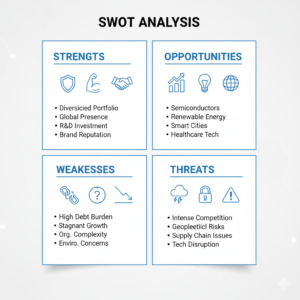
This SWOT analysis of Toshiba explores its strengths, weaknesses, opportunities, and threats in 2025. Toshiba’s diverse portfolio, global reach, and strong R&D investment remain key strengths. Weaknesses include debt, stagnant growth, and environmental perception issues. Opportunities lie in semiconductors, renewable energy, smart cities, and healthcare technology. Threats include fierce competition, debt liabilities, economic downturns, and technological disruptions.
Understanding this Toshiba SWOT analysis gives clear insight into the company’s current position and future prospects.
Toshiba Corporation is a global technology conglomerate based in Tokyo, Japan. Founded in 1875, it has shaped industries from consumer electronics to semiconductors and nuclear energy. Toshiba is widely recognized for its innovation, quality, and global reach.
In this blog, we present a complete SWOT analysis of Toshiba (2025). We will examine its strengths, weaknesses, opportunities, and threats in detail. This analysis will also highlight Toshiba’s strategies to stay competitive in global markets.
Company Overview
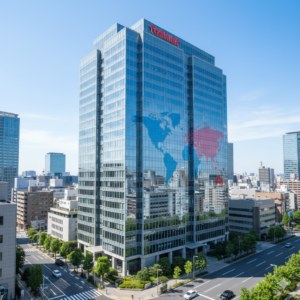
- Name: Toshiba Corporation
- Founded: 1875 (officially renamed Toshiba in 1978)
- Headquarters: Minato, Tokyo, Japan
- Industry: Conglomerate – semiconductors, infrastructure, energy, consumer products, IT solutions
- Ownership: Japan Industrial Partners (JIP)
- CEO: Taro Shimada
- Employees: ~106,000 (2023)
- Revenue (2023): $26.32 billion
- Operating income (2023): $1.88 billion
- Net income (2023): $0.95 billion
- Global presence: 70+ subsidiaries worldwide
Toshiba’s businesses cover semiconductors, social infrastructure, medical technology, consumer durables, power systems, and IT solutions. Its wide portfolio provides stability but also creates management challenges.
SWOT Analysis of Toshiba
Strengths of Toshiba
1. Wide Product Portfolio
Toshiba operates across multiple sectors, including semiconductors, consumer durables, IT services, energy systems, and infrastructure. This diversification spreads risk and provides multiple revenue streams.
2. Global Presence
Toshiba has operations across Asia, Europe, and North America. It runs 70+ subsidiaries and maintains strong distribution networks. This allows the company to serve diverse markets and reduce dependence on any single region.
3. Strong Research and Development (R&D)
Toshiba invests heavily in R&D. In 2022, it spent over 24.5 billion Japanese yen on R&D. The company holds more than 120,000 patents globally, with over 68,000 still active. This strong R&D focus ensures Toshiba remains competitive in innovation-driven industries.
4. Brand Value and Reputation
Toshiba is valued at over $12 billion, according to Forbes. The company has a strong reputation for reliability, quality, and innovation. Its long-standing brand presence strengthens consumer and business trust.
5. Financial Strength (Stabilizing)
In 2023, Toshiba recorded operating income of $1.88 billion and net income of $0.95 billion. This shows financial resilience despite challenges. A stable financial base allows reinvestment into growth areas.
6. Vertical Integration
Toshiba manages the entire value chain, from manufacturing to sales and services. This improves quality control, customer experience, and efficiency.
7. Marketing and Communication
Toshiba has strong communication strategies, using social media platforms like YouTube, Facebook, and Instagram. Its marketing focuses on targeted, clear messaging instead of saturation.
8. Employee Base
With over 105,000 employees worldwide, Toshiba has a large talent pool. It invests in employee development, which supports innovation and operational excellence.
9. Partnerships and Alliances
Toshiba has formed strategic alliances across semiconductors, IT, and infrastructure. Partnerships help in sharing expertise, expanding into new markets, and strengthening competitiveness.
10. Environmental Initiatives
The company has started investing in eco-friendly products and sustainable practices. This aligns with global trends and consumer expectations for greener products.
Also Read: SWOT Analysis of Maggi
Weaknesses of Toshiba
1. High Debt Burden
Toshiba has struggled with debt, mainly due to heavy write-downs in its nuclear business. In 2023, its long-term debt stood at $2.48 billion. This financial pressure affects its ability to invest freely in growth.
2. Stagnant Growth
Revenue growth has remained flat over the past few years. Fluctuations in earnings make long-term planning difficult and limit investor confidence.
3. Dependence on Few Segments
Toshiba relies heavily on power systems, consumer durables, and semiconductors. Weak performance in other divisions limits overall growth potential.
4. Environmental Criticism
Toshiba has faced criticism in the U.S. and other regions for not being “green” enough. Its products rank low in energy efficiency compared to competitors. This hurts brand reputation in eco-conscious markets.
5. Marketing Weaknesses
Although Toshiba invests in marketing, campaigns are inconsistent. Lack of regular branding activities affects customer loyalty and weakens brand recall.
6. Organizational Complexity
Managing a wide portfolio across industries makes decision-making slow. Hierarchical structures reduce agility and limit responsiveness to market changes.
7. Legacy Issues – Accounting Scandals
Past accounting scandals in the 2010s damaged Toshiba’s reputation. Although the company has improved transparency, rebuilding full trust takes time.
8. Decline in PC Business
Toshiba has lost significant ground in the personal computer market due to intense competition. This reduces visibility in a once-strong segment.
9. Westinghouse Bankruptcy
Toshiba’s nuclear power division, Westinghouse, filed for bankruptcy, leading to huge financial losses. This continues to affect Toshiba’s financial stability.
Opportunities for Toshiba
1. Growth in Semiconductors and Storage
Semiconductors drive the digital economy. Toshiba can expand its share in NAND flash, SSDs, and storage devices. Growing demand from AI, cloud, and 5G industries creates opportunities.
2. Renewable Energy Expansion
Global demand for renewable energy is rising. Toshiba can strengthen its presence in solar, wind, and hydrogen systems. Its expertise in power infrastructure can support global green energy projects.
3. Consumer Durables Growth
The consumer durable market continues to expand. Toshiba can increase its product footprint by launching energy-efficient appliances, expanding in emerging markets, and investing in stronger branding.
4. Healthcare Technology
With an aging population worldwide, demand for advanced healthcare equipment is growing. Toshiba can leverage its expertise in medical imaging and diagnostics to expand in this sector.
5. Smart Cities and IoT
The rise of smart cities creates demand for energy-efficient systems, traffic control, and building automation. Toshiba’s diverse technologies make it a strong candidate for integrated smart city solutions.
6. Electrification of Transportation
As electric vehicles gain popularity, Toshiba can expand in batteries, charging infrastructure, and power electronics. This aligns with global efforts to reduce carbon emissions.
7. Expansion in Emerging Markets
Developing economies such as India, Southeast Asia, and Africa present new growth opportunities. Offering affordable, localized products can help Toshiba expand its consumer base.
8. Digital Transformation Services
Toshiba can expand IT services, AI-powered solutions, and analytics for enterprises. Digital transformation is a global priority, creating demand for Toshiba’s expertise.
9. Strategic Partnerships and Acquisitions
Forming alliances or acquiring niche technology firms can give Toshiba faster entry into high-growth markets.
10. Eco-Friendly Product Development
Toshiba can improve its global standing by leading in eco-friendly appliances and green technologies. This aligns with consumer demand and regulatory requirements.
Threats to Toshiba
1. Competition
Toshiba faces strong competition from global players in every sector. In semiconductors, it competes with Samsung, SK Hynix, and Micron. In consumer durables, rivals include LG, Panasonic, and Sony. Competition squeezes margins and reduces market share.
2. Debt Liabilities
Large debt remains a major threat to Toshiba’s stability. Failure to manage or reduce debt could impact its survival and growth.
3. Economic Downturns
Global recessions reduce demand for electronics, infrastructure, and appliances. For a company already facing debt issues, downturns amplify risks.
4. Technological Disruption
Rapid technology changes create constant pressure. Failure to adapt quickly could make Toshiba’s products obsolete.
5. Regulatory Risks
Changes in environmental and trade regulations increase compliance costs. Toshiba’s non-green image makes it more vulnerable in markets with strict standards.
6. Geopolitical Tensions
Toshiba depends on global supply chains. Trade disputes, tariffs, and regional conflicts can disrupt production and sales.
7. Natural Disasters
Headquartered in Japan, Toshiba faces risks from earthquakes and other natural disasters. These events can halt production and damage facilities.
8. Cybersecurity Threats
As Toshiba expands digital services, cyberattacks become a bigger risk. Data breaches could harm its credibility and cause financial losses.
9. Price Wars
Aggressive pricing by rivals, especially in consumer durables and storage, may force Toshiba into price cuts, reducing profitability.
10. Reputation Risks
Past accounting scandals and ongoing financial challenges have hurt Toshiba’s reputation. Any future misstep could further reduce stakeholder trust.
Conclusion
This SWOT analysis of Toshiba shows a company with significant strengths and major challenges. Toshiba’s wide portfolio, global presence, and R&D power make it a respected player in technology and infrastructure. However, high debt, stagnant growth, and environmental concerns continue to weaken its performance.
Opportunities in semiconductors, renewable energy, healthcare, and smart cities can help Toshiba grow in 2025 and beyond. To succeed, Toshiba must improve its financial stability, invest in sustainability, and rebuild brand trust.
FAQs
What are Toshiba’s main strengths?
Toshiba’s main strengths are its wide product portfolio, global presence, strong R&D, and long-standing brand reputation.
What are Toshiba’s weaknesses?
Weaknesses include high debt, stagnant growth, inconsistent marketing, and environmental perception issues.
What opportunities does Toshiba have in 2025?
Toshiba can expand in semiconductors, renewable energy, healthcare technology, smart cities, and emerging markets.
What threats does Toshiba face?
Toshiba faces threats from global competition, debt, economic downturns, technological disruption, and regulatory changes.
How can Toshiba improve its performance?
Toshiba should focus on reducing debt, investing in green technologies, expanding in semiconductors, and strengthening marketing strategies.
Is Toshiba still a major player in semiconductors?
Yes, Toshiba remains one of the world’s top semiconductor manufacturers, especially in storage solutions.
Why is Toshiba criticized for environmental issues?
Toshiba’s products are often ranked low in energy efficiency. Critics argue it must adopt greener practices and improve sustainability.

A digital marketer with a strong focus on SEO, content creation, and AI tools. Creates helpful, easy-to-understand content that connects with readers and ranks well on search engines. Loves using smart tools to save time, improve content quality, and grow online reach.