

Summary
Visa Inc. is one of the world’s most trusted names in digital payments, serving billions of customers across more than 200 countries. As the payment industry undergoes rapid transformation due to fintech innovations, cryptocurrency adoption, and regulatory pressures, it is important to assess Visa’s market position. This SWOT Analysis of Visa (Updated 2025) explores the company’s strengths, weaknesses, opportunities, and threats in detail. By understanding Visa’s global dominance, internal challenges, and external environment, we gain insights into how Visa maintains leadership and prepares for the future.
Visa is not just a credit card company—it is a global payment technology powerhouse. With credit, debit, and prepaid card solutions, Visa links consumers, merchants, banks, and financial institutions across the world. It processes over 65,000 transactions per second, ensuring speed and reliability.
But in 2025, Visa faces increasing challenges. Digital wallets, blockchain, contactless payments, and fintech startups are reshaping consumer behavior. Meanwhile, regulations on interchange fees and data protection increase compliance costs.
A SWOT analysis of Visa allows us to look at its strengths, weaknesses, opportunities, and threats—helping us understand how Visa can maintain its leadership in the evolving digital financial ecosystem.
Company Overview of Visa
- Company Type: Public
- Industry: Payment Card Services
- Founded: September 18, 1958 (as BankAmericard, Fresno, California)
- Headquarters: One Market Plaza, San Francisco, U.S.
- Global Presence: 200+ countries and territories
- Products: Credit cards, Debit cards, Prepaid cards, Payment solutions
- Revenue (2023): US$32.7 billion
- CEO: Ryan McInerney
- Website: visa.com
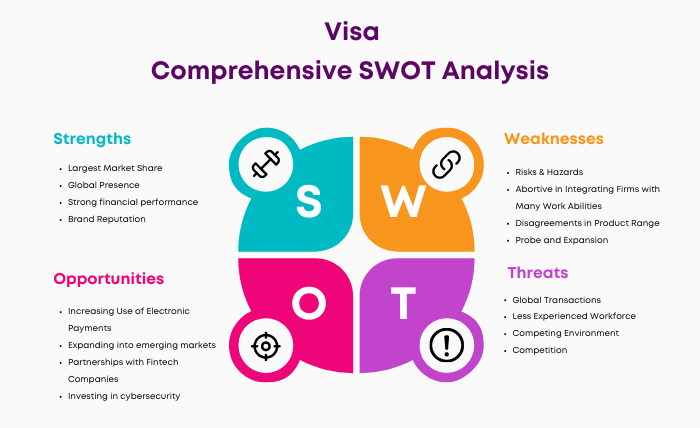
SWOT Analysis of Visa (Visa SWOT Analysis)
Strengths of Visa
Visa has multiple strengths that make it the global leader in payment solutions.
1. Largest Market Share
Visa commands nearly 50% of the world’s card payment market, far ahead of rivals like Mastercard and American Express. This dominance provides massive transaction volumes and high global visibility.
2. Global Presence
Operating in 200+ countries, Visa benefits from geographic diversification. This worldwide reach spreads risk across regions while enabling new opportunities in both developed and emerging markets.
3. Strong Financial Performance
Visa’s revenue for 2023 was $32.7 billion, with a quarterly revenue of $8.775 billion in March 2024. Continuous growth in payments and digital transactions highlights Visa’s resilience.
4. Brand Reputation
Visa is a household name and consistently ranks among the world’s most valuable brands. In 2023, Visa’s brand value was $169.1 billion, ranking sixth globally. This brand trust encourages loyalty among banks, merchants, and customers.
5. Innovative Products
Visa invests in innovation, from contactless payments to mobile wallets. These products align with consumer needs for convenience, making Visa relevant in the digital-first era.
6. Security Infrastructure
Visa’s secured dossier centers handle over 65,000 transactions per second, with 500+ fraud checks per second. This strong fraud prevention system reinforces customer trust.
7. Strategic Endorsements
Through sponsorships of the Olympics, Paralympics, and FIFA, Visa strengthens its brand association with excellence and global unity.
8. Currency of Progress Campaign
Visa actively promotes digital currencies and stablecoins like USDC, reflecting its forward-looking strategy in blockchain and financial inclusion.
9. Diversified Customer Base
Visa’s partners include banks, governments, fintechs, and individual users. This diversification prevents overdependence on one segment.
10. Strong Bank Relationships
Visa’s vast network includes 222 partners, such as Oracle and leading financial institutions. These relationships ensure widespread card issuance and merchant acceptance.
11. Commitment to Sustainability
Visa integrates sustainability into its corporate strategy, appealing to socially conscious consumers and investors.
In short, Visa’s strengths—market share, brand power, security, and global presence—make it nearly impossible to ignore in the digital payments landscape.
Weaknesses of Visa
Despite its dominance, Visa has internal weaknesses that need addressing.
1. Vulnerability to Fraud
Digital payments are prone to fraud. While Visa has strong security, any breach affects brand reputation and customer confidence.
2. Difficulty in Integrating Acquisitions
Visa’s track record of integrating acquisitions is mixed. Struggles in managing different operational models reduce agility in new markets.
3. Narrow Product Range
Compared to fintech firms offering lending, insurance, and wealth management, Visa remains heavily reliant on card payments.
4. Innovation Gaps
Competitors like PayPal, Stripe, and Apple Pay are innovating faster. Visa must accelerate blockchain and AI-driven solutions.
5. High Dependency on Contracts
Overreliance on a few large banking contracts poses risks. If these partners switch alliances, Visa could lose major revenue streams.
6. High Operating Costs
Visa spent $11.65 billion in 2023 on operating expenses, including marketing and compliance. This reduces margins compared to leaner fintech firms.
7. Reliance on Banking Sector
Visa’s growth is tied to the health of global banks. Any instability in the financial sector affects Visa directly.
8. Limited Control over Issuing Banks
Visa does not issue cards directly—it depends on banks. Customer service quality varies, which can dilute Visa’s reputation.
9. Cybersecurity Risks
Visa is a top target for hackers. Any successful breach could be catastrophic.
Overall, Visa’s weaknesses stem from its dependence on traditional financial models, slower innovation, and regulatory challenges.
Opportunities for Visa
Visa has strong opportunities to expand its dominance further.
1. Rising Electronic Payments
With the world moving toward cashless economies, Visa is in a prime position to expand in both developed and developing regions.
2. Expansion in Emerging Markets
Markets like India, Africa, and Southeast Asia are shifting from cash to digital. Visa’s partnerships with local banks can tap this demand.
3. Partnerships with Fintech
Collaborations with fintech firms allow Visa to reach younger, tech-savvy audiences and integrate into new ecosystems.
4. Cybersecurity Investments
Visa can strengthen its competitive edge by becoming the most secure digital payment brand, attracting safety-conscious customers.
5. Technological Innovation
Emerging technologies like blockchain, contactless RFID, and biometric payments open new service opportunities for Visa.
6. Growth in E-commerce
E-commerce continues to rise, and Visa is at the center of every online purchase, ensuring long-term growth.
7. Customized Financial Solutions
Visa can expand into microfinance, insurance, and lending, especially in underserved populations, to diversify revenue.
8. Sustainable Finance
Visa’s sustainability initiatives can attract eco-conscious businesses and investors, building goodwill and long-term trust.
9. Big Data Insights
With billions of transactions, Visa can leverage data for fraud detection, personalized offers, and targeted marketing campaigns.
These opportunities demonstrate Visa’s ability to innovate and capture untapped markets in the digital age.
Threats to Visa
Visa faces serious external threats that could disrupt its market leadership.
1. Intense Competition
Visa competes with Mastercard, American Express, PayPal, and new fintech startups. Aggressive pricing and innovation challenge Visa’s dominance.
2. Cryptocurrency & Blockchain Disruption
Crypto payments and decentralized finance (DeFi) threaten Visa’s traditional card-based business model.
3. Regulatory Pressures
Global regulations on interchange fees, anti-money laundering, and data privacy increase costs and reduce profitability.
4. Cybersecurity Threats
Data breaches, fraud, and identity theft are growing risks.
5. Political & Economic Instability
Visa’s global reach exposes it to geopolitical conflicts, currency fluctuations, and recessions that can reduce spending.
6. Market Saturation in Developed Countries
In markets like the U.S. and Europe, card penetration is already high, limiting further growth.
7. Changing Consumer Preferences
Younger consumers may prefer digital wallets, BNPL (buy now, pay later), and crypto payments instead of cards.
Visa must continuously adapt to remain competitive in the fast-evolving payments industry.
Conclusion
Visa Inc. remains the undisputed leader in global payments, backed by its strong brand, massive global reach, and robust financial performance. Its dominance in card payments, partnerships with banks, and investment in innovation ensure continued relevance.
However, weaknesses such as dependence on banks, high costs, and limited product diversification expose it to risk. At the same time, opportunities in emerging markets, e-commerce, fintech partnerships, and sustainable finance provide pathways for growth.
Threats like fintech competition, cryptocurrency disruption, cybersecurity, and regulation require agility and resilience. By leveraging its strengths and addressing these challenges, Visa can continue shaping the future of digital payments in 2025 and beyond.
FAQs
What are the main strengths of Visa?
Visa’s main strengths are its global market share, trusted brand reputation, strong financial performance, and advanced payment technology infrastructure.
What weaknesses does Visa face in 2025?
Visa struggles with high operating costs, reliance on banks, limited innovation compared to fintechs, and cybersecurity vulnerabilities.
What opportunities are available for Visa?
Visa can expand into emerging markets, partner with fintech firms, lead in blockchain and AI payments, and diversify financial services.
What are the biggest threats to Visa?
Major threats include competition from Mastercard and PayPal, cryptocurrency adoption, cybersecurity risks, and strict global regulations.
Why is SWOT analysis of Visa important?
SWOT analysis of Visa helps stakeholders understand the company’s strengths, challenges, market risks, and opportunities for sustainable growth.

A digital marketer with a strong focus on SEO, content creation, and AI tools. Creates helpful, easy-to-understand content that connects with readers and ranks well on search engines. Loves using smart tools to save time, improve content quality, and grow online reach.