


Keyword density has been debated in SEO circles for years. Some marketers still chase a “perfect” percentage, while others insist it no longer matters. The truth lies somewhere in between: Google has evolved far beyond simple keyword counting, but the way you place and emphasize your main terms on the page still affects how search engines understand your content. In this guide, you’ll learn what keyword density is, how it differs from keyword prominence in SEO, whether Google uses it as a ranking factor, and how to use keywords today without over-optimizing or risking penalties.
What Is Keyword Density?

Basic definition and formula
Keyword density is the percentage of times a keyword or phrase appears on a page compared to the total word count. In simple terms, it answers the question, “Out of all the words on this page, how many are my target keyword?”
The basic formula for keyword density is:
Keyword Density (%) = (Number of keyword occurrences ÷ Total words on page) × 100
For example, if your target keyword appears 15 times in a 1,000-word article, your keyword density is 1.5%.
Understanding “what is keywords density” with a simple example
Imagine you run a local bakery and write a 500-word page about “gluten-free cupcakes.” If you use the phrase “gluten-free cupcakes” 10 times, the keyword density for that phrase is:
(10 ÷ 500) × 100 = 2%
This is all “what is keywords density” really means: a straightforward ratio of keyword uses to total words. It does not account for synonyms, related terms, or user intent—only raw counts.
Why people still talk about keyword density SEO
Keyword density SEO strategies became popular in the early days of search engines, when algorithms were much simpler. Pages that repeated a keyword over and over often ranked well, which encouraged tactics like:
- Stuffing target phrases into every sentence
- Hiding keywords in white text on a white background
- Repeating keyword lists in footers and sidebars
Those days are gone. Modern search algorithms and quality systems are designed to detect manipulation and focus on relevance, quality, and user satisfaction. However, understanding keyword density is still useful as a diagnostic tool to avoid extremes.
Keyword Density vs. Keyword Prominence in SEO
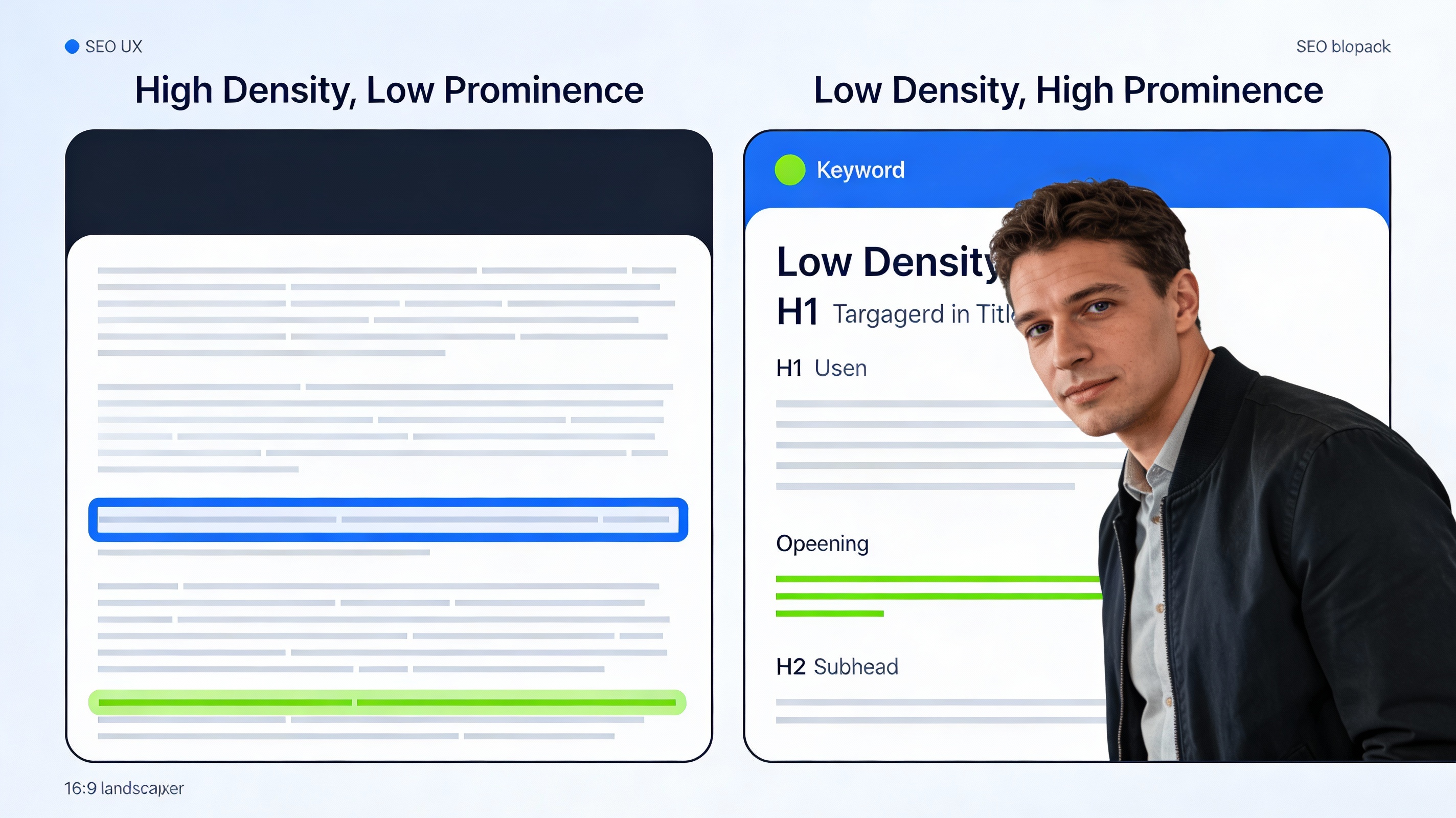
What is keyword prominence in SEO?
Keyword prominence in SEO refers to how visible and early your target keyword appears on a page, rather than how often it appears. It is about placement and emphasis, not volume.
Examples of prominent locations include:
- Title tag
- URL slug
- H1 or opening headings
- First 100–150 words of body copy
- Subheadings (H2, H3)
- Anchor text in internal links
- Image alt text where relevant
When SEOs talk about keyword prominence in SEO, they are focused on signaling to both users and search engines what the page is about as early and as clearly as possible.
Density vs. prominence: why the difference matters
Consider these two pages targeting “digital marketing strategy”:
- Page A uses the keyword 30 times in 2,000 words (1.5% density), but the term only appears in the middle of the content and not in the title, headings, or intro.
- Page B uses the keyword 12 times in 2,000 words (0.6% density), but includes it in the title tag, meta description, H1, first paragraph, and several H2s.
Both have measurable density, but Page B demonstrates stronger keyword prominence in SEO. In practice, Page B usually has a better chance of ranking because the content is clearly aligned with the topic from the outset, making it easier for search engines and users to recognize its relevance.
Real-world example of prominence outperforming raw density
Imagine a product page for “wireless noise-cancelling headphones.”
- Poor implementation: The phrase is repeated in every sentence of the description, but the title tag is “Top Audio Gear,” the H1 is “Our Best Products,” and the URL is “/products/12345”.
- Strong implementation: The title tag is “Wireless Noise-Cancelling Headphones | BrandName,” the H1 is “Wireless Noise-Cancelling Headphones,” and the first paragraph clearly introduces the product, with measured use of the keyword and natural language.
The second approach uses lower keyword density but far better keyword prominence and context, which is more aligned with modern ranking systems.
Also Read: B2B Brand Marketing Strategy: How To Build Demand In Long Sales Cycles
Is Keyword Density a Google Ranking Factor?
How Google has evolved beyond simple keyword counting
Early search engines relied heavily on exact keyword matches and basic frequency signals. This made google keyword density an easy target for manipulation and led to poor user experiences. Over time, Google introduced sophisticated updates and technologies to understand:
- The overall topic of a page, not just repeated phrases
- Synonyms and related words (for example, “attorney” and “lawyer”)
- User intent behind queries (informational, transactional, navigational)
- Content quality, expertise, and trust signals
The result: while keywords still matter, chasing a specific google keywords density percentage no longer makes sense as a standalone strategy.
Google’s stance on keyword stuffing and over-optimization
Google’s published spam policies explicitly warn against “keyword stuffing,” describing it as the practice of overloading a page with keywords in an attempt to manipulate rankings. This includes:
- Repeating the same words or phrases excessively
- Listing phone numbers or cities purely to gain visibility
- Using blocks of text with variations of the same phrase
When you aim for a precise keyword density and push your text beyond natural language, you risk crossing into spam territory. The first few occurrences of a keyword help clarify relevance, but additional repetitions offer diminishing returns and can trigger negative quality signals.
Why there is no “optimal keyword density” for Google
Many tools and checklists still talk about an “optimal keyword density” of 1%, 2%, or another fixed number. This is appealing because it appears simple and measurable. However, a universal “best” percentage does not exist for several reasons:
- Different topics require different terminology density. A medical article may need to repeat technical terms more often than a lifestyle blog.
- Content length varies widely; a 300-word product description and a 4,000-word guide cannot share the same ideal ratio.
- Modern algorithms use hundreds of signals; no single keyword metric can predict rankings.
In practice, focusing on readability, usefulness, and keyword prominence in SEO outperforms obsessing over a precise percentage.
How Google Uses Keywords Today
From exact matches to semantic understanding
Today, search engines use advanced language models to understand the meaning of content, not just its surface-level words. That means:
- Pages can rank for queries without containing the exact phrase, as long as the topic and intent match.
- Synonyms, related entities, and context all contribute to relevance.
- Over-optimized text can appear unnatural and reduce user engagement, which sends negative signals.
For example, a page targeting “home office setup” might rank for “how to set up a workspace at home” even if that exact phrase is never used, as long as the content comprehensively covers the topic.
The continued importance of clear topical signals
While semantic understanding is powerful, you still need to clearly indicate what your page is about. Strategic keyword placement helps:
- Search engines understand the primary topic
- Users immediately see that they’re in the right place
- Snippets and featured results better reflect your content
Combining natural use of your target keyword with strong keyword prominence in SEO-friendly locations is more important than driving up keyword density numbers.
How to Use Keyword Density as a Practical Guide (Not a Rule)
Healthy ranges to keep in mind
Although there is no official optimal keyword density, many content teams use soft ranges as a sanity check. Common guidelines are:
- 0.5%–2% for primary keywords on most informational pages
- Up to ~3% for shorter product pages or highly specific terms, provided the copy still reads naturally
These ranges are not ranking rules. They are simply guardrails to help you avoid both extremes: using a keyword so little that it feels absent or so much that it becomes repetitive.
When keyword density is a useful diagnostic metric
Use keyword density as a quick check in scenarios like:
- Content audits: Identifying pages where a target term barely appears, even though that page is meant to rank for it.
- Over-optimization checks: Spotting bloated landing pages with the same phrase every other sentence.
- Large-scale content production: Ensuring freelance or outsourced writers are not stuffing keywords to impress clients.
If a page has a density below 0.3% for a key topic phrase, you may need to increase its prominence. If density hits 4–5% and the text feels forced, you probably need to trim.
Practical example of revising density
Say you have a 1,500-word article about “email marketing automation,” but the keyword appears only twice (0.13% density). The title tag and H1 are generic. In this case you might:
- Update the title tag to “Email Marketing Automation: How to Scale Your Campaigns”
- Use the phrase in the H1
- Add it naturally in the introduction and one or two subheadings
- Include it a few times in the body where it fits contextually
The result: you improve keyword prominence and increase a very low keyword density without stuffing.
Best Practices for Keyword Prominence in SEO
Where to place your primary keyword
To leverage keyword prominence in SEO effectively, aim to include your main phrase in the following areas where it makes sense:
- Title tag: As close to the beginning as reasonably possible
- URL slug: Short, descriptive, and keyword-aligned
- Meta description: Used naturally in a compelling summary
- H1 heading: Reflecting the core topic
- Opening paragraph: Within the first 100–150 words
- One or more H2/H3 subheadings: Where it adds clarity
- Conclusion: When summarizing the main topic
This approach ensures your keyword stands out where search engines expect important context, while still keeping the copy natural and user-focused.
Supporting your primary keyword with related terms
Instead of repeating the same phrase endlessly, enrich your page with:
- Synonyms and variations (for example, “SEO keyword usage,” “keyword strategy,” “search phrases”)
- Related entities (brands, tools, concepts, locations)
- Topically relevant questions and answers
This not only avoids unnatural keyword density but also broadens the range of queries your content can rank for and aligns with how search engines interpret topics.
Internal links and anchor text
Internal linking is another important way to enhance keyword prominence in SEO. When appropriate:
- Link to your page using descriptive anchor text that contains or relates to your main keyword
- Avoid using the exact same anchor every time; mix in natural variations
- Ensure the linked page truly covers what the anchor implies
For example, if you have a detailed guide on “technical SEO basics,” linking to it with anchor text like “learn the basics of technical SEO” is more useful than “click here.”
Common Keyword Density Mistakes to Avoid
Chasing a magic percentage
One of the biggest mistakes is believing that a specific optimal keyword density, such as 2% or 3%, guarantees better rankings. This can lead to:
- Forced phrasing and awkward sentences
- Ignoring user intent and content structure
- Overlooking more important ranking factors like page speed, helpfulness, and authority
Use density as a guide, not a goal.
Ignoring readability and user experience
If a user lands on a page and immediately feels like they are reading a list of keywords instead of helpful information, they are likely to leave quickly. High bounce rates, low time on page, and poor engagement can all undermine your SEO efforts.
Ask yourself:
- Would I write this sentence this way if search engines did not exist?
- Does this paragraph sound natural when read out loud?
- Is the keyword truly necessary here, or am I adding it just to hit a number?
Over-optimizing footer and boilerplate sections
Some sites still stuff city names, services, or keywords into footers, sidebars, and boilerplate text across every page. This creates site-wide overuse of terms and can look manipulative. It also dilutes the uniqueness and value of each page.
Instead, limit repetitive keyword lists in boilerplate areas and focus on crafting unique, user-centric content in the main body of each page.
How to Optimize Content Without Keyword Stuffing
Start with search intent and user needs
Before thinking about keyword density SEO tactics, clarify user intent. Ask:
- Is the query informational, transactional, or something else?
- What problem is the searcher trying to solve?
- What level of detail and expertise will they expect?
Structure your content to satisfy that intent first. Once the outline matches user needs, integrate your primary and secondary keywords where they naturally fit.
Use a natural language approach
Write your first draft as if you were explaining the topic to a colleague. Then, in your editing pass:
- Check that your primary keyword appears in key prominent locations
- Replace some redundant repetitions with synonyms or pronouns where clear
- Merge overly similar sentences that exist only to repeat the phrase
This method keeps your writing human-friendly while still providing clear relevance signals to search engines.
Leverage headings and structure
Thoughtful use of headings helps both users and search engines. To optimize without stuffing:
- Include your main keyword in at least one H2 where it genuinely describes the section
- Use related phrases and questions in other headings (for example, “how does keyword density affect SEO?”)
- Avoid cramming the full keyword into every heading just for the sake of it
Good structure reduces the need to overuse exact phrases because it already makes the topic clear.
Evaluating Keyword Density with Tools (And Their Limitations)
What density tools can tell you
Many SEO tools and content editors can calculate google keyword density automatically. They can help you:
- Identify the most frequently used terms on a page
- Spot missing or underused primary phrases
- Compare your usage with top-ranking pages as a loose benchmark
Used correctly, these tools are helpful for quality control and consistency across large sites or content teams.
What density tools cannot do
However, no tool can tell you definitively:
- Whether your content satisfies user intent better than competitors
- How engaging or trustworthy your writing is
- Whether your site architecture, technical health, or link profile are strong enough
Density metrics are just one small piece of the SEO puzzle. They are not a substitute for a holistic strategy.
Putting It All Together: A Practical Workflow
Step-by-step on-page optimization process
Here is a simple workflow that balances keyword prominence in SEO with natural writing:
- Research: Identify a primary keyword and a handful of related phrases and questions.
- Outline: Structure your article around user intent, not keywords. Map sections to questions users are actually asking.
- Draft: Write freely, mentioning your primary keyword where it feels natural, especially early on.
- Optimize placement: Ensure your primary keyword is present in the title tag, URL slug, meta description, H1, first paragraph, and at least one subheading.
- Check density: Use a tool or manual count to confirm you’re not at an extreme (for example, under 0.3% or above 3–4% for most long-form content).
- Refine language: Replace unnecessary repetitions with synonyms or pronouns, tighten wordy sentences, and read sections out loud for flow.
- Enhance context: Add internal links, relevant images with descriptive alt text, and clear calls to action.
Continuous improvement with real-world data
After publishing, monitor performance in analytics and search console data:
- Which queries are driving impressions and clicks?
- Are users spending time on the page and engaging with it?
- Which related queries could be better addressed with minor content updates?
Use these insights to refine content structure, add missing sections, and adjust keyword usage where needed, always prioritizing usefulness over density targets.
FAQs
Does Google use keyword density as a direct ranking factor?
No. Google does not rely on a specific keyword density as a direct ranking factor. While using your target keyword a few times helps clarify what your page is about, chasing a particular percentage will not boost rankings on its own and can lead to keyword stuffing if overdone.
Is there an optimal keyword density I should aim for?
There is no universally optimal keyword density. Many professionals treat a range of about 0.5%–2% as a helpful guideline for long-form content, but this is not a rule from Google. Focus on natural language, clear keyword prominence in SEO-critical areas, and satisfying user intent instead of hitting a magic number.
How many times should I use my main keyword on a page?
Use your main keyword enough times that it feels clear and natural, especially in prominent locations like the title, H1, and introduction. For a 1,000–2,000 word article, this often ends up being in the range of 5–15 mentions, but it depends on the topic, context, and length. If it starts to sound repetitive, you are likely using it too much.
Can a page rank for a keyword even if it does not use that exact phrase?
Yes. Modern search engines can understand synonyms, related terms, and context, so a page can rank for queries without containing the exact phrase. However, including your primary keyword at least a few times in key locations makes it easier for search engines and users to recognize the page’s main topic.
What is the difference between keyword density and keyword prominence?
Keyword density measures how often a keyword appears as a percentage of total words, while keyword prominence describes how visible and early that keyword appears on the page. Prominence focuses on strategic placement (title, headings, intro), whereas density focuses on volume. In modern SEO, prominence is generally more important than chasing a specific density.
How can I avoid keyword stuffing while still being SEO-friendly?
Write for users first, then refine for search. Ensure your main keyword appears in critical on-page elements, but do not force it into every sentence. Use synonyms, related terms, and pronouns to keep language natural. Read sections out loud; if it sounds awkward or repetitive, reduce or rephrase your keyword usage.