


Summary
The BCG Matrix of Aditya Birla Group provides a strategic analysis of how one of India’s largest and most diversified conglomerates manages its vast portfolio of businesses. With interests spanning sectors like metals, cement, textiles, financial services, telecommunications, renewable energy, and retail, the Aditya Birla Group is a key player not only in India but across 36 countries.
This detailed and descriptive blog explores how the Boston Consulting Group (BCG) Matrix framework applies to the Aditya Birla Group, identifying its Stars, Cash Cows, Question Marks, and Dogs. Each quadrant is analyzed in-depth to understand which businesses are driving growth, which ensure profitability, and which face challenges in the competitive market.
By examining the BCG Matrix of Aditya Birla Group (2025), we gain insights into the company’s business strategy, diversification, and future direction, helping us understand how it maintains balance between innovation, stability, and expansion in a rapidly evolving economy.
The Aditya Birla Group is one of India’s most respected and globally recognized conglomerates, founded by Seth Shiv Narayan Birla in 1857 and expanded under the visionary leadership of Aditya Vikram Birla. Today, under the leadership of Kumar Mangalam Birla, the group operates across multiple sectors, from cement, aluminium, and fashion retail to financial services, telecommunications, and chemicals.
With a presence in over 36 countries and employing more than 140,000 people, the group is a testament to sustainable growth, strategic diversification, and resilience.
However, managing such a diversified portfolio poses a complex challenge. Each business operates in different industries with unique market dynamics, growth rates, and competitive pressures. To effectively allocate resources and prioritize investments, the BCG Matrix provides a valuable framework to evaluate performance and potential across its portfolio.
The BCG Matrix of Aditya Birla Group analyzes each division based on two dimensions:
- Market Growth Rate, which represents the attractiveness of the market; and
- Relative Market Share, which reflects the group’s strength in that sector compared to competitors.
What is the BCG Matrix
 `
`
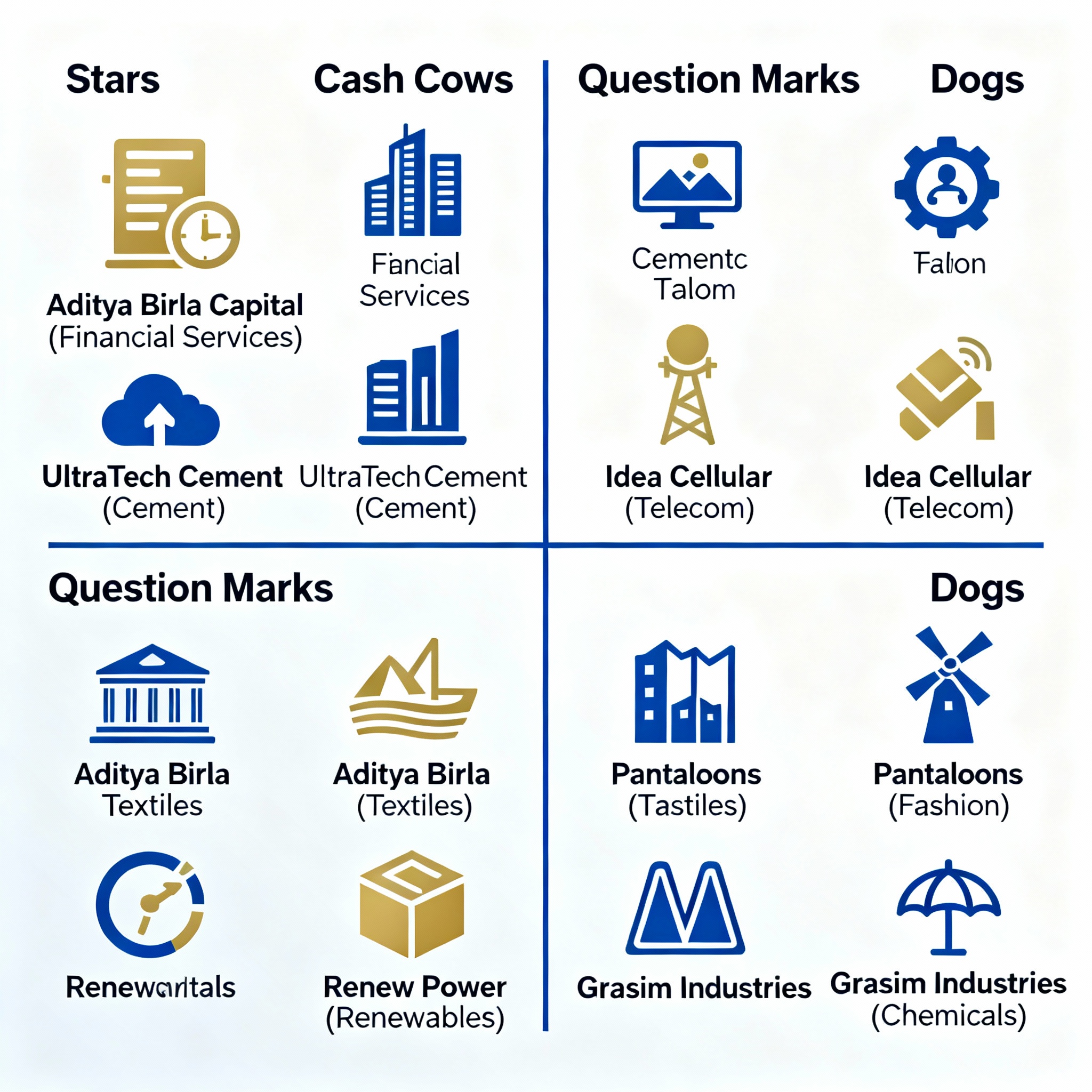
The Boston Consulting Group (BCG) Matrix, developed in the 1970s, is a portfolio management tool used to assess business units or products based on their market growth and market share. It helps companies decide where to invest, where to maintain, and where to divest.
The model divides business units into four categories:
Stars – High market share in high-growth markets. These are leaders in rapidly expanding industries and require continuous investment.
Cash Cows – High market share in low-growth markets. These divisions generate steady profits that support other businesses.
Question Marks – Low market share in high-growth markets. They have potential but need strategic focus and capital investment.
Dogs – Low market share in low-growth markets. These divisions have limited profitability and may require restructuring or exit.
When applied to the Aditya Birla Group, the BCG Matrix helps us understand which businesses are driving innovation and expansion and which are mature, stable, or facing decline.
Why the BCG Matrix is Important for Aditya Birla Group
The Aditya Birla Group’s strength lies in its diversified portfolio. However, this diversification also brings complexity. The BCG Matrix helps the group:
- Optimize Resources: Identify which businesses to invest in or scale down.
- Evaluate Profitability: Understand which divisions are generating consistent revenue.
- Balance Growth and Stability: Ensure a healthy mix of mature and emerging sectors.
- Support Strategic Decisions: Guide mergers, acquisitions, or divestments based on data-driven insights.
- Enhance Long-term Sustainability: Focus on innovation and green initiatives in high-potential industries like renewable energy and fashion retail.
This framework ensures the group maintains both financial strength and future readiness in a dynamic global economy.
Detailed BCG Matrix Analysis of Aditya Birla Group
Stars (High Market Share, High Market Growth)

Aditya Birla Capital (Financial Services)
Aditya Birla Capital Limited (ABCL) has emerged as one of India’s leading financial services players, offering a diverse range of solutions including life insurance, mutual funds, personal finance, and lending. The financial services industry in India has witnessed rapid digitalization and expanding customer demand due to economic growth and financial inclusion initiatives.
ABCL has a strong brand presence, growing customer base, and diverse financial products. With India’s financial sector expected to grow significantly by 2030, Aditya Birla Capital continues to strengthen its position through technology-driven solutions and customer-centric innovation.
This division’s high growth and strong market presence make it a Star within the group’s portfolio.
Aditya Birla Fashion and Retail Limited (ABFRL)
The fashion and retail business has shown remarkable growth, driven by rising disposable incomes, urbanization, and online shopping trends. ABFRL owns popular brands such as Louis Philippe, Van Heusen, Allen Solly, Peter England, and Pantaloons, along with international collaborations with brands like Forever 21 and Reebok India.
The fashion retail sector continues to grow rapidly, both online and offline. ABFRL’s digital initiatives and expansion into Tier 2 and Tier 3 cities position it strongly for future growth.
Given its dominance and continued expansion in a high-growth market, ABFRL is a major Star in the BCG Matrix of Aditya Birla Group.
Renewable Energy (Aditya Birla Renewables)
The renewable energy division focuses on solar and wind energy projects, aligning with global sustainability goals and India’s renewable energy targets. With increasing government support for clean energy and corporate sustainability, this segment has become a fast-growing business area.
The group’s commitment to green energy transition and technological investment makes it a Star segment with strong future potential.
Cash Cows (High Market Share, Low Market Growth)
UltraTech Cement
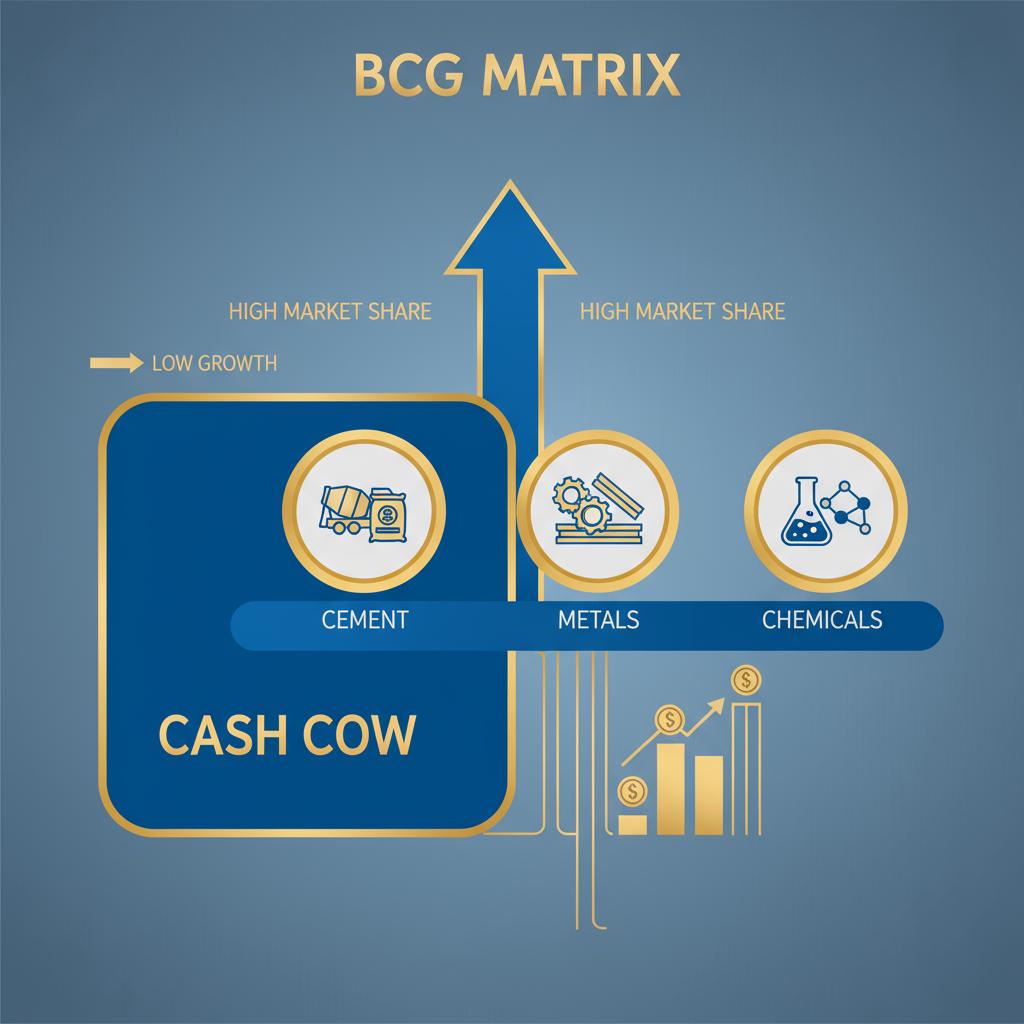
UltraTech Cement is one of the largest cement producers in the world and the undisputed leader in India’s cement industry. The company’s vast production capacity, extensive distribution network, and strong brand equity ensure consistent profitability.
Although the cement sector’s growth rate has stabilized, UltraTech maintains a dominant market share and delivers reliable returns. The demand for housing and infrastructure ensures long-term stability, even in a low-growth market.
As a mature and profitable division, UltraTech Cement serves as a Cash Cow, funding the group’s investments in emerging sectors.
Hindalco Industries (Metals and Aluminium)
Hindalco Industries, the group’s flagship metals company, is a global leader in aluminium and copper production. Its subsidiary, Novelis Inc., is one of the world’s largest recyclers of aluminium.
While the global metals market faces cyclical fluctuations, Hindalco maintains strong market share, cost efficiency, and vertical integration. Its focus on sustainable practices and product diversification ensures consistent cash flow.
Due to its scale, profitability, and established market presence, Hindalco is a prime Cash Cow in the Aditya Birla Group BCG Matrix.
Aditya Birla Chemicals
This division manufactures products like caustic soda, epoxies, and fertilizers, supplying to industries like textiles, paper, and pharmaceuticals. The chemical sector is mature and competitive, but Aditya Birla Chemicals remains profitable due to cost leadership and operational excellence.
It continues to provide steady revenue and stability to the group, categorizing it as a Cash Cow.
Question Marks (Low Market Share, High Market Growth)

Vodafone Idea Limited (Telecommunications)
The telecom industry in India is one of the fastest-growing yet highly competitive sectors. Vodafone Idea (Vi), a joint venture between Aditya Birla Group and Vodafone Group Plc, has faced challenges due to intense competition from Jio and Airtel, regulatory pressures, and high debt.
However, the telecom market continues to expand, especially with 5G deployment and digital transformation initiatives. Vodafone Idea’s future success depends on its ability to secure funding, improve network coverage, and adopt advanced technologies.
Despite its current struggles, the potential for revival makes Vodafone Idea a Question Mark segment with possible transition to a Star if managed effectively.
Aditya Birla Science and Technology (R&D Division)
Innovation is essential for long-term growth across sectors, and the Aditya Birla Science and Technology division focuses on developing advanced materials, sustainable solutions, and digital process improvements.
While the R&D segment has limited direct revenue contribution today, it supports the growth of high-potential sectors such as renewables, fashion, and manufacturing. With continued investment and innovation, it has the potential to become a Star in the coming years.
Dogs (Low Market Share, Low Market Growth)
Textiles (Traditional Operations)
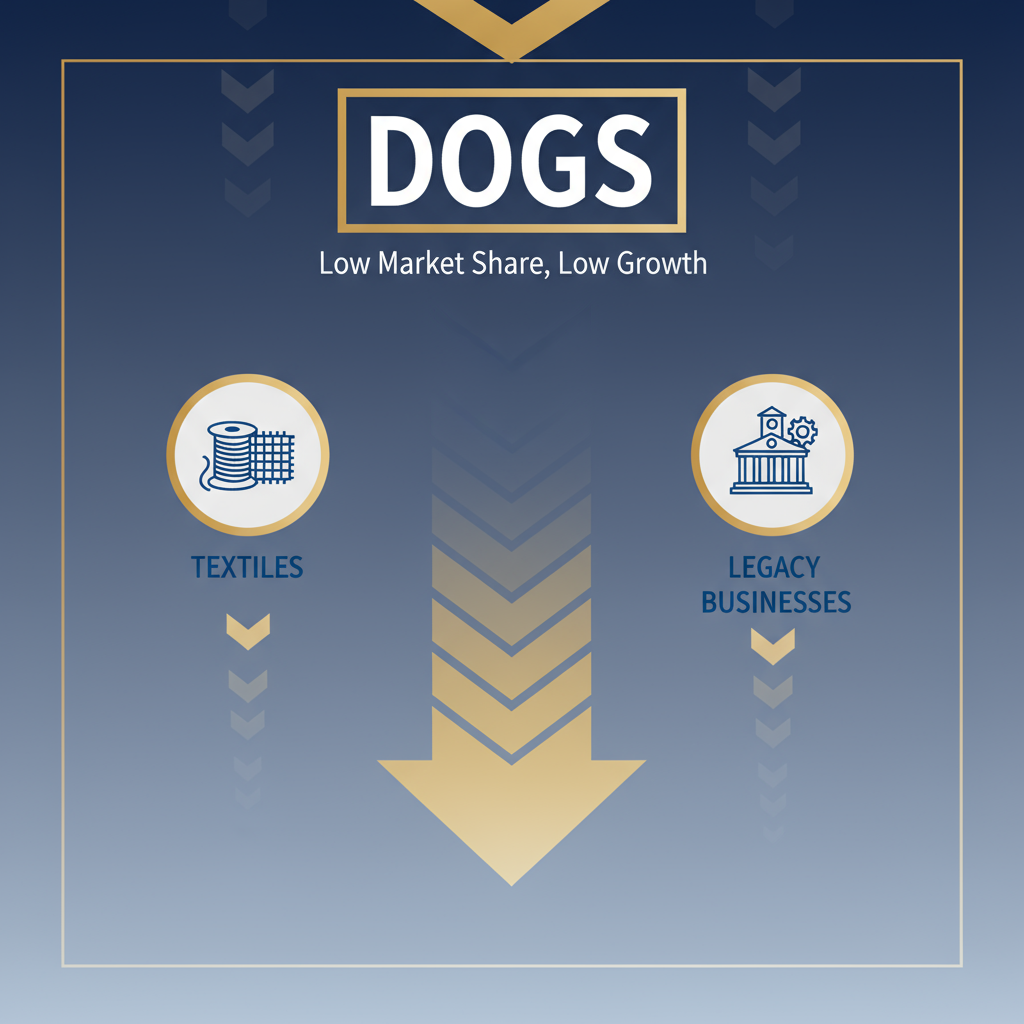
Textiles were among the Aditya Birla Group’s oldest businesses. Although the group remains a respected name in this industry, global competition, changing consumer trends, and slow innovation have limited growth opportunities.
While niche segments like linen and premium apparel still perform moderately, traditional textile operations have low market share in a saturated global market, making them a Dog in the BCG Matrix.
Aditya Birla Carbon (Certain Legacy Product Lines)
Although carbon black manufacturing remains profitable for the group, certain product lines face stagnation due to shifts toward alternative materials and sustainability concerns.
While Aditya Birla Carbon remains a key global player, specific low-demand categories within this division fall under the Dog quadrant.
Non-core Businesses
Other minor or legacy segments such as old fertilizer or trading businesses have limited growth or profitability and are gradually being phased out to streamline operations.
Also Read: BCG Matrix of the Airline Industry
Strategic Insights from the BCG Matrix of Aditya Birla Group
The BCG Matrix of Aditya Birla Group (2025) reveals several strategic insights about the group’s business direction:
- The group maintains a balanced portfolio across growth and stability, ensuring both innovation and consistent profitability.
- Investments in high-growth areas like financial services, fashion retail, and renewable energy indicate a forward-looking approach.
- Mature divisions like UltraTech and Hindalco provide financial resilience during economic slowdowns.
- The telecom business, though challenged, remains a critical long-term investment due to the digital economy’s growth.
- Continuous focus on R&D and sustainability positions the group as a leader in responsible business practices.
Challenges and Limitations of the BCG Matrix for Aditya Birla Group
While the BCG Matrix provides strategic clarity, it also has limitations when applied to diversified conglomerates:
- Measuring market growth and share can be complex across varied industries.
- Interconnected business units make strict categorization difficult.
- Economic and regulatory changes can rapidly shift a business’s quadrant.
- Qualitative aspects like brand reputation, sustainability, and innovation are not captured in the model.
- The model assumes constant market conditions, which is rarely true for global industries like telecom or metals.
Despite these limitations, the BCG Matrix remains a valuable strategic framework for portfolio evaluation and decision-making.
Conclusion
The BCG Matrix of Aditya Birla Group (2025) demonstrates how one of India’s most diversified conglomerates strategically manages its businesses across different growth phases.
Stars like Aditya Birla Capital, ABFRL, and Renewables drive innovation and expansion.
Cash Cows like UltraTech Cement, Hindalco, and Aditya Birla Chemicals ensure financial strength and stability.
Question Marks like Vodafone Idea and R&D ventures represent future growth opportunities that need focused investment.
Dogs like traditional textile operations and low-demand product lines highlight the importance of modernization and divestment.
This strategic balance ensures the Aditya Birla Group’s long-term sustainability and leadership across multiple sectors. The BCG Matrix not only highlights where the group stands today but also provides a roadmap for where it must invest to thrive in an ever-changing global economy.
FAQs
What is the BCG Matrix of Aditya Birla Group?
The BCG Matrix of Aditya Birla Group categorizes its diverse businesses based on market growth and market share to help identify which divisions are driving growth, generating profits, or require strategic restructuring.
Which are the Star businesses of Aditya Birla Group?
Aditya Birla Capital, Aditya Birla Fashion & Retail, and Aditya Birla Renewables are Star businesses showing strong market share in high-growth sectors.
What are the Cash Cows in the Aditya Birla Group?
UltraTech Cement, Hindalco Industries, and Aditya Birla Chemicals are Cash Cows that generate steady profits in mature markets.
Why is Vodafone Idea a Question Mark in the BCG Matrix?
Vodafone Idea operates in a fast-growing telecom market but currently has low market share, making it a high-potential but uncertain investment.
Which divisions fall under Dogs in Aditya Birla Group?
Traditional textile operations and low-growth legacy businesses are categorized as Dogs due to declining demand and limited profitability.

A digital marketer with a strong focus on SEO, content creation, and AI tools. Creates helpful, easy-to-understand content that connects with readers and ranks well on search engines. Loves using smart tools to save time, improve content quality, and grow online reach.