


Summary
The BCG Matrix of Axis Bank offers a strategic lens to understand how India’s third-largest private sector bank allocates its resources, manages risk, and pursues growth across its diverse business verticals. From strongholds in retail banking and digital transformation to emerging opportunities in wealth management and international operations, Axis Bank’s BCG analysis reveals a well-diversified portfolio designed for long-term profitability and sustainability. This detailed study examines the positioning of Axis Bank’s services under the four BCG quadrants — Stars, Cash Cows, Question Marks, and Dogs, highlighting how the bank leverages these insights for strategic decision-making and business growth.
The Indian banking sector is witnessing rapid digital transformation, rising competition, and evolving customer preferences. To thrive in such a dynamic environment, banks like Axis Bank Limited rely on strategic models such as the BCG Matrix to analyze performance and growth opportunities across their business units.
The BCG Matrix of Axis Bank serves as a tool to evaluate how its diverse products and services contribute to overall growth and profitability. By categorizing its businesses into four segments — Stars, Cash Cows, Question Marks, and Dogs — Axis Bank can identify which sectors need investment, which generate consistent revenue, and which may require restructuring or divestment.
About Axis Bank Limited
Company Overview
Axis Bank Limited, formerly known as UTI Bank (1993–2007), is one of India’s most prominent private sector banks. Headquartered in Mumbai, the bank provides a wide range of financial services to individuals, corporates, SMEs, and government institutions.
As of 2025, Axis Bank operates across more than 4,800 branches, employs over 104,400 people, and maintains a significant market presence as India’s third-largest private sector bank by assets and market capitalization.
Business Sector and Services
Axis Bank operates across multiple financial segments, reflecting a balanced and diversified business model:
- Retail Banking: Savings accounts, personal loans, credit cards, and housing loans.
- Corporate Banking: Working capital loans, project financing, and trade services for enterprises.
- SME Banking: Dedicated lending and financial advisory services for small and medium enterprises.
- Treasury & Investments: Risk management, trading, and investment solutions.
- Digital Banking: Online banking, mobile apps, and partnerships with fintech players.
- Wealth Management & Insurance: Through subsidiaries like Axis Mutual Fund and Axis Securities.
This multi-segment approach ensures that Axis Bank is not dependent on a single source of revenue, which is crucial for long-term stability.
Operating Geography
Axis Bank has a strong domestic footprint and a growing international presence. It operates branches in key global financial hubs such as:
- Singapore
- Dubai (DIFC)
- Hong Kong
- London
These international branches primarily serve NRI customers and corporate clients involved in cross-border trade and investment.
Also Read:BCG Matrix Analysis of Nike
Revenue Snapshot (2025)
Axis Bank’s FY 2025 report indicates:
- Retail Banking: ~48% of total revenue
- Corporate Banking: ~32% of total revenue
- Treasury and Investment Operations: ~10% of total revenue
- Other Businesses (Wealth, Insurance, Fintech): ~10%
The balanced contribution from multiple verticals highlights the effectiveness of the Axis Bank growth strategy.
What is the BCG Matrix
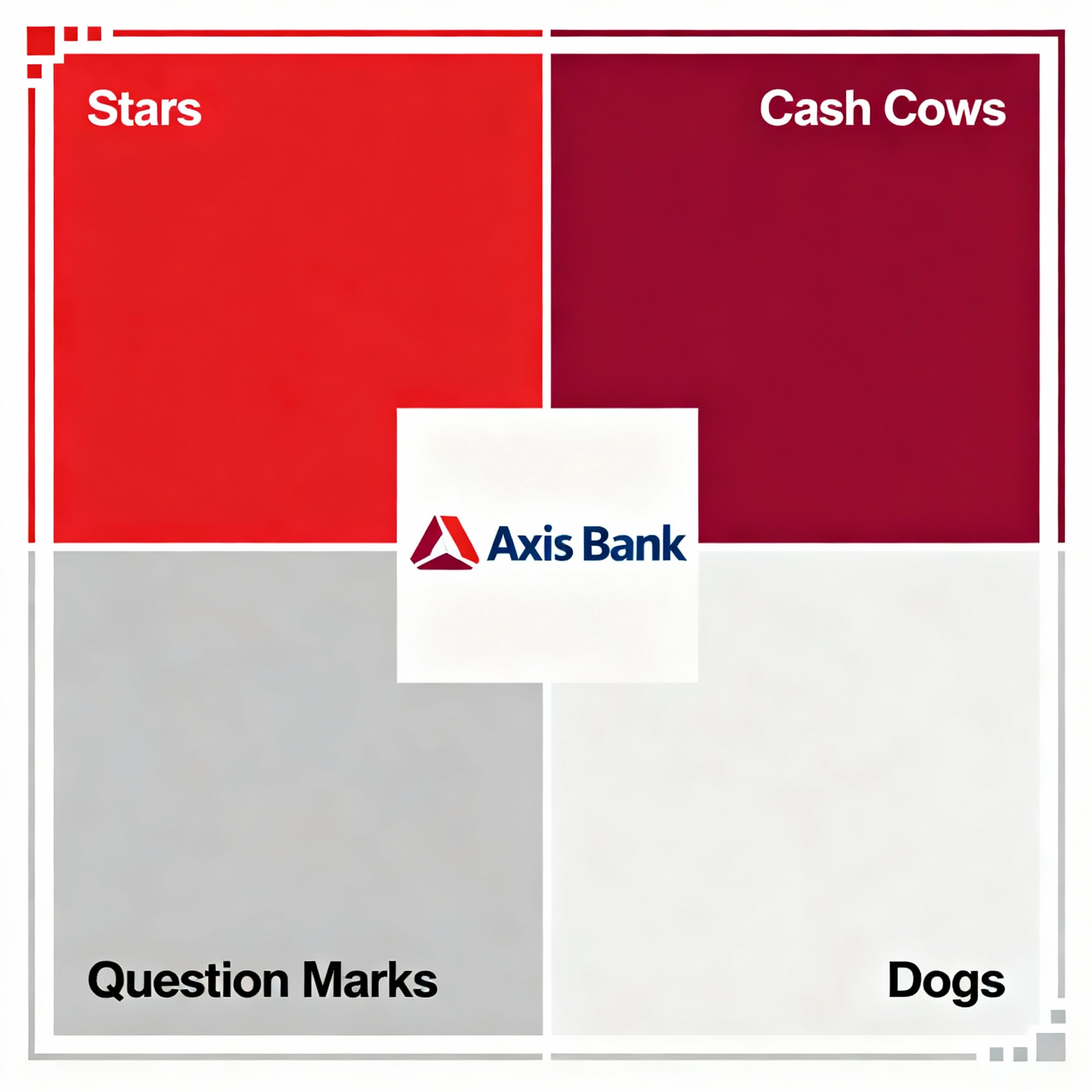
The BCG Matrix (Boston Consulting Group Matrix) is a strategic framework that helps organizations evaluate their products or business units based on two key dimensions:
- Market Growth Rate
- Relative Market Share
The model divides a company’s business portfolio into four quadrants:
- Stars (High Market Share, High Market Growth)
- Cash Cows (High Market Share, Low Market Growth)
- Question Marks (Low Market Share, High Market Growth)
- Dogs (Low Market Share, Low Market Growth)
This matrix enables companies like Axis Bank to allocate resources effectively and focus on areas that promise sustainable growth.
Why Use the BCG Matrix in Banking?
Unlike manufacturing firms, banks have multiple service lines that perform differently in various market segments. The BCG Matrix of Axis Bank helps in:
- Prioritizing high-growth business segments.
- Identifying areas needing investment or divestment.
- Balancing short-term profits and long-term innovation.
- Enhancing decision-making based on growth potential and profitability.
Benefits of Using the BCG Matrix for Axis Bank
Optimized Resource Allocation
The Axis Bank BCG analysis allows management to allocate resources efficiently by identifying which products should receive investment and which should be scaled back. For instance, digital banking and fintech collaborations receive significant investment, while underperforming legacy segments are streamlined. This ensures that funds are directed toward high-return areas.
Enhanced Portfolio Management
By applying the BCG Matrix, Axis Bank maintains a healthy balance between stability and innovation. Its Cash Cow segments provide steady income, while Star segments fuel growth. This balance ensures that the bank can reinvest profits into emerging sectors without compromising financial stability.
Informed Strategic Decision-Making
The BCG Matrix of Axis Bank provides valuable insights into market dynamics and customer behavior. It helps the leadership decide where to innovate, where to consolidate, and where to reduce exposure. This approach fosters a data-driven decision-making culture within the organization.
Risk Management and Diversification
Through its diversified portfolio, Axis Bank mitigates the risk of overdependence on any one segment. The BCG Matrix helps in identifying declining sectors (Dogs) and growth areas (Stars and Question Marks), enabling better risk management and sustainable business growth.
Detailed BCG Analysis for Axis Bank Limited
Cash Cows (High Market Share, Low Growth)

These are Axis Bank’s strong and stable business areas that generate consistent profits.
- Retail Banking: With millions of savings and current account holders, retail banking remains a cornerstone of Axis Bank’s revenue.
- Credit Card Division: Axis Bank’s partnership with major brands (Flipkart, Vistara, etc.) ensures a loyal customer base and stable income.
- Wealth Management Services: A mature segment offering steady returns through investment products.
These Cash Cow divisions are essential for maintaining profitability and funding investments in high-growth areas.
Stars (High Market Share, High Growth)

Stars represent the most promising and fast-growing sectors in Axis Bank’s portfolio.
- Digital Banking Platforms: Axis Bank has made major strides in digital innovation through Axis Aha!, Open by Axis, and Neo+ apps.
- Corporate Banking and Institutional Finance: With India’s growing corporate sector, Axis Bank’s tailored financial solutions have seen remarkable growth.
- Fintech Collaborations: The bank’s alliances with fintech startups have boosted digital payments, lending, and customer acquisition.
Stars are crucial for driving the Axis Bank growth strategy, and continued investment in these areas will ensure long-term dominance.
Question Marks (Low Market Share, High Growth)
These sectors show growth potential but currently have limited market share.
- International Operations: Although Axis Bank has a presence in global financial hubs, its international market share remains small compared to domestic operations.
- Insurance and Mutual Funds: Through subsidiaries like Axis Mutual Fund and Axis Securities, the bank has entered new financial domains. With increased marketing and partnerships, these could transform into Stars in the near future.
Question Marks require careful investment to assess whether they can deliver long-term profitability.
Dogs (Low Market Share, Low Growth)

These segments show limited growth and profitability.
- Certain Rural Banking Operations: Despite government initiatives, rural banking faces low demand for advanced financial products.
- Underperforming Loan Portfolios: Some sectors like agriculture loans or microfinance have shown slow recovery rates.
While Dogs do not contribute significantly to profit, Axis Bank uses them strategically for CSR initiatives and regulatory compliance.
BCG Matrix Diagram for Axis Bank
| Quadrant | Business Segment | Market Growth | Market Share | Strategy |
| Stars | Digital Banking, Corporate Finance, Fintech Partnerships | High | High | Invest and expand |
| Cash Cows | Retail Banking, Credit Cards, Wealth Management | Low | High | Maintain and harvest |
| Question Marks | International Operations, Mutual Funds, Insurance | High | Low | Selective investment |
| Dogs | Rural Banking, Legacy Loan Segments | Low | Low | Divest or optimize |
Strategic Insights from Axis Bank’s BCG Matrix
- Balanced Portfolio: Axis Bank effectively combines high-growth segments with stable cash generators.
- Digital Transformation: The bank’s push towards digital and fintech solutions positions it ahead of competitors like HDFC and ICICI in technology adoption.
- Risk Diversification: Through multiple income streams, Axis Bank mitigates the risk of market fluctuations.
- Customer-Centric Growth: The focus on personalized digital experiences strengthens customer loyalty and retention.
Challenges and Limitations of the BCG Matrix for Axis Bank
While the BCG Matrix is a powerful analytical tool, it has certain limitations in the context of banking:
- Service Intangibility: Measuring market share and growth in services is more complex than in product-based industries.
- Dynamic Market Conditions: Rapid regulatory and technological changes can alter market performance quickly.
- Non-Financial Factors: The BCG Matrix does not account for customer satisfaction or brand value — both critical in banking.
Thus, Axis Bank complements this framework with other models like SWOT analysis and Ansoff Matrix to gain a holistic strategic view.
Conclusion
The BCG Matrix of Axis Bank reveals a well-balanced and strategically managed portfolio. The bank’s strength lies in its Cash Cow retail operations and Star digital banking initiatives, while emerging sectors like mutual funds and insurance act as potential growth drivers.
By leveraging the BCG Matrix, Axis Bank ensures optimized resource allocation, informed decision-making, and effective risk management, aligning its operations with long-term profitability and innovation.
As India’s financial ecosystem evolves, Axis Bank’s focus on digital excellence, customer trust, and sustainable growth will continue to strengthen its market position.
FAQs
Q1. What is the BCG Matrix of Axis Bank?
The BCG Matrix of Axis Bank is a strategic framework that categorizes its business units based on market growth and market share to guide investment decisions and portfolio management.
Q2. Which services of Axis Bank are considered Cash Cows?
Retail Banking, Credit Cards, and Wealth Management are the Cash Cows, providing steady income with low growth but high profitability.
Q3. Why is Digital Banking a Star in Axis Bank’s portfolio?
Digital Banking has both high growth and high market share, making it a key driver of Axis Bank’s modernization and expansion strategy.
Q4. What are the Question Marks in Axis Bank’s BCG Matrix?
Axis Bank’s international operations and mutual fund services are Question Marks, showing strong growth potential but limited current market share.
Q5. What insights does the BCG Matrix provide for Axis Bank’s management?
It helps in resource prioritization, risk diversification, and identifying sectors that need investment or restructuring for sustainable growth.

A digital marketer with a strong focus on SEO, content creation, and AI tools. Creates helpful, easy-to-understand content that connects with readers and ranks well on search engines. Loves using smart tools to save time, improve content quality, and grow online reach.