


Summary
The BCG Matrix of Domino’s Pizza explains how the company’s different products perform in the fast-food industry based on their market growth rate and market share. Domino’s, a leading pizza brand, has built its reputation across global markets through consistent innovation, digital expansion, and customer satisfaction.
In this analysis, we categorize Domino’s products into four groups—Cash Cows, Stars, Question Marks, and Dogs—using the Boston Consulting Group (BCG) model. The pizza segment remains the strongest performer, while products like sandwiches and garlic bread show rapid growth potential. On the other hand, chicken items represent uncertainty, and salads struggle to attract customers.
This detailed analysis highlights how Domino’s manages its portfolio to sustain growth, maintain profitability, and adapt to changing consumer preferences.
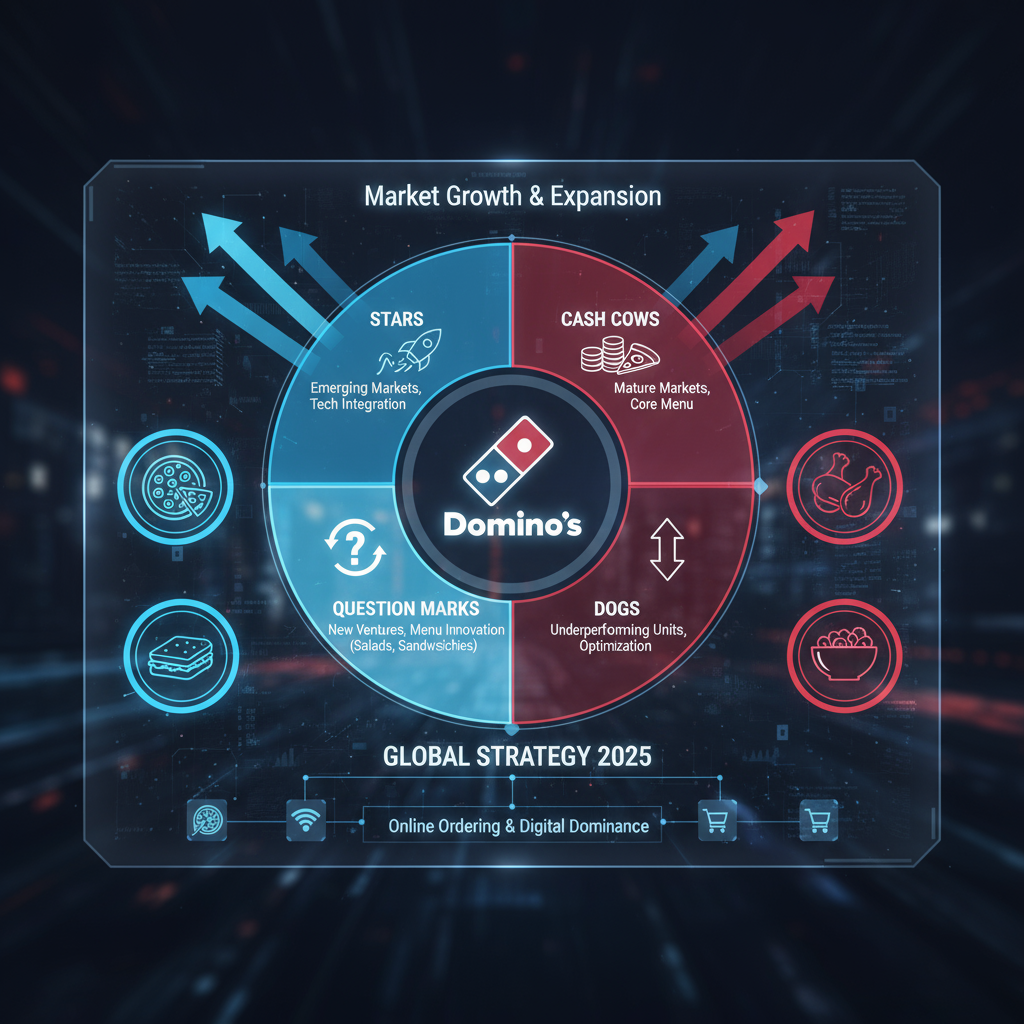
Domino’s Pizza is one of the largest fast-food restaurant chains in the world. It originated in the United States and has expanded to multiple regions, including North America, Europe, the Middle East, and Asia Pacific. The brand operates through thousands of franchises, offering a range of food items such as pizzas, sandwiches, sides, and desserts.
While the company offers a diverse menu, pizzas remain its main revenue driver. Domino’s is known for its continuous menu innovation, having updated nearly 70% of its offerings in the last decade to meet customer expectations and market trends.
To understand Domino’s market performance, we use the BCG Matrix, a strategic tool that helps identify which products generate profit, which require investment, and which should be reconsidered. The BCG Matrix of Domino’s helps us evaluate the company’s strengths, weaknesses, and opportunities across its product portfolio.
What is the BCG Matrix Framework
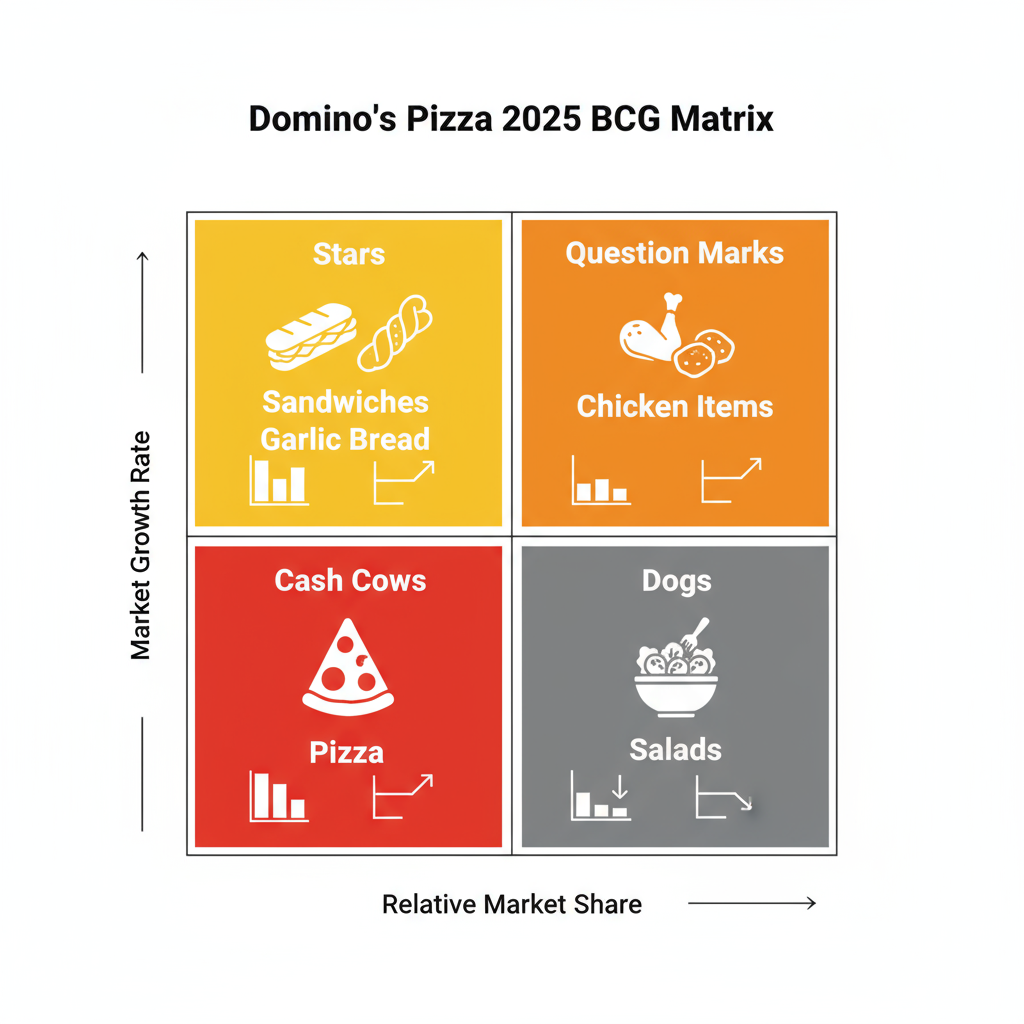
The Boston Consulting Group (BCG) Matrix is a business strategy tool that evaluates a company’s product lines based on two key factors:
- Market Growth Rate – how fast the industry or market for a product is expanding.
- Market Share – the company’s share compared to its competitors in that market.
The matrix is divided into four categories:
| Quadrant | Market Share | Market Growth | Meaning |
| Cash Cows | High | Low | Stable products generating steady profit |
| Stars | High | High | Growing products needing investment |
| Question Marks | Low | High | Uncertain products with growth potential |
| Dogs | Low | Low | Weak products with poor performance |
Using this framework, we can assess which products of Domino’s generate revenue, which have potential, and which may require strategic changes.
Cash Cows

Cash Cows are products that have high market share in low-growth industries. They generate consistent cash flow with minimal investment. The earnings from these products often fund new business opportunities and support overall company stability.
Domino’s Cash Cow: Pizza Segment
The pizza segment is the strongest and most profitable area for Domino’s. It dominates the fast-food pizza industry across multiple countries.
Domino’s sells about 1.5 million pizzas every day through its global franchise network. This massive sales volume provides a strong revenue base. The pizza market may not be growing as rapidly as newer food categories, but Domino’s maintains a commanding share due to its brand loyalty, taste consistency, and delivery efficiency.
Digital Advantage
Domino’s has successfully integrated digital technology into its business model. Online ordering platforms and mobile apps have simplified customer interaction and increased order frequency. The use of technology has helped the company strengthen its cash cow products by improving accessibility and customer satisfaction.
Why Pizza Is a Cash Cow
- High market share with consistent global demand.
- Strong digital infrastructure for ordering and delivery.
- Stable revenue with minimal reinvestment requirements.
- Supports funding for newer or riskier product innovations.
The pizza segment represents the financial backbone of Domino’s and continues to ensure sustainable profitability.
Stars
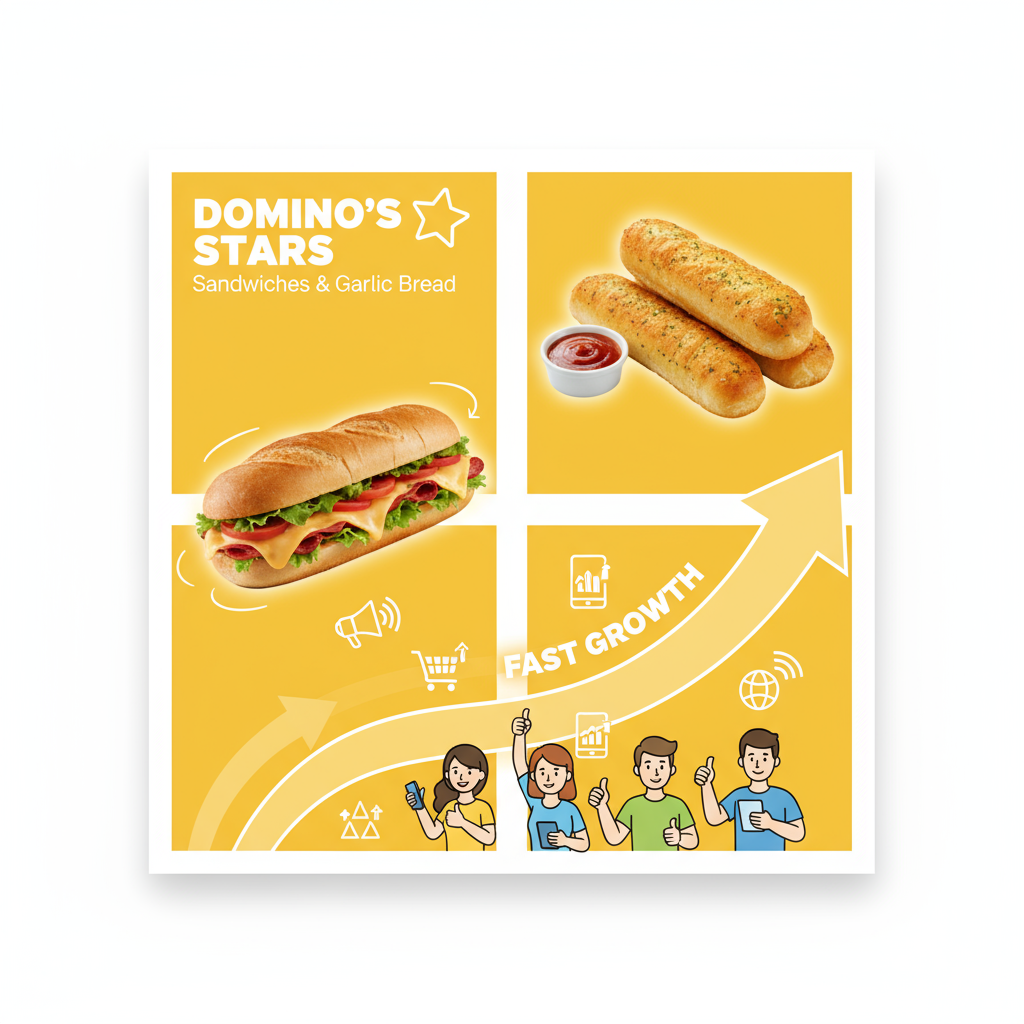
Stars are products that have high market share in fast-growing markets. These products require investment to sustain their position but are likely to become future Cash Cows once the market stabilizes.
Also Read:BCG Matrix Analysis of Nike
Domino’s Stars: Sandwiches and Breads
Domino’s identified a market need beyond pizzas and introduced sandwiches and bread items, such as garlic bread and oven-baked sandwiches, to diversify its menu. These products have grown steadily in demand due to their convenience, flavor, and value for money.
Market Growth
The sandwich and bread segment in fast food has been expanding as consumers look for lighter, quicker meal options. Domino’s decision to include these items allowed the brand to tap into a broader customer base.
The garlic bread and cheese breadsticks became highly popular as side dishes, while sandwiches served as quick alternatives to pizza meals.
Competition
Domino’s faces competition in this category from established brands like Subway and McDonald’s. Despite this, Domino’s has managed to create a loyal following for its oven-baked sandwiches through its delivery model and quality consistency.
Why Sandwiches and Breads Are Stars
- Growing consumer preference for non-pizza menu items.
- Positive customer feedback and rising demand.
- Opportunities for global expansion in diverse markets.
- Potential to become future Cash Cows as the category matures.
By investing in marketing and menu expansion, Domino’s can strengthen these products further and secure long-term growth.
Question Marks
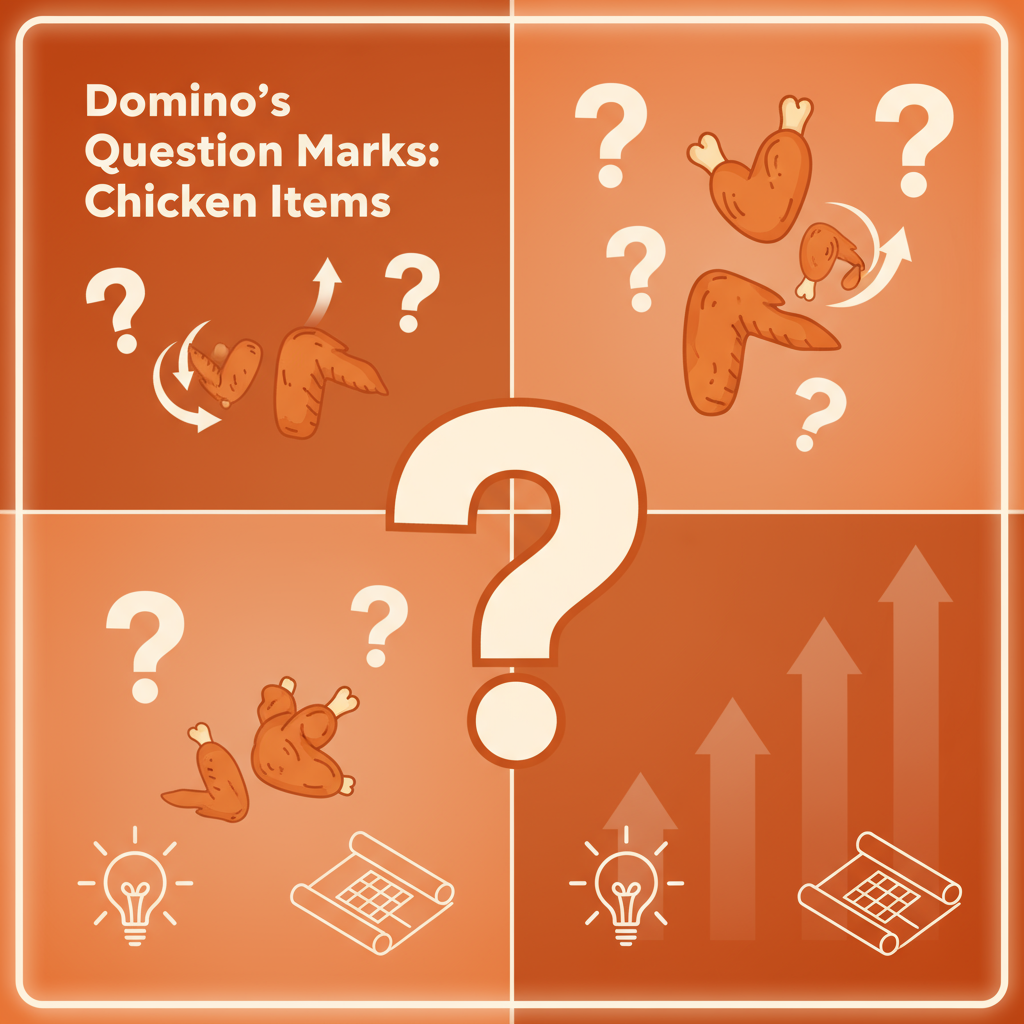
Question Marks are products that exist in high-growth markets but hold a low market share. They require significant investment and innovation to determine whether they can become profitable or should be discontinued.
Domino’s Question Marks: Chicken Items
Domino’s introduced chicken-based products such as chicken wings and specialty chicken to attract customers who prefer non-pizza items. While these additions broadened the menu, they have not achieved the same success as pizzas or sandwiches.
Market Performance
Consumer response to Domino’s chicken items has been inconsistent. Many customers still associate Domino’s primarily with pizza, not with chicken. Despite advertising campaigns and product variations, chicken dishes remain less popular.
Domino’s management continues to explore ways to improve this category. They have experimented with flavor options, dipping sauces, and promotional offers to increase visibility.
Strategic Risk
There is a significant risk of failure in this product line. The company must decide whether to continue investing or to focus on more successful categories. If the brand manages to reposition its chicken offerings effectively, this category could grow. Otherwise, it may remain a weak spot in Domino’s menu.
Why Chicken Items Are Question Marks
- Operate in a growing market but lack strong sales.
- Require marketing investment to gain customer acceptance.
- Potential for growth if repositioned or rebranded.
- May evolve into Stars or fall into the Dogs category depending on performance.
Dogs
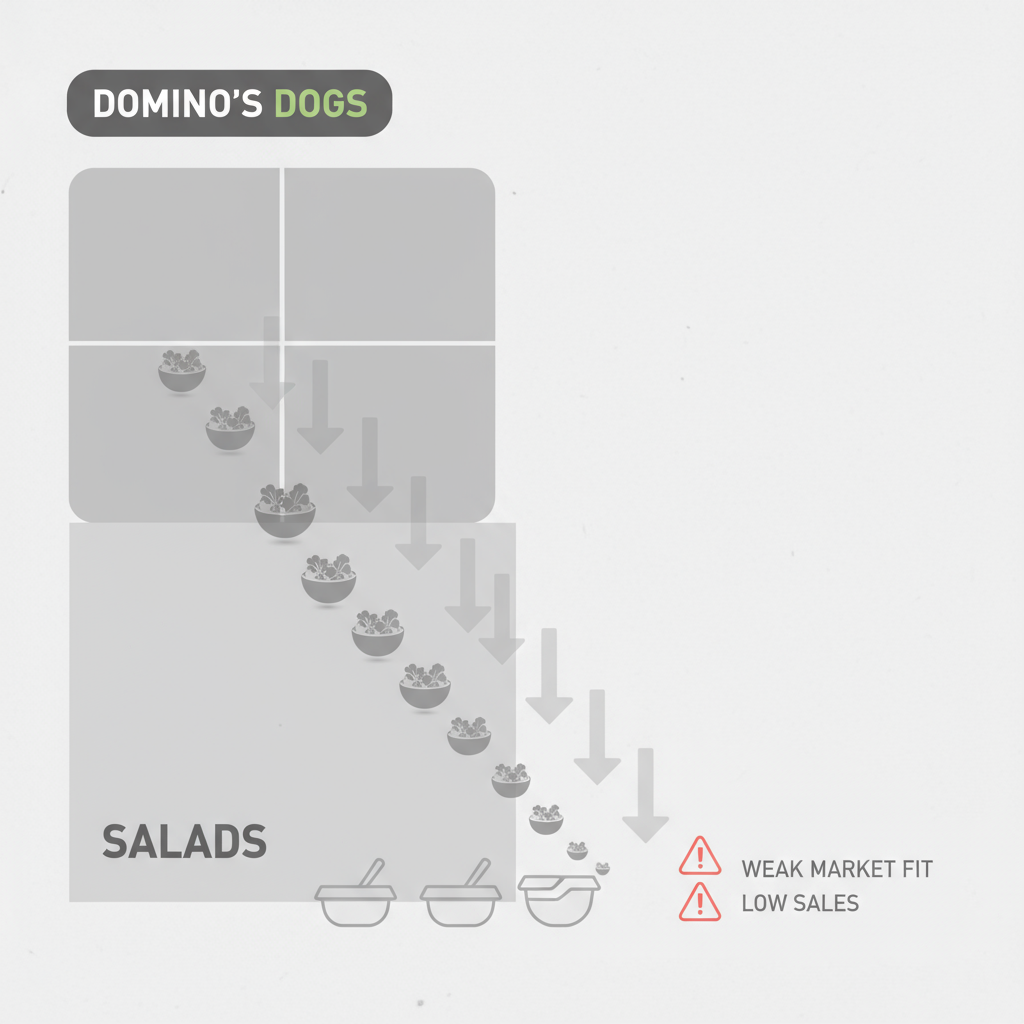
Dogs are products that have low market share and low growth rate. They contribute little to profitability and often fail to attract long-term customers.
Domino’s Dogs: Salads
Domino’s attempted to introduce salads to attract health-conscious consumers. However, this initiative did not meet expectations. The main issue was brand perception—customers do not associate Domino’s with salads or diet-friendly foods.
Market Response
Consumers view Domino’s as a pizza and fast-food brand. Therefore, salads did not align with customer expectations. Even though the intention was to diversify and appeal to a broader audience, sales remained low.
Critics and customers also pointed out that salads were rarely chosen as a standalone meal from a pizza restaurant, especially during late-night orders. This mismatch between product and brand image made salads a poor fit in Domino’s menu.
Why Salads Are Dogs
- Low consumer interest and weak sales performance.
- Misalignment with Domino’s fast-food brand image.
- Low profitability and limited growth potential.
- High marketing and operational costs compared to return.
In most cases, products in this category are discontinued or limited to specific markets. Domino’s may consider removing salads from its main menu or replacing them with better-aligned options such as baked sides or low-calorie pizzas.
Key Insights from the BCG Matrix of Domino’s Pizza
- Pizza remains the core strength – It ensures consistent revenue and funds innovation.
- Menu diversification has worked partially – Sandwiches and breads succeeded; chicken and salads struggled.
- Digital transformation boosts efficiency – Technology-driven ordering and delivery enhance sales.
- Brand perception matters – Customers expect Domino’s to focus on pizza and sides, not on salads.
- Investment decisions are data-driven – Domino’s uses insights from each quadrant to guide marketing and product development.
Strategic Recommendations
- Strengthen Cash Cows
Continue enhancing the pizza experience with new crust options, toppings, and faster delivery. Use profits from this category to support innovation in other products. - Expand Stars
Invest in global marketing for sandwiches and breads. Introduce region-specific flavors and variations to capture local markets. - Reposition Question Marks
Rebrand chicken items with improved flavors or combos. Collaborate with influencers and food bloggers to change perceptions. - Reduce Dogs
Limit or discontinue salads. Replace them with side items that fit Domino’s brand identity, such as baked pasta or healthy pizza bases. - Continue Digital Innovation
Strengthen Domino’s online ordering systems and delivery automation to maintain competitive advantage.
Key Takeaways
- The BCG Matrix of Domino’s shows how each product contributes to the company’s market strategy.
- Pizzas are Cash Cows that ensure financial stability.
- Sandwiches and breads are Stars with high growth potential.
- Chicken items are Question Marks that require improvement.
- Salads are Dogs that do not align with Domino’s brand identity.
- Continuous innovation and clear brand positioning remain the keys to Domino’s long-term success.
FAQs
What is the BCG Matrix of Domino’s Pizza?
The BCG Matrix of Domino’s Pizza analyzes its product portfolio based on market share and market growth. It helps identify which products are profitable, growing, or underperforming.
Which products are Cash Cows for Domino’s Pizza?
The pizza segment is the Cash Cow for Domino’s. It generates the most revenue with consistent demand and minimal reinvestment.
Which products are Stars in the BCG Matrix of Domino’s?
Sandwiches and garlic bread are Stars. They show strong growth and positive consumer acceptance.
Why are chicken products considered Question Marks?
Chicken items like wings and specialty chicken operate in a growing market but have low sales and brand association issues.
Why did salads fail for Domino’s?
Consumers do not associate Domino’s with salads. The brand image and market expectations made salads unprofitable.
How does the BCG Matrix help Domino’s?
It helps Domino’s allocate resources effectively, identify strong products, and improve weaker ones.
Conclusion
The BCG Matrix of Domino’s Pizza provides a clear view of how the company manages its diverse product portfolio. It highlights the dominance of pizza as the main revenue driver, the growing success of sandwiches and breads, and the challenges with chicken and salad items.
Domino’s strength lies in its ability to adapt to customer needs while maintaining a strong digital infrastructure. By focusing on innovation, quality, and customer satisfaction, Domino’s continues to secure its position as a global leader in the fast-food industry.

A digital marketer with a strong focus on SEO, content creation, and AI tools. Creates helpful, easy-to-understand content that connects with readers and ranks well on search engines. Loves using smart tools to save time, improve content quality, and grow online reach.